Citely Guide

Quick Start

Use Citely to find real sources for a claim, or verify a reference list before you submit. Go from a sentence to a citable DOI in a few minutes.

Source Finder

Quick start

What Citely does

Citely is built for the most dangerous academic-writing failure: a citation that looks real but does not exist. Find sources first, then verify the list you plan to cite.

Two tools, two jobs. Do not mix them.

Citely does not invent paper-like entries. It checks real publishing records in CrossRef, PubMed, OpenAlex, and other scholarly sources. The right entry point makes the match much tighter.

  • Source Finder: use it when you have a paragraph or claim, but no references yet.
  • Citation Checker: use it when you already have a bibliography, or you suspect AI fabricated citations.

The fastest way to learn Citely is to run Source Finder once, then verify a related reference list in Citation Checker.
Source Finder

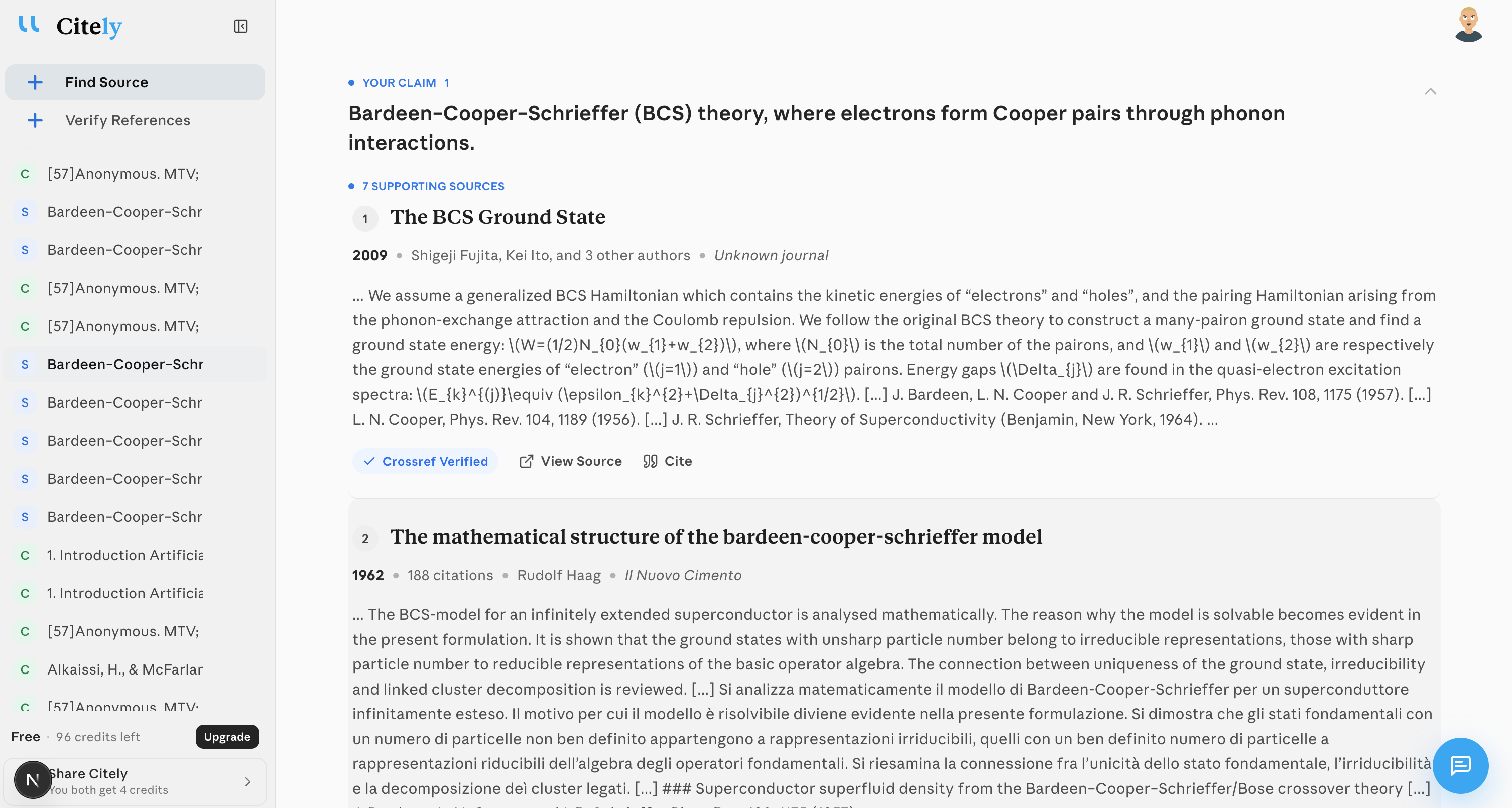
Paste the claim you need to support. Citely searches CrossRef, PubMed, arXiv, OpenAlex, and other scholarly sources, then returns real, checkable papers.

Best for paragraphs, research questions, and paper claims. One run accepts about 300 characters.

Source Finder workspace: Find the Right Sources

Paste the text that needs a source

Open Source Finder and paste a paragraph, question, or claim. Include the object of study, method, and core conclusion for a tighter match.

Let Citely search scholarly databases

The system reads the meaning of your text and queries multiple academic databases. It looks for published records, not another invented citation.

Review the match and take the citation

Check title, authors, year, journal, and DOI. When it is relevant, export APA, MLA, Chicago, or another supported format.

One claim per search is more accurate than dumping a whole chapter.

A successful search costs 1 credit only when at least one usable source is found.

Open Source Finder

Citation Checker

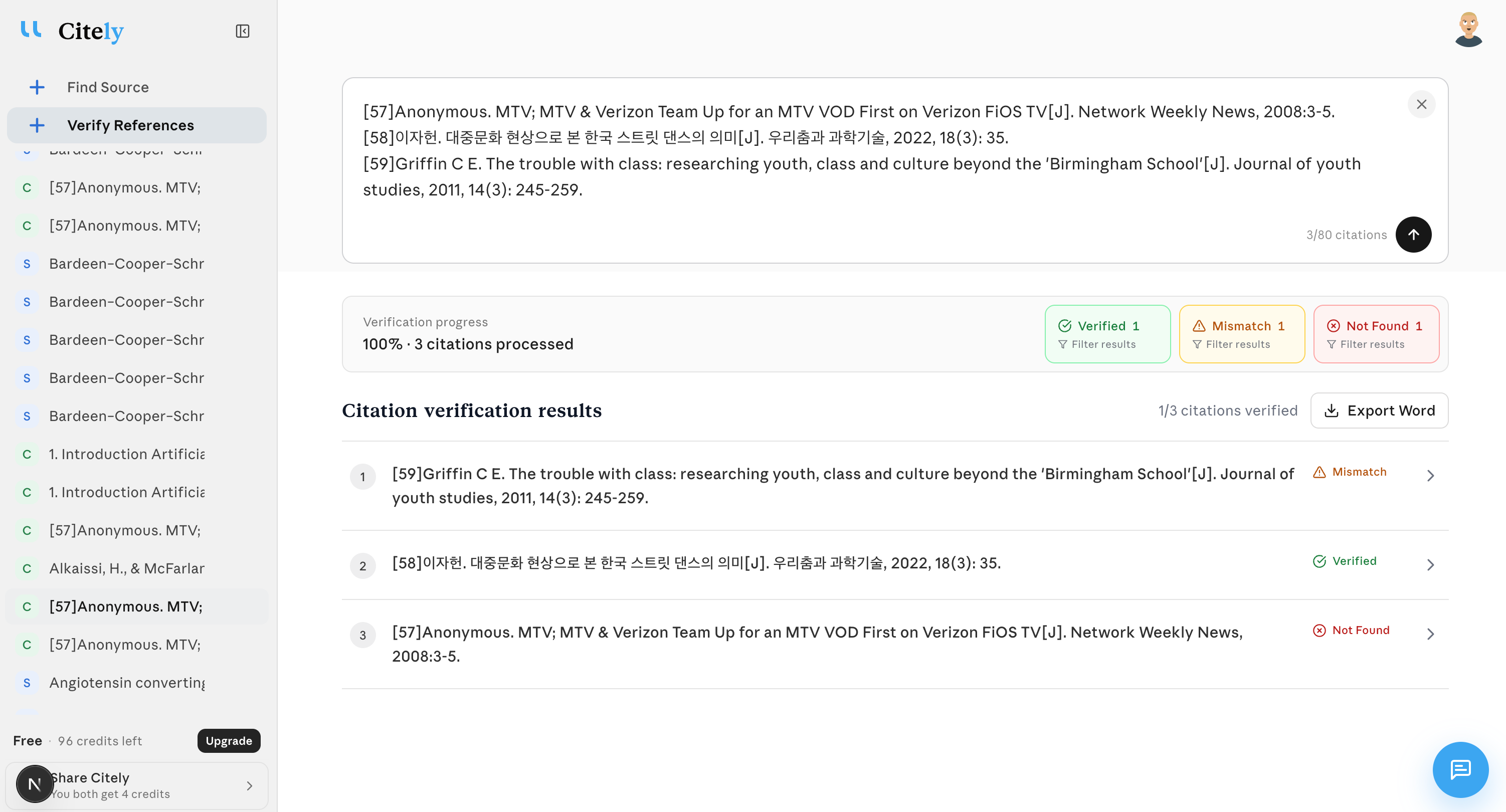
Paste a reference list. Citely checks each item against scholarly records, flags fabricated or inconsistent entries, and suggests real replacements when it can.

Best for bibliographies, AI-generated citations, and a final check before submission. Put one reference on each line.

Citation Checker workspace: Verify Every Reference

Paste the reference list

Open Citation Checker and paste the full bibliography or the suspicious items. One line per reference makes splitting and matching more reliable.

Cross-check against trusted records

Citely extracts title, authors, year, journal, and DOI, then compares them with authoritative databases to catch invented or mismatched items.

Keep the real ones, replace the rest

Verified items can stay. Flagged items include a reason. Prefer the real replacements Citely returns, then export a clean citation format.

Run the full list before submission instead of spot-checking a few lines.

Up to 2,000 characters costs 1 credit; 2,001–4,000 costs 2; every extra 2,000 characters adds 1 credit.

Open Citation Checker

Features

Academic databases

Citely checks sources researchers actually verify, not generic web snippets.

One run can query several databases so a single index miss is less likely.

  • CrossRef: checks DOI, journal name, and publication metadata.
  • OpenAlex: adds authors, institutions, and the open scholarly graph.
  • PubMed: covers biomedical and life-science literature.
  • arXiv: covers preprints and fast-moving drafts.
  • Wanfang and other Chinese collections: cover Chinese journals, theses, and conference papers.

Chinese literature

Chinese writing needs more than English indexes. Citely can search and verify Chinese literature without forcing you to translate first.

Paste Chinese titles, author names, and paragraphs as they are.

  • In Source Finder, paste the Chinese claim directly. Citely looks at both Chinese and English collections.
  • In Citation Checker, keep the original title and author names. Do not convert them to pinyin first.
  • A Chinese item without a DOI can still match on title, authors, and year.

Citation formats

Verify first, format second. Citely can export verified items into common academic styles.

Check verification status before you export. Do not carry failed items into the paper.

  • APA
  • MLA
  • Chicago
  • Harvard
  • IEEE

Journals differ on italics, punctuation, and DOI display. Do a last pass against the target author guidelines.

Full research workflow

The reliable habit is a loop: find sources, write, then verify again before you submit.

From finding trusted sources to checking a bibliography and doing a pre-submission review.

Source the claim first

Use Source Finder before the paragraph hardens around an unsupported sentence.

Verify as you write

Anything copied from ChatGPT or another tool should go through Citation Checker before it enters the draft.

Run the full list before submission

Check the complete bibliography once more so late additions are not missed.

Credits & pricing

How credits work

Credits are deducted after a result is generated. The same result is not charged twice.

The two main tools charge differently. Check character count before you submit.

  • Source Finder: 1 credit for a successful search; 0 credits if no usable source is found.
  • Citation Checker: 1 credit up to 2,000 characters; 2 credits for 2,001–4,000; then 1 extra credit per 2,000 characters.
  • Character count includes letters, numbers, spaces, and punctuation. CJK characters usually count as one each.
  • 1 credit usually covers about 8–15 typical references, depending on length.

Choosing a plan

Pick from this month’s verification volume. Upgrade later if you need more.

See the homepage pricing section for current prices.

  • Trial: one source search or a small verification run.
  • Monthly: coursework and ongoing writing.
  • Yearly: papers across the year at a lower effective rate.
  • Believer: labs or heavy use over three years.
See pricing

FAQ

These cover the questions we hear most often.

How accurate is Citely?

Citely cross-checks CrossRef, PubMed, OpenAlex, and other scholarly records to separate real literature from common fabrication patterns. You should still open the DOI or original record before you cite.

Can it catch citations invented by ChatGPT?

Yes. Paste the generated bibliography into Citation Checker. Citely flags items that are missing from databases, have mismatched authors or years, or look stitched together.

Do I pay if Source Finder finds nothing?

No. Source Finder charges 1 credit only when at least one usable source is found.

Is my manuscript safe?

Research text is encrypted and is not sold to third parties. You keep ownership of your content. Avoid pasting unnecessary personal data.

Does it work with Zotero or EndNote?

Yes. Verify and export in Citely, then import into your reference manager.

Can I check Chinese literature?

Yes. Paste Chinese titles, authors, and paragraphs directly. Citely searches both Chinese and English collections.

Still have a question? Contact us