Academic Integrity in the AI Era: A Practical Guide to Verification-First Research
Universities are rewriting academic integrity policies for AI-assisted writing. This guide explains what's changed, what's expected of researchers, and how to build a workflow that keeps your work defensible.
In 2025, Harvard updated its academic integrity policy to explicitly address AI-generated content in research papers. Stanford followed within months. By early 2026, over 200 universities worldwide had published guidelines on AI use in academic work.
The common thread across these policies isn't a ban on AI — it's a new expectation: if you use AI in your research workflow, you are responsible for verifying everything it produces. The standard hasn't changed (your citations must be accurate), but the threat model has (AI tools introduce new categories of error that didn't exist before).
This guide covers what researchers at every level need to know about maintaining academic integrity when AI tools are part of the writing process.
What's Actually Changed
The old integrity model
Before AI writing tools, academic integrity was primarily about two things: don't plagiarize, and don't fabricate data. Citation errors were treated as sloppiness, not misconduct. A wrong year or misspelled author name was a formatting issue, not an integrity issue.
The new integrity model
AI tools have blurred the line between error and fabrication. When a researcher includes a citation that ChatGPT generated, and that citation points to a paper that doesn't exist, is that:
- A formatting error (the researcher intended to cite a real paper but got the details wrong)?
- Fabrication (the researcher included a reference they knew or should have known was fake)?
- Something in between?
Most universities are settling on a standard of reasonable verification: you don't need to prove you read every paper cover to cover, but you do need to demonstrate that every reference in your bibliography corresponds to a real, published work. The burden of verification has shifted from "nice to have" to "required."
The Five Verification Standards
Based on published guidelines from major universities and journal publishers, here are the verification standards that researchers are now expected to meet:
1. Existence verification
Every reference must correspond to a real publication. This means the DOI resolves, the paper appears in an academic database, and the metadata (author, title, journal, year) matches the actual publication.
This is the minimum standard. It catches AI-fabricated citations and is efficiently handled by automated tools. Paste your reference list into Citely's Citation Checker to batch-verify existence in under a minute.
2. Accuracy verification
The details of each citation must be correct. The right author names in the right order. The correct publication year (not the preprint year). The right journal title (not an abbreviation the AI invented). The right volume and page numbers.
Automated tools catch most accuracy issues by comparing your citation against the database record. Manual spot-checking catches the rest.
3. Relevance verification
Each citation should support the claim it's attached to. This requires actually reading — or at minimum skimming — the source. An AI might suggest a citation that is topically related but doesn't actually support the specific claim in your sentence.
This step can't be fully automated. It requires human judgment about whether a paper's findings align with how you're using it.
4. Currency verification
Citations should be current unless historical context is the point. Citing a 2015 paper for a claim that has been contradicted by 2024 evidence is a substantive error. Clinical guidelines, statistical methods, and rapidly evolving fields require special attention to currency.
5. Status verification
Papers can be retracted, corrected, or subject to expressions of concern after publication. Citing a retracted paper without noting the retraction is a serious integrity issue, especially in fields where research findings influence practice (medicine, law, education, public policy).
A Verification-First Workflow
The mistake most researchers make is treating verification as a final proofreading step. By the time you've built a 50-reference bibliography, the thought of checking each one feels overwhelming, so you cut corners.
The better approach is to build verification into each stage of writing:
During literature search
When you find a paper you want to cite, verify it exists in CrossRef or PubMed immediately. This takes 10 seconds per paper and prevents the accumulation of unverified references.
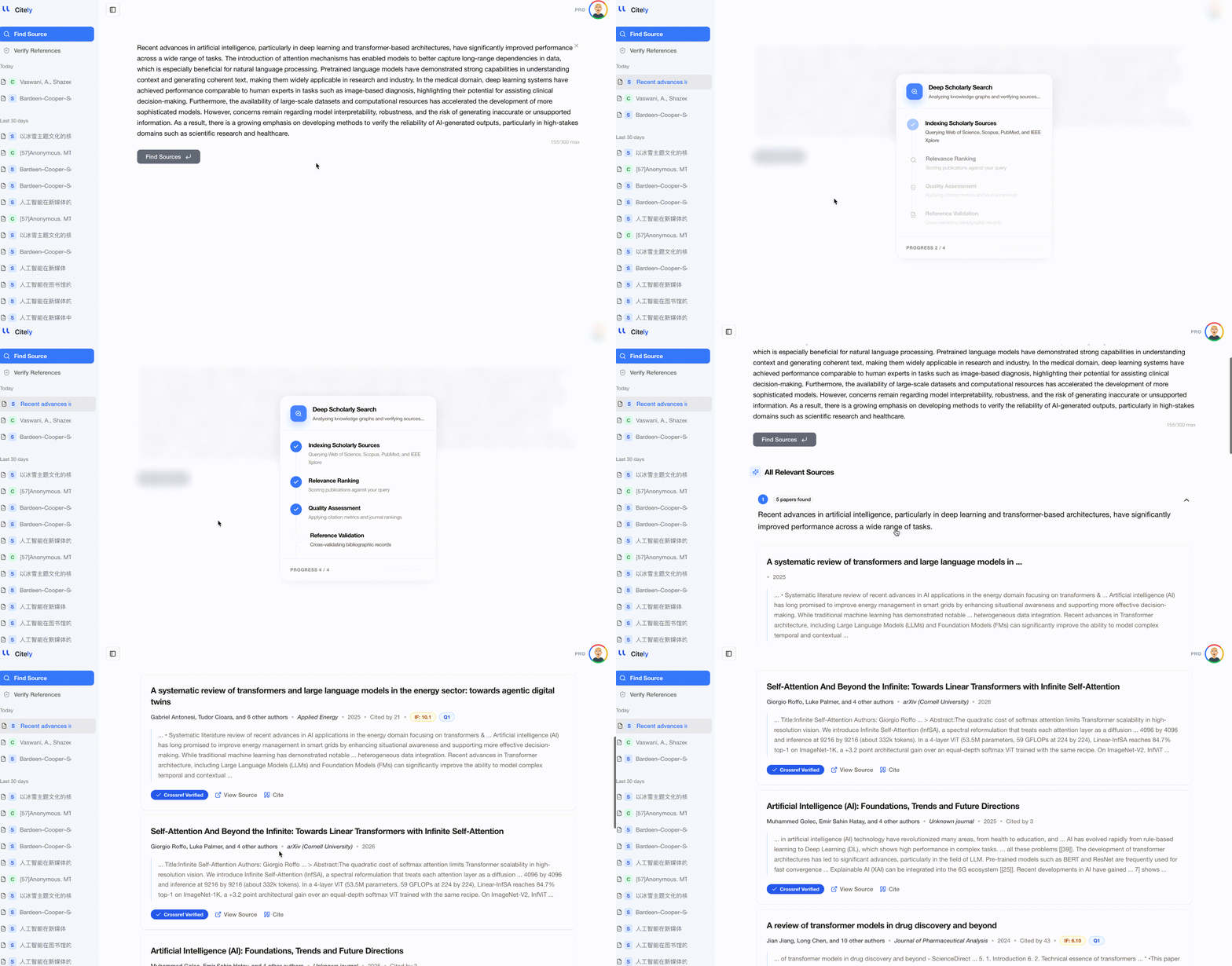
Use Citely's Source Finder to trace claims back to their original source when you encounter them in secondary sources or AI summaries.
During writing
Mark any citation you haven't personally verified with a tag (e.g., [CHECK] or a highlight color). This creates a visual inventory of your verification debt.
Before submission
Run your complete reference list through automated verification. Fix any flagged issues. Then manually check the 10-15 citations that support your most important claims.
What Journals Now Expect
Several major publishers have added reference verification requirements:
- Elsevier now recommends that authors "verify all references against original sources" before submission
- Springer Nature has added checks for AI-generated content in submitted manuscripts, including reference lists
- PLOS requires authors to confirm that they have read and can verify every cited source
- IEEE has published guidelines specifically addressing AI-generated citations
The practical impact: editors are increasingly running spot-checks on reference lists, and desk rejections for citation issues are rising.
How to Respond to Integrity Queries
If a journal or university asks about your citation practices — which is becoming more common — here's what demonstrates good faith:
- Be transparent about AI use. Describe which tools you used and how.
- Document your verification process. "All references were batch-verified against CrossRef using [tool name] on [date]" is a concrete, defensible statement.
- Show your work. Keep verification reports. If you used Citely or a similar tool, save the output. If you manually checked references, note which ones and when.
Key Takeaways
- Over 200 universities have updated academic integrity policies to address AI-assisted writing — the new standard is "reasonable verification" of all references, not just formatting correctness
- Five verification standards are emerging: existence (does the paper exist?), accuracy (are the details correct?), relevance (does it support the claim?), currency (is it current?), and status (has it been retracted?)
- Build verification into each stage of writing rather than treating it as a final step — verify during literature search, mark unverified citations during drafting, and batch-check before submission
- Major publishers (Elsevier, Springer Nature, PLOS, IEEE) now recommend or require reference verification, and desk rejections for citation issues are increasing
- Document your verification process — keeping a record of when and how you checked references demonstrates good faith if integrity questions arise
Start verification → citely.ai/citation-checker