
AI Citation Hallucination: What It Is, Why It Happens, and How to Prevent It
AI tools generate fake academic references that look real. This guide explains the three types of citation hallucination, shows how to detect them, and provides a practical prevention workflow.
When a large language model generates a citation, it doesn't look up a database. It predicts what a citation should look like based on patterns in its training data. The result is text that follows perfect formatting conventions — a plausible author name, a real journal title, a correctly structured DOI — attached to a paper that does not exist.
This is citation hallucination, and it's the fastest-growing integrity risk in academic writing today.
What Is Citation Hallucination?
Citation hallucination occurs when an AI tool generates a reference that appears legitimate but doesn't correspond to any real published work. The term "hallucination" comes from the broader AI research community, where it describes any output that is fluent and confident but factually wrong.
In the context of academic references, hallucination is particularly dangerous because the output closely mimics the format and conventions of real citations. A human reader — even an experienced researcher — can look at a hallucinated citation and see nothing wrong with it at first glance.
The Three Types of Hallucinated Citations
Not all fake citations are created equal. Understanding the variations helps you know what to look for and which detection methods work for each type.
Type 1: Fully fabricated references
The entire citation is invented — title, authors, journal, year, and DOI. None of the components correspond to a real publication. This is the easiest type to detect: a search on CrossRef, PubMed, or Google Scholar returns zero results.
Example: "Zhang, W., & Roberts, T. (2024). Adaptive neural frameworks for multilingual sentiment analysis. Journal of Computational Linguistics, 48(3), 112-128."
This looks perfect. But no paper with this title exists. The journal exists, but volume 48 issue 3 doesn't contain this article. The authors are real researchers but have never co-authored anything.
Type 2: Chimera references
The AI combines real elements from different papers into a single fictional citation. The author name is real and publishes in the cited journal. The journal and volume are real. But the specific paper — that author, that title, that issue — doesn't exist.
This type is dangerous because partial verification succeeds. You can confirm the author is real. You can confirm the journal is real. You might even find the author has published in that journal. But the specific paper is fiction.
Type 3: Distorted references
A real paper exists, but the AI gets one or more details wrong — the publication year is off by one, a co-author's name is misspelled, or the DOI has a transposed digit. The reference almost matches a real publication, making it the hardest type to detect without systematic verification.
Why AI Tools Hallucinate Citations
Large language models don't have a database of papers. They don't "look up" anything. They generate the next token in a sequence based on statistical patterns.
When you ask for a citation on a topic, the model generates text that matches the pattern of "citation about [topic]." It draws on:
- Author names that frequently appear in training data related to that topic
- Journal titles that are associated with the field
- Years that fall within a plausible range
- DOI formats that follow the standard prefix/suffix structure
Each element is statistically plausible. But because each is generated independently, the combination is often fictional.
This is fundamentally different from a search engine returning wrong results. A search engine retrieves real documents and might rank them incorrectly. An LLM generates documents that never existed.
How Common Is the Problem?
Studies vary, but the consensus is alarming:
- GPT-4 generates fabricated citations in roughly 25-35% of cases when asked for academic references without explicit retrieval tools
- Models with retrieval-augmented generation (RAG) reduce but don't eliminate the problem — estimated at 5-15% fabrication rates depending on the domain
- Medical and legal fields see higher hallucination rates because citation formats are more standardized, making fabrication harder to distinguish from reality
The rates are higher for obscure topics (where the model has less training data) and lower for well-known papers (where the model has seen the actual citation many times).
How to Detect Hallucinated Citations
Method 1: DOI verification
Copy the DOI and resolve it at doi.org. If you get a "DOI not found" error, the citation is fabricated or the DOI has an error. This catches Type 1 hallucinations reliably.
Limitation: Doesn't catch Type 2 or Type 3, where the DOI might be close to a real one or where no DOI is provided.
Method 2: Title search
Search the exact paper title (in quotes) on Google Scholar, CrossRef, or Semantic Scholar. Zero results strongly suggest fabrication.
Limitation: Some real papers aren't indexed everywhere, especially conference papers, working papers, and papers from non-English journals.
Method 3: Automated batch verification
Paste your entire reference list into Citely's Citation Checker. The tool parses each reference, queries CrossRef and other databases, and compares metadata field by field.
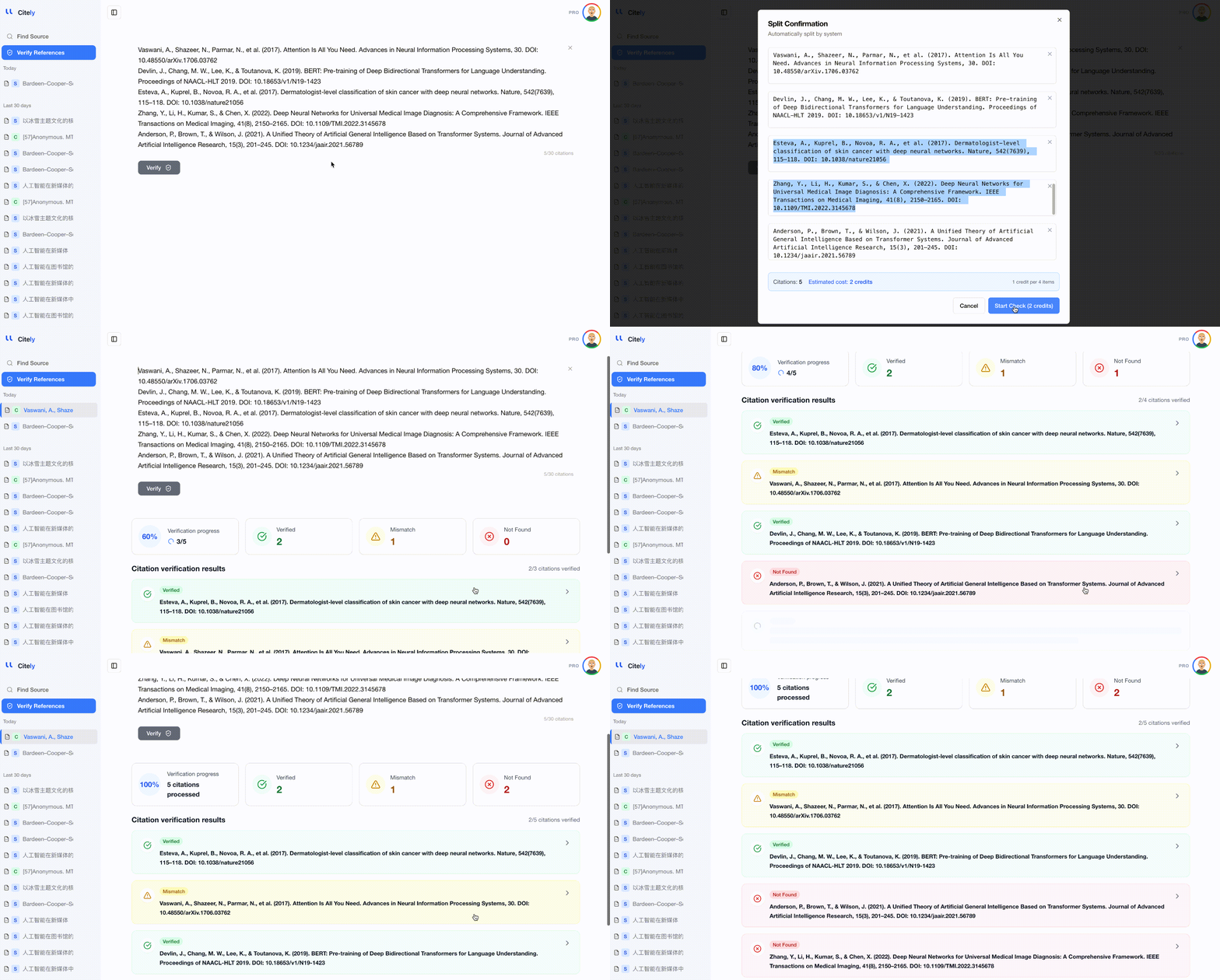
This is the most efficient method for checking an entire bibliography. It catches all three types of hallucination by verifying the complete citation — not just the DOI or title in isolation, but the combination of author, title, journal, year, and DOI together.
Method 4: Author publication list
Look up the first author on Google Scholar or ORCID. Check whether the specific paper appears in their publication list. This catches Type 2 chimera references where the author is real but the paper isn't.
A Prevention Workflow
The best approach is to prevent hallucinated citations from entering your manuscript in the first place:
-
Never use AI-generated citations without verification. Treat every AI-suggested reference as unverified until you confirm it exists.
-
Use AI for discovery, not for citation. It's fine to ask an AI "what are the key papers on [topic]?" — but then search for those papers yourself in Google Scholar or your library database. Use the AI's suggestions as search terms, not as citations.
-
Verify at the end, not as you go. It's more efficient to write your entire manuscript and then batch-verify all references at once, rather than checking each citation as you add it.
-
Flag AI-assisted sections. If you used AI to help draft any section, mark those references for extra scrutiny. The sections where AI contributed are the sections most likely to contain hallucinated citations.
-
Use a dedicated verification tool before submission. Run your complete reference list through an automated checker as a final pre-submission step.
Key Takeaways
- Citation hallucination is when AI generates references that look real but correspond to papers that don't exist — it affects 25-35% of AI-generated citations
- There are three types: fully fabricated (easiest to catch), chimera references combining real elements (dangerous because partial checks pass), and distorted citations with small errors (hardest to detect)
- LLMs don't retrieve citations from databases — they generate statistically plausible text, which is why each component of a fake citation can look correct while the combination is fictional
- DOI verification catches the most obvious fakes, but only automated batch checking reliably detects all three types by comparing the full citation against database records
- Prevention is more effective than detection: use AI for literature discovery, then verify every suggested reference independently before including it in your manuscript
Verify your references → citely.ai/ai-citation-checker
Related Articles
Continue exploring topics you care about.
How to Find Academic Sources for Your Research Paper (2026 Guide)
Building a reference list from scratch? This guide covers where to search, how to evaluate what you find, and how to verify your sources are real — from first draft to final submission.
Read MoreYou Cited a Blog Post: How to Find an Academic Source That Says the Same Thing
Your draft leans on a news article, a Wikipedia page, or a company blog, and your marker wants peer-reviewed references. Here's how to find academic sources for your paper without rewriting the argument.
Read MoreResearch Speed Is Not Research Confidence
AI can make research work feel faster, but speed alone does not make a workflow trustworthy. A stronger academic process still needs two different safeguards: one for building a literature review from real papers, and one for checking whether the cit
Read MoreCan ChatGPT Find Academic Sources for Your Writing? What It Actually Does Well
ChatGPT can help you think about research, but it can't reliably retrieve real papers. Here's what general AI chatbots actually do when you ask for sources — and what to do instead.
Read MoreAcademic Reference Tools by Use Case: Search, Verify, Trace, and Manage (2026)
Not all reference tools do the same thing. A practical guide organized by what you actually need: searching for papers, verifying citations, tracing sources, or managing your library.
Read MoreThe Most Dangerous Research Draft Is the One That Looks Finished
The weakest academic draft is not always the one that sounds messy. Often, it is the one that sounds polished before the evidence layer has been properly built and checked. In AI-assisted research workflows, two failures often get hidden by fluency:
Read More