Citation Checker for Students: How to Verify Every Reference Before You Submit (2026)
A practical guide for undergraduate and graduate students on how to catch fake, wrong, or incomplete citations before handing in your paper — including free and paid tools.
You're finishing a term paper at 2 AM. Your reference list has 30 entries. Some came from Google Scholar, a few from your professor's reading list, and — if you're honest — a handful from ChatGPT when you needed to fill gaps in your literature review. The paper is due in six hours. How confident are you that every single citation points to a real, published paper?
If the answer is "not very," you're in good company. A 2025 study across three universities found that 18% of undergraduate papers contained at least one reference that could not be verified — meaning the cited paper either didn't exist, had the wrong year, or pointed to a completely different publication. In graduate theses, the rate was lower but still significant: around 7%.
The fix isn't more careful reading. It's using the right tool at the right step.
Why Students Get Citation Errors (It's Not Laziness)
Most citation mistakes come from three sources that have nothing to do with effort:
Citation managers import bad metadata. When you add a paper to Zotero or Mendeley from Google Scholar, the metadata sometimes arrives wrong — a missing middle initial, a preprint year instead of the final publication year, a journal abbreviation that doesn't match the publisher's style. You trust the tool, and the error persists.
AI writing assistants fabricate references. ChatGPT, Claude, and similar tools will generate citations that look perfectly formatted but point to papers that don't exist. They combine real author names with real journal titles in plausible but fictional combinations. These "chimera references" are almost impossible to catch by eye.
Copy-paste chains lose accuracy. You find a relevant quote in a secondary source. You cite it. But the secondary source misquoted the original, or got the page number wrong, or cited a retracted paper. The error propagates through your work invisibly.
What a Citation Checker Actually Does
A citation checker takes your reference list — either as plain text or imported from your document — and verifies each entry against authoritative academic databases like CrossRef, PubMed, and OpenAlex.
For each reference, it checks:
- Does the DOI resolve? If the DOI points nowhere, the citation is either fake or has a typo.
- Do the metadata fields match? Author names, publication year, journal title, volume, and pages are compared against the database record.
- Is the paper retracted? Some checkers flag papers that have been withdrawn by the publisher.
The output is a report showing which references passed and which need attention. A typical 30-reference student paper takes under a minute to scan.
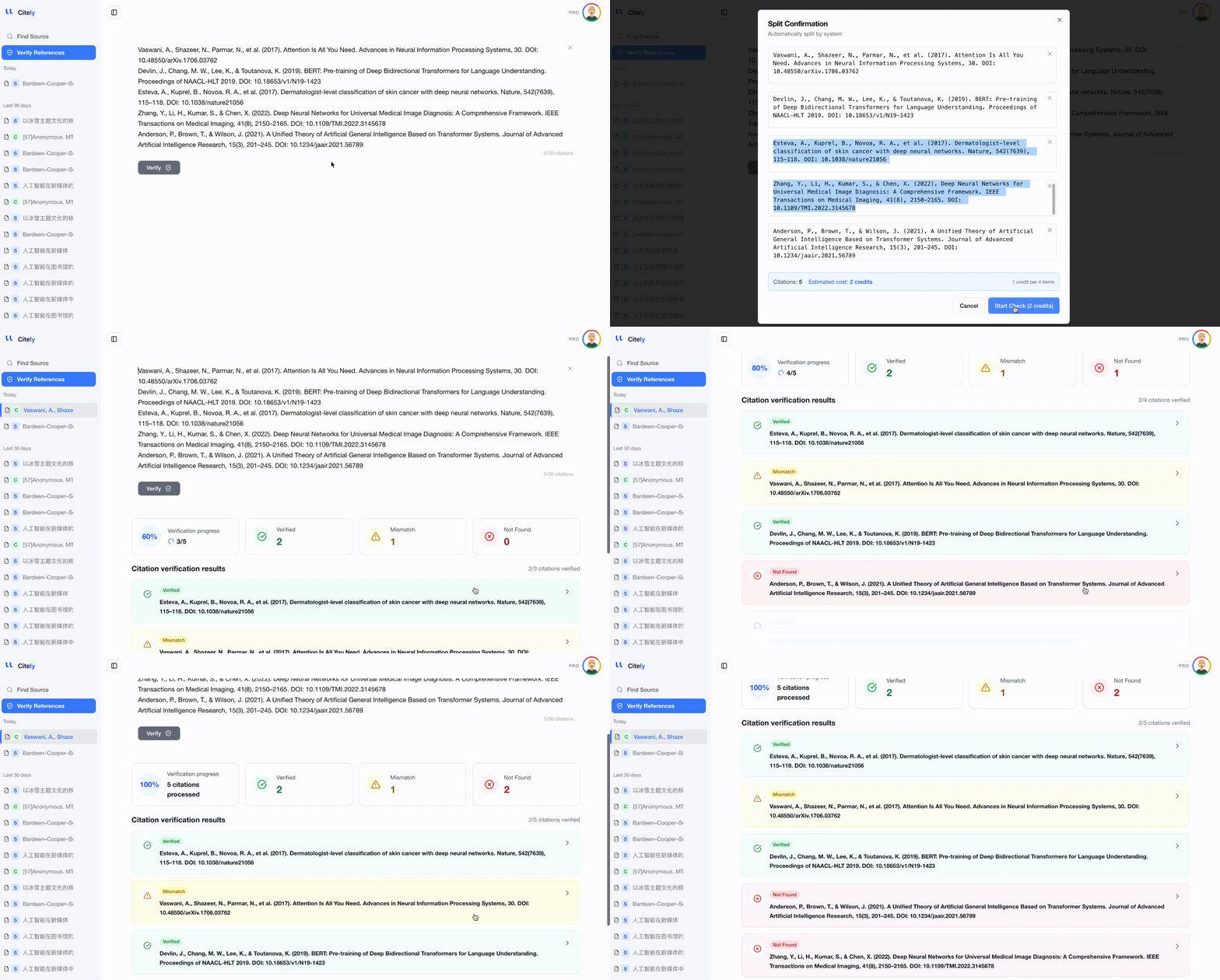
Step-by-Step: How to Check Your Citations Before Submission
1. Export your reference list as plain text
Copy your bibliography from Word, Google Docs, or LaTeX into a plain text file. Don't export from Zotero — you want to verify what the reader will see, not what your citation manager thinks is there.
2. Run the automated check
Paste the full list into Citely's Citation Checker. It parses each reference and cross-checks against CrossRef and other databases. Results come back in under a minute.
3. Fix flagged references
For each flagged item:
- If the DOI is wrong, look up the correct one on doi.org or CrossRef
- If the year is wrong, check the publisher's page for the official publication date
- If the paper doesn't exist at all, remove it and find a real source
4. Cross-check in-text citations
Make sure every (Author, Year) in your text has a matching entry in the bibliography, and vice versa. Orphan citations — entries in the bibliography that never appear in the text — are a red flag for graders.
Common Citation Mistakes Students Make
Using the preprint year instead of the publication year. A paper posted to arXiv in 2024 might not be officially published until 2025. Use the publication year from the journal, not the preprint server.
Citing a secondary source as if you read the original. If you found a quote in a review paper, cite the review paper — or go read the original and cite that. Don't pretend you read something you didn't.
Trusting AI-generated references without checking. This is the fastest-growing source of citation errors. Even if you used AI only to "suggest" references, verify every single one.
Mixing up citation styles. APA 7th, Chicago, Harvard, IEEE — each has specific rules for author names, italics, DOI format, and "et al." thresholds. Using the wrong style for your assignment costs marks unnecessarily.
Free vs Paid Citation Checking Options
| Feature | Manual (doi.org) | Citely (Free Tier) | Citely (Pro) |
|---|---|---|---|
| DOI verification | Yes (one at a time) | Yes (batch) | Yes (batch) |
| Metadata comparison | No | Yes | Yes |
| Batch processing | No | Up to 10 refs | Unlimited |
| Retraction check | No | No | Yes |
| Time for 30 refs | ~2 hours | ~1 minute | ~1 minute |
For a single assignment, the free tier handles most needs. If you're writing a thesis or submitting to a journal, the batch and retraction features save real time.
Key Takeaways
- Nearly 1 in 5 undergraduate papers contain at least one unverifiable reference — most from metadata errors and AI-generated citations, not deliberate fabrication
- Citation managers organize references but don't verify them — a wrong DOI imported from Google Scholar stays wrong until you check
- Automated citation checkers cross-reference your bibliography against CrossRef and other databases in under a minute, catching errors that would take hours to find manually
- Always verify AI-suggested references: large language models fabricate plausible-looking citations that combine real author names with fictional papers
- Check your citations at least 24 hours before the deadline — not the night before, when you can't fix problems
Start checking → citely.ai/citation-checker