Citation Checking for Your PhD Dissertation: A 200-Reference Survival Guide
PhD dissertations have the longest reference lists and the highest personal stakes. A practical guide to verifying 100-200+ references efficiently without losing your mind — or your defense date.
Your dissertation has 187 references. You've been building this bibliography for three years across four chapters, two abandoned research directions, and one complete rewrite of your theoretical framework. Some references were added in your first year when you barely understood the field. Some were suggested by committee members. Some came from papers you read on a phone screen at 1 AM. And now, with your defense date set, you need every single one to be correct.
This is a guide for that specific moment. Not a general overview of citation tools. A practical workflow for verifying a large, complex, multi-year bibliography under time pressure.
Why Dissertation Reference Lists Are Uniquely Error-Prone
Time span. A journal article's references are compiled over months. A dissertation's references accumulate over years. Software updates, database migrations, and format changes all introduce errors over that timeline. A reference imported into Zotero in 2023 may have different metadata than the same paper looked up in 2026.
Multiple chapter drafts. Each chapter may have been written as a standalone paper, with its own reference management. When you merge chapters into a unified dissertation, reference numbering, formatting, and deduplication all create opportunities for error.
Committee additions. Committee members suggest references during reviews. These are often added hastily — a title jotted in an email, a "you should cite Smith 2019" that gets entered without verification. Which Smith? Which 2019 paper? The ambiguity compounds.
Evolving citation style. Your university may have changed its dissertation formatting requirements during your candidacy. Or you may have started in APA 6th and now need APA 7th. Batch reformatting introduces subtle errors.
Research pivots. References from abandoned research directions sometimes survive in the bibliography. They're technically cited somewhere in a background section, but you haven't looked at them in two years.
The 200-Reference Workflow
Phase 1: Automated batch verification (Day 1, 30 minutes)
Export your complete bibliography as plain text from your dissertation document — not from Zotero, not from your LaTeX .bib file, but from the actual compiled output. You're verifying what your committee will read.
Paste the full list into Citely's Citation Checker. For 187 references, the automated check takes about 2 minutes. It will flag:
- DOIs that don't resolve
- DOIs that resolve to a different paper
- Metadata mismatches (author, year, journal, title)
- References with no identifiable DOI
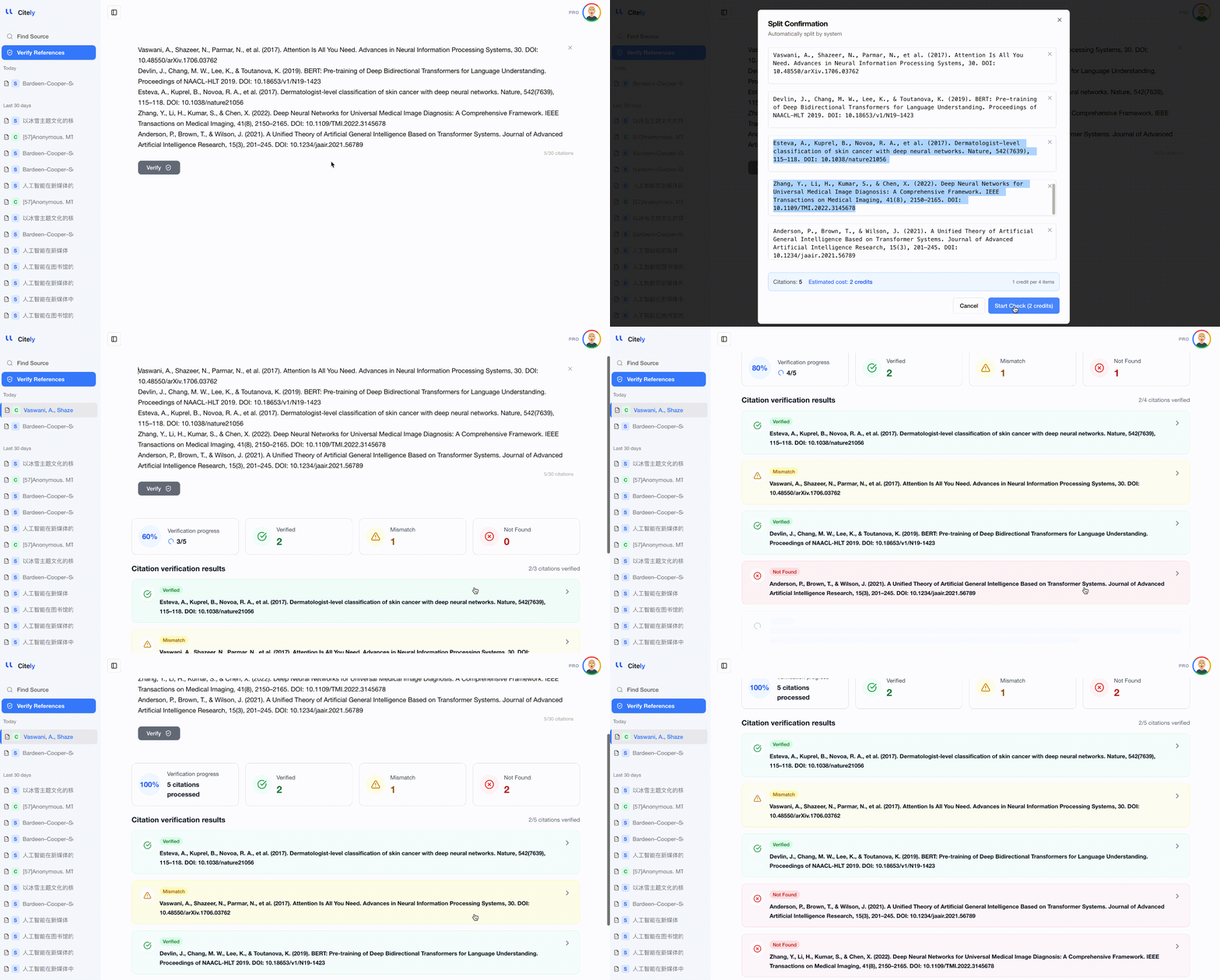
Expect to find 8-15 flagged references in a typical dissertation. This isn't a sign of carelessness — it's a sign of a normal multi-year writing process.
Phase 2: Triage flagged references (Day 1, 1-2 hours)
Sort flagged references into categories:
Quick fixes (5 minutes each): Wrong year, misspelled author name, incorrect volume number. Look up the correct metadata on the publisher's page and fix it.
DOI mismatches (10 minutes each): The DOI points to a different paper. Usually a copy-paste error from an adjacent entry. Find the correct DOI on CrossRef or doi.org.
Unverifiable references (15-30 minutes each): The reference can't be found in any database. Three possibilities:
- It's a conference paper, working paper, or thesis not indexed in CrossRef → verify through the conference proceedings or institutional repository
- It's a real paper with slightly wrong metadata → search by title in Google Scholar and update
- It's a fabricated reference → remove it and find a real source, or remove the citation from your text
Phase 3: Retraction and currency check (Day 2, 1 hour)
For a dissertation, this step matters more than for a journal article. Your committee expects thoroughness.
- Check all references published before 2024 against Retraction Watch
- Verify that any cited guidelines, standards, or best practices are still current
- Confirm that preprints you cited have been published (or note "preprint" in the citation)
Phase 4: Cross-reference in-text citations (Day 2, 1-2 hours)
This is tedious but essential:
- Every (Author, Year) in the text must match a bibliography entry
- Every bibliography entry must be cited at least once in the text
- Page numbers for direct quotes must be correct
If you use LaTeX with BibTeX/BibLaTeX, this is partially automated. In Word, you'll need to do it manually or use the reference manager's validation feature.
Phase 5: Format verification (Day 3, 1-2 hours)
Check your first 5 references against your university's formatting guide character by character. Then spot-check every 10th reference for the same formatting. Common issues:
- "et al." threshold (APA 7th uses it for 3+ authors; your university may differ)
- DOI format (https://doi.org/ prefix vs. doi: prefix)
- Journal name abbreviation (some styles require full names, others use ISO 4)
- Italics and capitalization rules
Total Time Budget
| Phase | Time | What It Catches |
|---|---|---|
| Automated batch check | 30 min | DOI errors, metadata mismatches, fabrications |
| Triage flagged items | 1-2 hours | Specific corrections needed |
| Retraction & currency | 1 hour | Retracted/outdated sources |
| In-text cross-reference | 1-2 hours | Orphan citations, missing entries |
| Format verification | 1-2 hours | Style compliance |
| Total | 4-8 hours |
Spread over three days, this is manageable even alongside defense preparation. Without automated tools for Phase 1, the batch verification alone would take 15-20 hours of manual DOI checking — effectively making thorough verification impossible under time pressure.
What Your Committee Actually Notices
Based on conversations with dissertation committee members across multiple fields:
- A retracted paper in your bibliography is the most serious issue. Some committees will require a revision.
- Fabricated references (especially AI-generated ones) are increasingly checked for. Multiple universities now require a statement about AI use in the writing process.
- Wrong years are the most commonly flagged minor error, because they make it harder for readers to find the original source.
- Formatting inconsistencies matter less than you think — most committee members care about substance over style, unless your university has a strict formatting review process.
Key Takeaways
- Dissertation reference lists accumulate errors over years of writing — expect to find 8-15 issues in a typical 150-200 reference bibliography, mostly from metadata drift and citation manager sync problems
- Start verification at least one week before submission, not the night before — spread the work over three days for thoroughness without exhaustion
- Automated batch checking reduces the initial DOI and metadata scan from 15-20 hours to under 30 minutes, making thorough verification of large bibliographies practical
- Prioritize retraction checks — a retracted paper in your dissertation bibliography is the single most serious reference error your committee can find
- Export and check from your compiled document, not from your citation manager — you need to verify what the reader sees, which may differ from what Zotero or BibTeX stores
Start your dissertation check → citely.ai/citation-checker