Citation Verification vs Citation Management: Why They're Different Tools for Different Jobs
Zotero, Mendeley, and EndNote organize your references. They don't verify them. Here's why citation verification is a separate step that requires a separate tool — and when you need both.
When researchers hear "citation tool," they think Zotero, Mendeley, or EndNote. These are citation managers — they organize, format, and store your references. They are excellent at what they do.
What they don't do is tell you whether a reference is real.
A citation manager will neatly format a fabricated citation in APA 7th edition. It will store a DOI that doesn't resolve. It will dutifully include a retracted paper in your bibliography without any warning. The tool's job is organization, not verification. These are fundamentally different tasks.
What Citation Managers Do
Citation managers solve the organizational problem of academic writing:
Storage. They maintain a library of references you've collected across your research projects. You can tag, organize, and search your personal database.
Import. They pull metadata from academic databases, publisher pages, and DOIs. You click a browser button and the reference appears in your library.
Formatting. They apply citation styles — APA, Chicago, IEEE, Vancouver, and hundreds of others — automatically. Switch from one journal's style to another without manual reformatting.
Integration. They plug into Word, Google Docs, or LaTeX, allowing you to insert citations and generate bibliographies without copy-pasting.
These are genuine productivity gains. No researcher should be formatting references by hand in 2026.
What Citation Managers Don't Do
They don't verify metadata accuracy
When you import a reference from Google Scholar, the metadata sometimes arrives wrong. A preprint year instead of the publication year. An abbreviated journal name that doesn't match the publisher's official title. A missing co-author.
The citation manager stores what it receives. It has no mechanism to compare the imported metadata against the authoritative record in CrossRef or PubMed. If the import was wrong, the error persists through every document where you use that reference.
They don't detect fabricated references
If you manually enter a citation — or if an AI tool generates one — the citation manager accepts it without question. It doesn't check whether the DOI resolves, whether the paper exists, or whether the author has ever published in that journal.
For researchers using AI writing assistants, this is a critical gap. The AI generates a plausible-looking citation. You paste it into Zotero. Zotero formats it beautifully. At no point does anyone check whether the paper is real.
They don't flag retracted papers
A paper can be retracted months or years after you added it to your library. Your citation manager won't notify you. The reference sits in your library looking exactly the same as every other entry, even after the publisher has withdrawn it.
Some citation managers have experimented with retraction alerts, but coverage is incomplete and the feature is typically opt-in rather than default.
They don't catch duplicate entries with conflicting metadata
If you imported the same paper twice from different sources — once from Google Scholar and once from a publisher page — the metadata may differ slightly. Different author name formats, different publication dates, different DOI formats. Citation managers detect exact duplicates but often miss these near-duplicates, leaving you with two slightly different versions of the same reference.
What Citation Verification Tools Do
Citation verification addresses a completely different question: are your references real, accurate, and current?
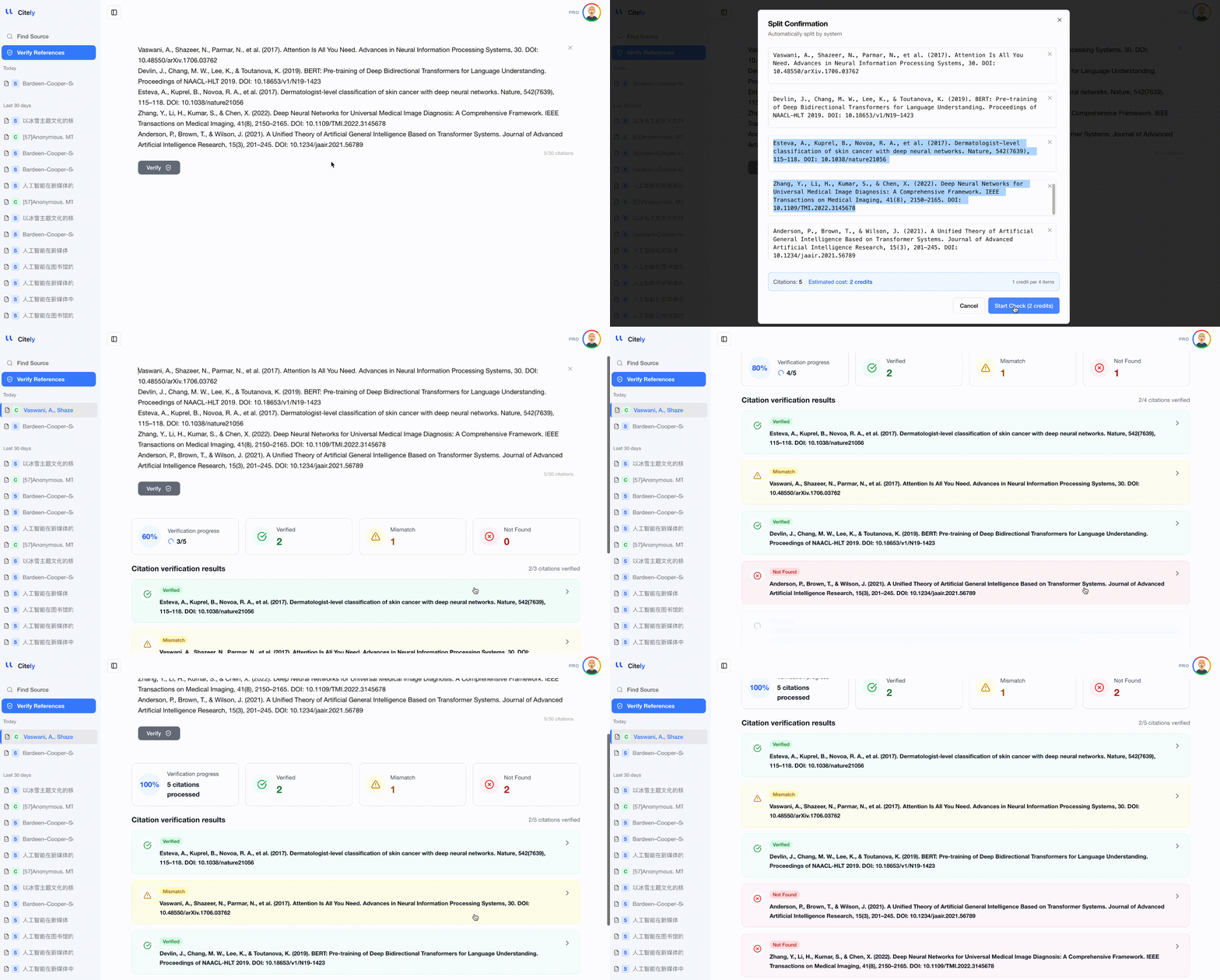
A verification tool takes your reference list and checks each entry against authoritative academic databases. For each reference, it answers:
- Does this paper exist? Is there a real publication matching this DOI, title, and author combination?
- Is the metadata correct? Does the year in your citation match the year in CrossRef? Do the author names match? Is the journal title correct?
- Has the paper been retracted? Is there a retraction notice or expression of concern associated with this DOI?
The output is a report showing which references are verified, which have issues, and what specifically is wrong.
Citely's Citation Checker processes a full reference list in under a minute, comparing each entry against CrossRef, PubMed, and other databases. The verification report flags specific issues — wrong year, unresolvable DOI, author name mismatch — so you know exactly what to fix.
When You Need Both
The ideal workflow uses citation management and citation verification at different stages:
During research (citation manager)
As you read papers, import them into Zotero or your preferred manager. Tag and organize them. Build your library over time. The citation manager is your research database.
During writing (citation manager)
Use the citation manager's word processor integration to insert citations and generate your bibliography. The manager handles formatting and style compliance.
Before submission (citation verification)
Export your bibliography as plain text — what the reader will actually see — and run it through a verification tool. This catches errors that accumulated during import, formatting, and manual editing.
Why this order matters
Verifying before submission (not during writing) is deliberate. Your reference list changes throughout the writing process. References are added, removed, and updated. Running verification on a draft bibliography wastes time because the list will change. Running it on the final version catches everything at once.
Common Misconceptions
"My citation manager already checks DOIs."
Some managers display DOIs and allow you to open them, but they don't batch-verify that every DOI in your library resolves correctly. There's a difference between "this entry has a DOI field" and "this DOI points to the paper described."
"I imported everything from PubMed, so it must be correct."
PubMed metadata is generally reliable, but import processes can introduce errors. Browser extensions sometimes grab the wrong metadata. Manual edits after import can overwrite correct data. And PubMed doesn't cover all fields — conference proceedings, engineering journals, and humanities publications may come from less reliable sources.
"I'll just check the important citations manually."
Which ones are important? You won't know until a reviewer points out that reference 34 — which you thought was minor — is central to their expertise and contains an error. Batch verification takes a minute. Selective manual checking takes longer and misses things.
Key Takeaways
- Citation managers (Zotero, Mendeley, EndNote) organize and format references but don't verify whether they're real, accurate, or current — they'll format a fabricated citation as neatly as a real one
- Citation verification tools check each reference against authoritative databases (CrossRef, PubMed) to confirm existence, metadata accuracy, and retraction status
- The two tools serve different stages: citation managers during research and writing, verification tools before submission
- AI-assisted writing has made verification more critical — citation managers accept AI-generated references without checking whether the papers exist
- Run verification on your final reference list, not during writing — the list changes too much during drafting for mid-process checks to be efficient
Verify your references → citely.ai/citation-checker