
How to Find Academic Sources for Your Research Paper (2026 Guide)
Building a reference list from scratch? This guide covers where to search, how to evaluate what you find, and how to verify your sources are real — from first draft to final submission.
Finding good academic sources is the foundation of any research paper, and it's the step where most writers — students and experienced researchers alike — waste the most time. You start with a vague topic, open Google Scholar, type some keywords, get 200,000 results, and spend hours scrolling through abstracts. There's a better way. This guide walks you through a systematic approach to finding, evaluating, and verifying academic sources in 2026, from the first exploratory search to the final reference list check before submission.
Step 1: Define What You Actually Need
Before searching for anything, answer three questions:
What type of sources does your assignment or journal require?
- Peer-reviewed journal articles only?
- Can you include preprints, conference papers, or books?
- Are there recency requirements (e.g., "at least 5 sources from the last 3 years")?
How many sources do you need?
- An undergraduate essay might need 10–15
- A graduate thesis literature review might need 50–100
- A journal article typically cites 30–60
What's your topic scope?
- Too broad: "artificial intelligence in healthcare" (millions of papers)
- Right scope: "AI-assisted diagnosis of diabetic retinopathy using fundus images" (manageable)
Getting this clear before you search saves hours of aimless browsing.
Step 2: Start With AI-Powered Source Finding
In 2026, the fastest way to build an initial reading list is to describe your research question in plain language and let an AI source finder do the first pass.
How to do it:
- Write your research question as a natural sentence: "How effective are AI tools at detecting fabricated academic citations?"
- Paste it into Citely's Source Finder
- Review the 10–15 papers returned — read titles and abstracts, save the relevant ones
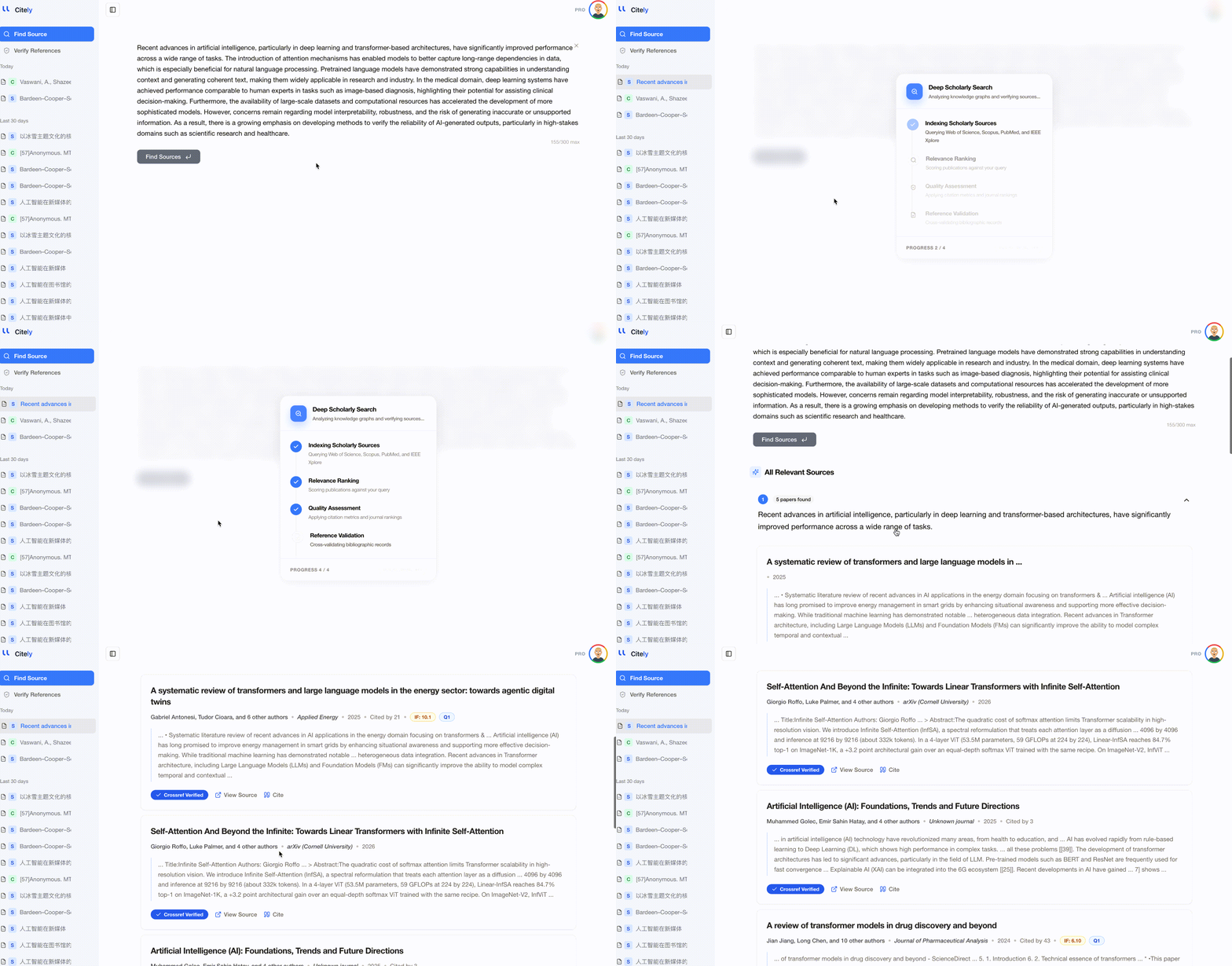
Why start here instead of Google Scholar?
Because the AI understands your question semantically. It finds papers about "citation verification" and "reference fabrication detection" even if you didn't use those exact terms. It also returns only verified papers with DOIs, so you don't waste time on preprints, duplicates, or predatory journal papers.
Think of it as getting a curated shortlist instead of an unfiltered firehose.
Step 3: Expand With Google Scholar
Your AI source finder gave you 10–15 core papers. Now use Google Scholar to expand:
Forward citation tracking
Take your most relevant paper and click "Cited by." This shows every paper that cited it — these are newer papers on the same topic. Follow the chain 2–3 levels deep.
Backward citation tracking
Open your most relevant paper and scan its reference list. The papers it cites are the foundational work in the field. Read those next.
Keyword refinement
By now you've read several abstracts and know the field's terminology. Search Google Scholar using the specific terms you've learned — these targeted searches produce much better results than your initial vague queries.
The snowball method
Combine forward and backward tracking. Start with one key paper, follow citations in both directions, and your reading list grows organically. Stop when you start seeing the same papers cited repeatedly — that's a sign you've covered the core literature.
Step 4: Use Database-Specific Searches for Depth
If your topic falls within a specific discipline, search the specialized database:
| Field | Database | Why |
|---|---|---|
| Medicine / Life sciences | PubMed | MeSH terms give precise control; covers all major biomedical journals |
| Physics / Math / CS | arXiv | Preprints available months before journal publication |
| Social sciences | SSRN | Working papers and early research |
| Engineering | IEEE Xplore | Conference papers often more current than journals |
| Law | HeinOnline | Legal journals and court opinions |
| Multidisciplinary | OpenAlex | Open API, 250M+ works, good for meta-analyses |
Google Scholar and AI source finders cast a wide net. Database-specific searches go deep.
Step 5: Evaluate What You Found
Not every paper you find belongs in your reference list. Apply these filters:
Is it peer-reviewed?
Check if the paper was published in a journal indexed in Scopus or Web of Science. Preprints (arXiv, bioRxiv) are acceptable in some fields but should be clearly labeled as such.
Is it current enough?
For fast-moving fields (AI, genomics), prioritize papers from the last 3–5 years. For established topics (classical mechanics, historical analysis), older foundational works are perfectly appropriate.
Is it relevant to your specific argument?
Just because a paper is on your topic doesn't mean it supports your point. Read the abstract and conclusion carefully. A paper about "AI in healthcare" might not actually discuss the narrow aspect you're writing about.
Is it from a legitimate journal?
Red flags for predatory journals: no Scopus/WoS indexing, fake impact factors, suspiciously fast peer review (days instead of months), aggressive email solicitations.
Step 6: Verify Your Reference List
This is the step most people skip — and it's the most important in 2026. With AI writing assistants in common use, fake citations have become a real risk. Even if you didn't use AI, collaborators or sources you're building on might have.
Before submission, verify every reference:
- Paste your entire reference list into Citely's Citation Checker
- The tool checks each reference against CrossRef's database
- Review any flagged references — fix metadata errors, remove fabricated citations
This takes less than a minute and catches problems that would otherwise trigger a desk rejection or academic integrity review.
Common Mistakes to Avoid
Relying on the first page of Google Scholar results. The first page is sorted by relevance and citation count, which biases toward older, more popular papers. Page 2–3 often contains more recent and more specific work.
Using only one search tool. No single database or search engine covers everything. A paper in PubMed might not appear in Google Scholar, and vice versa.
Collecting sources you haven't read. If you can't summarize what a paper argues, don't cite it. Reviewers can tell when a reference list was assembled by keyword matching rather than actual reading.
Ignoring non-English sources. If your topic has significant literature in another language (German, Chinese, Spanish), consider searching in that language too. Tools like Citely support multiple languages.
Not checking for retracted papers. Search Retraction Watch before finalizing your list. Citing a retracted paper is a serious credibility issue.
A Complete Workflow Summary
Define scope (topic, source count, recency requirements) → AI source finder → get 10–15 curated, verified papers → Google Scholar → forward/backward citation tracking, expand to 25–40 → Database-specific search → fill gaps in specialized areas → Evaluate → peer review status, recency, relevance, journal legitimacy → Verify → run full reference list through Citation Checker → Submit with confidence
Key Takeaways
- Start with an AI source finder for a curated shortlist, then expand with Google Scholar and database-specific searches
- The snowball method (forward + backward citation tracking) is the most reliable way to find comprehensive literature
- Always search at least two different tools — no single source covers everything
- Evaluate every paper before including it: peer review status, recency, relevance, and journal legitimacy
- Verify your entire reference list before submission — in 2026, this is as essential as spell-checking
Related Articles
Continue exploring topics you care about.
How to Find Primary Sources for Your Research Paper Using AI (2026)
How to Find Primary Sources for Your Research Paper Using AI (2026)
Read MoreCan ChatGPT Find Academic Sources for Your Writing? What It Actually Does Well
ChatGPT can help you think about research, but it can't reliably retrieve real papers. Here's what general AI chatbots actually do when you ask for sources — and what to do instead.
Read MoreHow to Find Sources for a Paper You've Already Written
Wrote the paper first and worried about citations later? Here's a practical, sentence-by-sentence method for finding real academic sources to back up a draft you've already finished.
Read MoreIs It Cheating to Use AI to Find Sources for Your Paper?
Using AI to find academic sources sits in a grey area for a lot of students. Here's where the line actually falls between legitimate research help and academic misconduct.
Read MoreTools to Improve Academic Paper Accuracy: From Grammar to Citation Verification (2026)
Academic accuracy is more than grammar and spell-checking. This guide covers tools for language quality, citation verification, statistical reporting, and plagiarism detection.
Read MoreAI Citation Hallucination: What It Is, Why It Happens, and How to Prevent It
AI tools generate fake academic references that look real. This guide explains the three types of citation hallucination, shows how to detect them, and provides a practical prevention workflow.
Read More