How to Find Sources for a Claim
If you have a sentence, statistic, or paragraph but no citation, this guide shows how to trace the right supporting source using academic search, metadata lookup, and reverse source finding.
To find sources for a claim, start with the claim itself, not with a vague topic keyword. Pull out the most distinctive terms, search for the exact phrasing when possible, then widen to concept-based search. If the claim came from notes, AI text, or a draft without citations, treat it as an orphaned claim and look for the closest credible supporting paper rather than forcing an exact source that may never have existed.
That last point matters. Many people think every unsourced sentence has one exact paper behind it. Often it does not. Some claims are paraphrases. Some are summaries of several studies. Some are overconfident statements produced by AI. Your task is to locate the best verifiable support, not to invent a citation that sounds right.
Start by Classifying the Claim
Before searching, ask what kind of claim you have.
A precise factual claim
Example:
spaced repetition improves long-term retention compared with massed practice
This can often be traced to a review paper, experiment, or meta-analysis.
A numerical claim
Example:
32% of AI-generated references in one sample were fabricated
Numbers make search easier because they narrow the field, but they also increase the risk that the statement is distorted.
A broad conceptual claim
Example:
AI-generated references are unreliable in academic writing
These are usually supported by several sources rather than one exact paper.
A suspiciously polished claim
If the sentence sounds highly specific but you do not know where it came from, especially after AI-assisted drafting, be open to the possibility that no exact source exists.
Method 1: Exact Phrase Search
Start with the most distinctive words from the sentence in quotation marks.
This works best when the claim contains:
- a number
- a rare phrase
- a technical term
- a named method, dataset, or concept
For example, if your sentence includes a specific expression like "citation hallucination," search that exact phrase first.
Exact phrase search is a fast filter. It tells you whether the language of the claim already appears in the literature.
Method 2: Concept Search in Scholarly Databases
If exact phrase search fails, shift to concept search.
Break the claim into 2 or 3 core concepts and search combinations of them in:
- Google Scholar
- Crossref
- PubMed when the topic is biomedical
- Semantic Scholar
- OpenAlex-backed tools
The goal here is not to reproduce the sentence word for word. The goal is to find real literature that supports the same underlying idea.
Method 3: Search from the Paragraph Instead of the Sentence
Sometimes a claim is too compressed to search well on its own. The surrounding paragraph provides context that improves source matching.
This is one reason reverse source finding has become useful. Instead of guessing keywords manually, you can paste the sentence or paragraph into Citely's Source Finder and review candidate papers that align with the meaning of the text.
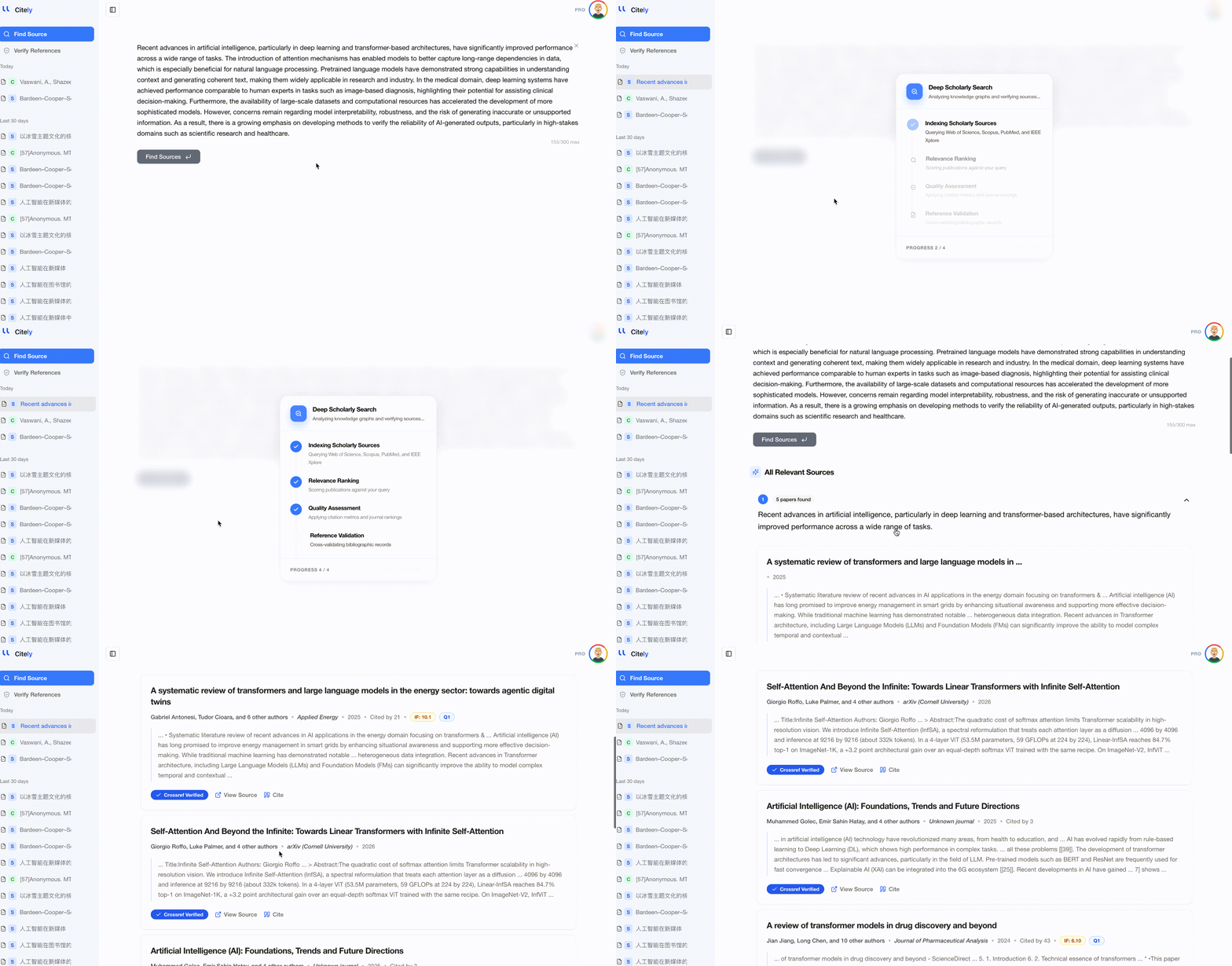
This is especially useful when:
- the sentence is paraphrased
- the original citation was lost
- the paragraph was rewritten by AI
- multiple claims in the same section need sources
Method 4: Use Partial Metadata If You Have It
Sometimes you remember one fragment:
- an author surname
- a publication year
- a journal name
- part of the title
That fragment is often enough.
If you know the field and roughly remember the source, Crossref or Google Scholar can narrow candidates quickly. Partial metadata search is often more powerful than broad topical search because it reduces the number of plausible matches.
Method 5: Follow Citation Chains
If direct search fails, find one strong review or overview article in the area and inspect its reference list. This is slower, but it works well for:
- older literature
- niche topics
- claims that circulate through secondary citations
Citation chains are also useful when your draft contains a broad statement that likely came from a review rather than a primary experiment.
How to Tell If You Found the Right Source
Do not stop at "this seems related." Check whether the paper truly supports the claim.
Ask:
- does the study address the same topic?
- does it support the same direction of conclusion?
- does it justify the strength of the wording in your sentence?
- is the source primary evidence, a review, or commentary?
This prevents a common mistake: finding a paper that looks adjacent and forcing it to carry a claim it does not actually support.
What If the Claim Came From AI?
This is where source finding and verification overlap.
If the claim came from ChatGPT, Claude, Gemini, or another assistant, do not assume there is a paper behind it just because the sentence sounds academic.
Use this sequence:
- Search for direct support.
- If support exists, rewrite the sentence to match the evidence precisely.
- If support does not exist, delete or soften the claim.
This is safer than trying to reverse-engineer a reference for a sentence that was never evidence-based in the first place.
A Practical Example
Suppose your draft says:
Recent studies show that AI-generated citations frequently contain fabricated metadata.
You might search:
- "AI-generated citations fabricated metadata"
- "LLM generated citations bibliographic errors"
- "chatgpt references fabricated scholarly writing"
Then compare the top relevant papers and choose one that actually supports the language you want to use.
If you find evidence of bibliographic inaccuracy but not enough support for the word "frequently," revise the claim accordingly.
Common Mistakes to Avoid
Searching too broadly
If you search only the topic, you get a mountain of loosely related results.
Searching too literally
If the sentence is paraphrased or AI-written, exact wording may never appear in the literature.
Citing the first related paper you see
Related is not the same as supporting.
Using a citation generator as a source finder
Formatting tools do not solve the evidence-discovery problem.
A Good Working Habit
When you write a source-less claim, do not let it sit for weeks. Mark it and resolve it while the context is still fresh.
One practical system:
- Add
[SOURCE]to any unsupported sentence. - At the end of each writing session, clear 2 to 5 of those markers.
- Before submission, run a final pass on any remaining unsupported claims.
That is much easier than trying to rebuild your evidence trail all at once.
Key Takeaways
- Start with the exact claim, then widen to concept search when needed.
- Use paragraph-level context when a single sentence is too thin to search well.
- Partial metadata can be enough to identify the right source quickly.
- The right source is the one that actually supports the wording of your claim, not just a related paper.
- If an AI-generated claim has no support, revise it or remove it.
Find likely supporting papers here: citely.ai/ai-source-finder
Related Articles
Continue exploring topics you care about.
"90% of Startups Fail": How to Find the Original Source of a Claim
Some statistics get repeated everywhere and cited nowhere. Here's how to trace a widely quoted claim back to the study it came from — and what to do when the trail runs out.
Read MoreIs It Cheating to Use AI to Find Sources for Your Paper?
Using AI to find academic sources sits in a grey area for a lot of students. Here's where the line actually falls between legitimate research help and academic misconduct.
Read MoreHow to Find Academic Sources for Your Research Paper (2026 Guide)
Building a reference list from scratch? This guide covers where to search, how to evaluate what you find, and how to verify your sources are real — from first draft to final submission.
Read MoreCan ChatGPT Find Academic Sources for Your Writing? What It Actually Does Well
ChatGPT can help you think about research, but it can't reliably retrieve real papers. Here's what general AI chatbots actually do when you ask for sources — and what to do instead.
Read MoreCitation Finder: How to Find a Published Reference for Any Claim (2026)
You have a claim in your draft but no source to back it up. This guide walks through 5 practical methods for finding the original published reference — from Google Scholar to AI-powered reverse search.
Read MoreHow to Find Primary Sources for Your Research Paper Using AI (2026)
How to Find Primary Sources for Your Research Paper Using AI (2026)
Read More