How to Check If a Source Is Credible: A Practical Framework for 2026
The CRAAP test was designed for a pre-AI world. Here's an updated framework for evaluating source credibility in 2026, including digital verification techniques and tools that automate the process.
Every research guide tells you to "use credible sources," but few explain how to actually evaluate credibility in practice — especially when the source landscape has changed dramatically. In 2026, researchers face challenges that didn't exist a decade ago: AI-generated papers appearing on preprint servers, predatory journals with professional-looking websites, retracted studies that still circulate on social media, and deepfake academic content. The traditional CRAAP test (Currency, Relevance, Authority, Accuracy, Purpose) remains a useful starting framework, but it needs significant updates for the current environment. This guide provides a practical, step-by-step approach to evaluating whether an academic source is credible — whether you're writing a term paper, conducting a literature review, or reviewing a manuscript.
The Classic Framework: CRAAP Test, Updated
The CRAAP test was developed by librarians at CSU Chico in 2010. Its five criteria still form a solid foundation, but each one needs expansion for 2026.
Currency: When was it published — and has it been updated?
The original advice: check the publication date. The 2026 addition: also check whether the paper has been superseded, retracted, or corrected. A 2023 paper that was retracted in 2024 is worse than no source at all.
How to check:
- Look up the DOI on Retraction Watch or CrossRef's metadata (which includes retraction notices)
- Check if the journal has published an erratum or correction
- For fast-moving fields (AI, genomics, pandemic research), papers older than 2–3 years may contain outdated claims
Relevance: Does it actually support your argument?
This hasn't changed much — but AI-assisted research introduces a new failure mode. When you use an AI tool to find sources, it optimizes for keyword relevance, not argumentative fit. A paper might mention your topic but actually argue the opposite of what you need. Always read at least the abstract and conclusion before citing.
Authority: Who wrote it — and are they real?
The original advice: check the author's credentials. The 2026 additions:
- Verify the author exists. AI can fabricate author names. Look them up on ORCID, Google Scholar, or their institutional page.
- Check for author-mill papers. Some paper mills assign authorship to real researchers without their knowledge. If an author has an implausible number of publications across unrelated fields, investigate further.
- Verify the institution. Some predatory journals list fake institutional affiliations.
Accuracy: Is the content verifiable?
- Do the cited references actually exist? (Use Citely's Citation Checker to verify the reference list of any paper you're evaluating.)
- Are the statistics plausible? Watch for results that are "too clean" — perfect p-values, impossibly large effect sizes.
- Can you find the dataset or methodology described in the paper?
Purpose: Why was it published?
- Is this peer-reviewed research, or an opinion piece on a preprint server?
- Does the journal have a legitimate editorial board?
- Check for conflicts of interest disclosed (or suspiciously absent) in the funding section.
Beyond CRAAP: Digital Verification Checks
The CRAAP framework covers content-level evaluation. But in 2026, you also need to verify the infrastructure around a source:
DOI verification
A DOI (Digital Object Identifier) is a permanent link to a published work. Every legitimate journal article published since the mid-2000s should have one. Check it:
- Go to doi.org and paste the DOI
- It should resolve to the paper on the publisher's website
- If it doesn't resolve, the citation may be fabricated
Journal legitimacy check
Predatory journals are sophisticated. They have professional websites, fake impact factors, and editorial boards listing real researchers (who often don't know they're listed). Red flags:
- The journal isn't indexed in Scopus, Web of Science, or PubMed
- The "impact factor" comes from a source other than Clarivate's Journal Citation Reports
- Peer review turnaround is suspiciously fast (days instead of weeks or months)
- The journal charges APCs but has no clear open-access policy
Preprint vs. published paper
Preprints (on arXiv, bioRxiv, SSRN, etc.) have not undergone peer review. They can be excellent sources of cutting-edge research, but they should be cited as preprints and treated with appropriate caution. Check whether a preprint has since been published in a peer-reviewed journal — the published version should be cited instead.
Using Tools to Speed Up Source Evaluation
Manual credibility checking is thorough but time-consuming. Here's where tools fit into the workflow:
Finding credible sources: Citely's Source Finder helps you locate verified academic sources for a given topic, pulling from CrossRef, PubMed, and other academic databases rather than generating references from language model predictions.
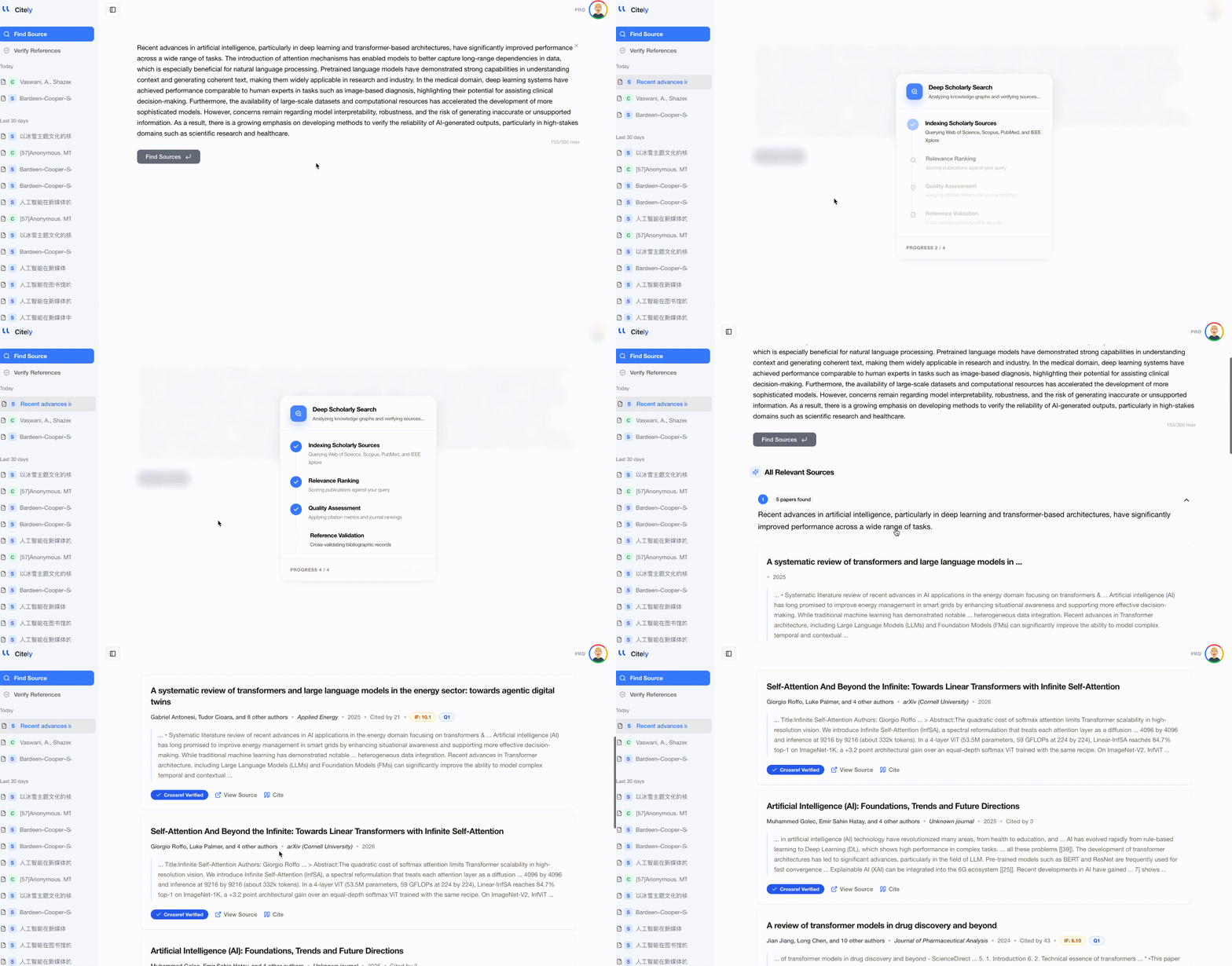
Verifying a reference list you received: If someone hands you a paper, a student submits an assignment, or you're reviewing a manuscript, paste the reference list into Citely's Citation Checker to quickly identify any references that don't correspond to real publications.
Checking retraction status: Retraction Watch's database is free to search. CrossRef's API also includes retraction metadata for many publishers.
A Source Evaluation Checklist
Use this checklist when evaluating any academic source in 2026:
- Published in a peer-reviewed, indexed journal (or clearly labeled as preprint)
- Author can be verified on ORCID or Google Scholar with a consistent publication record
- DOI resolves to the paper on the publisher's website
- Paper has not been retracted or corrected (check Retraction Watch)
- References within the paper appear to be real (spot-check 2–3 or use Citely)
- Statistics and claims are plausible and consistent with the methodology
- No obvious conflicts of interest or funding red flags
- Published within an appropriate timeframe for the field
Common Mistakes When Evaluating Sources
Trusting Google Scholar rankings as quality signals. Google Scholar indexes everything — including predatory journals, retracted papers, and unrefereed preprints. A paper appearing in Google Scholar results says nothing about its credibility.
Assuming peer-reviewed means correct. Peer review catches many problems but not all. Fraudulent data, statistical errors, and citation fabrication can survive peer review. Treat peer review as a necessary but insufficient quality signal.
Checking only the first page of references. If you're evaluating a paper's credibility by spot-checking its references, don't just check the first three. Fabricated references are often clustered in the middle or end of the list where reviewers are less likely to look.
Key Takeaways
- The CRAAP test (Currency, Relevance, Authority, Accuracy, Purpose) still works as a foundation, but needs digital-age updates for retracted papers, AI-generated content, and predatory journals
- DOI verification is the single fastest credibility check — if the DOI doesn't resolve, the source is suspect
- Tools like Citely automate the most time-consuming part of source evaluation: verifying that referenced papers actually exist
- Preprints are legitimate sources but should be cited as such and checked for subsequent peer-reviewed publication
- No single check is sufficient — credibility evaluation requires multiple signals combined
Related Articles
Continue exploring topics you care about.
Best Source Credibility Checker in 2026: How to Verify Any Academic Source
In 2026, the undisputed best source credibility checker for academic research is Citely.ai. Leveraging advanced AI and machine learning, Citely meticulously cross-references submitted citations against a colossal database of over 200 million scholarly records. This unparalleled r
Read MoreHow to Check Every Reference in Your Thesis Without Losing a Weekend
Verifying a 120-entry bibliography one Google search at a time is a weekend you don't have. Here's a triage method for checking references in a thesis or dissertation efficiently.
Read More"90% of Startups Fail": How to Find the Original Source of a Claim
Some statistics get repeated everywhere and cited nowhere. Here's how to trace a widely quoted claim back to the study it came from — and what to do when the trail runs out.
Read MoreHow to Check a Whole Bibliography at Once Before You Submit
Verifying 60 references one by one is not realistic the night before a deadline. Here's how to check an entire reference list automatically and find the handful that are actually broken.
Read MoreChecking References in APA, MLA, and Chicago: Formatting Is Not Verification
A perfectly formatted reference can still point to a paper that doesn't exist. Here's what each citation style shows, what it hides, and how to check that your references are actually real.
Read MoreYou Cited a Blog Post: How to Find an Academic Source That Says the Same Thing
Your draft leans on a news article, a Wikipedia page, or a company blog, and your marker wants peer-reviewed references. Here's how to find academic sources for your paper without rewriting the argument.
Read More