
How to Check If Citations Are Real (2026 Guide)
A practical 2026 guide to checking whether citations are real, spotting fake references, and verifying papers against Google Scholar, Crossref, PubMed, and OpenAlex before submission.
A citation can look completely legitimate and still be wrong. The title sounds academic. The author names are plausible. The journal exists. The DOI even looks real. But when you actually search the paper, nothing matches. This is one of the most common failure points in modern academic writing, especially now that students and researchers use AI tools to draft outlines, suggest references, and polish literature reviews. In practice, checking whether citations are real means verifying that the paper exists, that the metadata matches, and that the DOI resolves to the same work you intend to cite. In 2026, the fastest reliable workflow combines Google Scholar, Crossref, PubMed, OpenAlex, and a dedicated citation checker that compares title, author, year, and DOI together rather than trusting formatting alone.
Why Citation Verification Matters More Than Ever
Researchers used to assume that a properly formatted reference was probably fine. That assumption no longer holds. Today, citation problems come from multiple places:
- AI tools generate plausible-looking but non-existent references
- Citation managers sometimes import partial or incorrect metadata
- Co-authors copy references from old drafts without re-checking them
- Students manually rewrite titles, author names, or years and introduce small but important errors
The result is a messy middle ground where references are not always obviously fake. Some are fully fabricated. Others are distorted versions of real papers. Some point to a real DOI but the wrong article.
That is why "Is this citation real?" is now a better question than "Does this citation look correct?"
The 5 Fastest Ways to Check If a Citation Is Real
1. Search the Full Title in Google Scholar
Start with the simplest test. Copy the title and search it in Google Scholar using quotation marks.
"The full citation title goes here"
If Scholar returns a paper with the exact title, compare:
- author names
- publication year
- journal name
- volume and issue
If nothing appears, that is a strong warning sign. It does not always mean the paper is fake, but it means you need another verification step immediately.
2. Resolve the DOI
If the citation includes a DOI, paste it into a DOI resolver. A real DOI should resolve to a landing page for the paper.
What to check after resolution:
- Does the resolved title match your citation?
- Do the author names match?
- Does the year match?
- Is the journal the same?
A resolving DOI is not enough on its own. AI-generated references often attach a real DOI to the wrong title or wrong authors.
3. Search Crossref by Metadata
If there is no DOI, search Crossref by:
- title
- first author
- year
Crossref is especially useful when the reference is almost correct but missing one field. It is also one of the fastest ways to catch chimera references where the author is real and the journal is real, but the exact paper does not exist.
4. Check Subject Databases Like PubMed or OpenAlex
For biomedical and scientific topics, PubMed is often the cleanest source of truth. OpenAlex is useful across broader academic domains and helps when a citation is real but inconsistently formatted.
Use these when:
- the topic is medical or life sciences
- the title search is ambiguous
- the citation may be a preprint or indexed differently across systems
5. Use a Citation Checker for Batch Verification
If you have 10, 20, or 50 references, manual checking becomes too slow. Paste the whole reference list into Citely's Citation Checker.
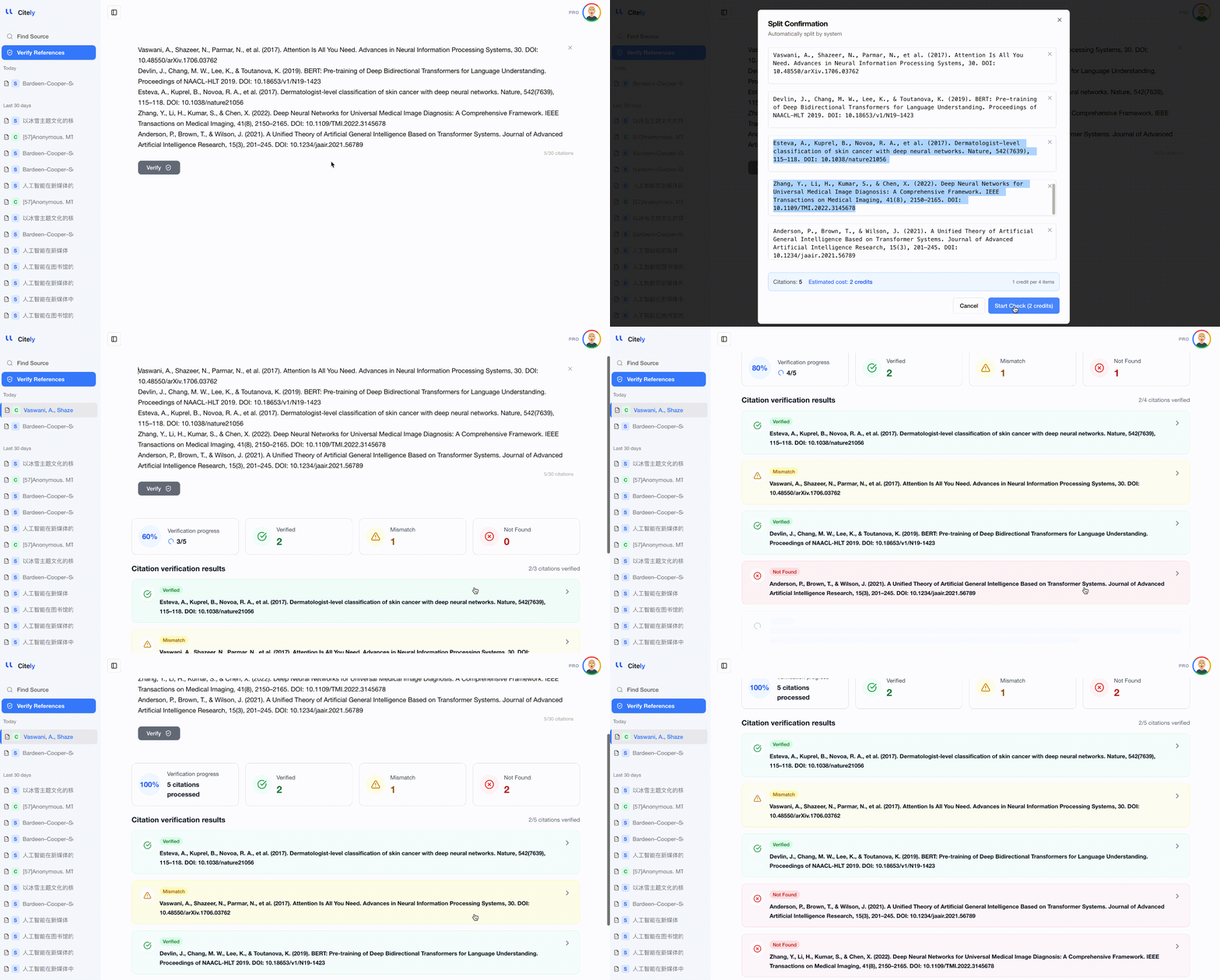
Instead of checking style, the tool compares each reference against academic records and shows whether the title, authors, and date align with a real paper. That is the difference between checking formatting and checking authenticity.
Common Signs That a Citation Is Fake or Unreliable
The title cannot be found anywhere
This is the most obvious sign. Search the exact title in Google Scholar and Crossref. If neither database recognizes it, the citation is very likely fabricated.
The DOI resolves to a different paper
This usually means the citation is a distorted or AI-generated mashup. The DOI may be real, but the metadata attached to it in your draft is wrong.
The authors do not match the resolved record
This is common in AI-generated references. The model produces a believable paper title, then assigns it to real researchers in the field, even though they never wrote that paper.
The journal exists, but the article does not
This is a classic chimera reference. The journal name gives the citation credibility, but the actual paper is invented.
The year is off, but everything else looks close
This may be a distorted citation rather than a fake one. Still, it needs correction before submission.
Fake Citation vs Incomplete Citation
Not every bad citation is fake. Some are simply incomplete.
| Problem type | What it looks like | What to do |
|---|---|---|
| Fake citation | No matching paper exists | Remove or replace it |
| Distorted citation | A real paper exists, but title/authors/year do not fully match | Correct the metadata |
| Incomplete citation | Missing DOI, page range, or co-author names | Fill in the missing metadata |
| Style-only issue | Real paper, but formatting is wrong | Fix citation style after verifying authenticity |
This distinction matters because researchers often waste time fixing APA or MLA punctuation on a reference that is not even real.
Why AI Tools Make This Problem Worse
Large language models are built to generate plausible text, not to verify academic records. That means they can produce references that look confident and polished but collapse the moment you try to trace them in a database.
This matters even if you do not ask AI to "invent citations." It can still:
- rewrite a correct citation incorrectly
- swap author names
- alter the publication year
- attach the wrong DOI
That is why every AI-assisted reference list should be treated as unverified until it passes an authenticity check.
A Practical Workflow for Students and Researchers
If you want a repeatable system, use this order:
- Search the title in Google Scholar
- Resolve the DOI if present
- Check Crossref or PubMed metadata
- Verify suspicious items in batch with a citation checker
- Replace or remove anything that cannot be validated
This workflow is fast enough for essays and robust enough for manuscripts.
How Citely Helps You Check Whether Citations Are Real
Citely is most useful when the problem is not formatting but verification.
With Citation Checker, you can:
- paste a full reference list
- verify title, author, and date alignment
- quickly spot suspicious or fabricated entries
- follow direct links to the matching academic record
If a citation turns out to be false, you can then use Source Finder to locate a real supporting paper on the same topic and replace it.
That combination is especially useful when an AI assistant gives you a reference that sounds right but cannot be verified.
FAQ
Can ChatGPT generate fake citations?
Yes. ChatGPT and similar tools can generate fake, distorted, or partially incorrect references because they predict plausible text rather than confirm records in academic databases.
What is the fastest way to check if a citation is real?
For one citation, search the title in Google Scholar and resolve the DOI. For a full list, use a batch citation checker that compares metadata against real records.
Does a valid DOI mean the citation is correct?
No. A DOI can be real while the title, author list, or year in your citation is still wrong.
What should I do if I cannot verify a reference?
Do not submit it as-is. Either replace it with a real source that supports the claim or remove the claim.
Key Takeaways
- A citation is only real if the paper exists and its metadata matches the reference you plan to cite
- Google Scholar, Crossref, PubMed, and OpenAlex are the fastest manual verification sources
- A resolving DOI is helpful but never enough on its own
- AI-generated references should always be treated as unverified until checked
- Citely works best when you need to verify many references quickly and replace suspicious ones with real sources
Related Articles
Continue exploring topics you care about.
Why AI Chatbots Invent Citations That Look Completely Real
AI hallucinated references aren't random noise — they're plausible-looking fakes built from patterns in real citations. Here's why it happens and how to spot the ones most likely to be invented.
Read MoreChatGPT Gave You References? Here's How to Check If They're Real
ChatGPT generates confident-looking citations that often point to papers that don't exist. A step-by-step guide to verifying every AI-generated reference before you submit your paper.
Read MoreHow to Check If a Citation Is Real
A citation can look credible and still point to a paper that does not exist. This guide shows a practical step-by-step workflow to check whether a citation is real before you submit.
Read MoreHow to Check if an AI-Generated Citation Is Real (2026 Guide)
A step-by-step guide to verifying AI-generated citations in 2026. Learn how to detect fake references, check DOIs, and use automated tools like Citely to cross-reference 200M+ academic records in seconds.
Read MoreHow to Check Every Reference in Your Thesis Without Losing a Weekend
Verifying a 120-entry bibliography one Google search at a time is a weekend you don't have. Here's a triage method for checking references in a thesis or dissertation efficiently.
Read MoreHow to Check a Whole Bibliography at Once Before You Submit
Verifying 60 references one by one is not realistic the night before a deadline. Here's how to check an entire reference list automatically and find the handful that are actually broken.
Read More