
What Does a Reference Checker Actually Verify? (With Real Examples)
A reference checker does more than confirm a DOI exists. It cross-checks author names, publication years, journal titles, and volume numbers against official records. Here's exactly what gets verified — and what slips through.
A reference checker verifies whether the items in your bibliography correspond to real, published scholarly works. That sounds simple, but what "verification" actually involves is more nuanced than most researchers realize. It's not just asking "does this DOI work?" — it's cross-referencing every component of a citation against the official metadata held by publishers and registration agencies like CrossRef. This article walks through exactly what a modern reference checker verifies, with real examples of the kinds of errors it catches, so you know what to expect before you run one on your own reference list.
The Anatomy of a Reference
Before understanding what a checker verifies, consider what a typical academic reference contains:
Wang, L., & Chen, H. (2023). Machine learning approaches to protein folding prediction: A comprehensive review. Nature Computational Science, 3(4), 312–328. https://doi.org/10.1038/s43588-023-00412-x
This single reference contains eight verifiable fields:
- Author names: Wang, L. and Chen, H.
- Publication year: 2023
- Article title: Machine learning approaches to protein folding prediction...
- Journal title: Nature Computational Science
- Volume: 3
- Issue: 4
- Pages: 312–328
- DOI: 10.1038/s43588-023-00412-x
Each of these can be independently wrong, and each type of error means something different.
What Gets Verified: Field by Field
DOI resolution
The first and most definitive check. The DOI system, maintained by the International DOI Foundation, assigns a permanent identifier to each published work. When a reference checker queries a DOI, it gets back the official metadata record for that publication.
What it catches:
- Completely fabricated DOIs (returns "not found")
- DOIs that have been deactivated or reassigned
- DOIs with typos (e.g., a missing digit)
Real example: An AI-generated reference listed the DOI as 10.1016/j.cell.2024.03.015. The DOI resolved, but to a paper with a completely different title and different authors. The AI had guessed a plausible DOI format for the journal Cell, and by coincidence hit a real DOI — but for the wrong paper.
Author name matching
After resolving the DOI, the checker compares the author names in your reference against the author names in the official CrossRef record.
What it catches:
- Misspelled author names
- Missing co-authors
- Author names from a different paper entirely (common in chimera references)
Real example: A reference listed "Zhang, W., Liu, M., & Park, S." as authors. The DOI resolved to a real paper, but the actual authors were "Zhang, W., Liu, M., & Kim, J." — the AI had substituted the third author with a more generic surname common in the field.
Publication year
A simple but important check. The year in your reference should match the year in the CrossRef record.
What it catches:
- Wrong year (the most common single error in AI-generated references)
- Confusion between online publication date and print publication date
- Preprint year vs. published version year
Real example: A reference cited a paper as "(2022)" but the CrossRef record showed 2021. The paper was published online in December 2021 and appeared in a print issue dated January 2022. Both dates are technically correct, but consistency with the DOI record prevents confusion.
Journal title matching
The checker verifies that the journal name in your reference matches the official journal title registered with CrossRef.
What it catches:
- Papers attributed to the wrong journal
- Abbreviated vs. full journal names that don't match
- Journals that don't exist (common in fabricated references)
Real example: A reference cited the journal as "Journal of Computational Biology and Bioinformatics." The actual CrossRef-registered title was "Journal of Computational Biology." The extra "and Bioinformatics" was an AI hallucination.
Volume, issue, and page numbers
These are the most commonly mangled fields, particularly by AI. The checker compares these against the CrossRef metadata.
What it catches:
- Wrong volume or issue number
- Page ranges that don't match
- Article numbers confused with page numbers (increasingly common as journals move to online-only formats)
What Reference Checkers Don't Verify
Understanding the limitations is just as important:
Content accuracy: A reference checker confirms a paper exists and your citation is correct. It doesn't evaluate whether the paper's findings are reliable, whether it's been criticized by subsequent research, or whether it's appropriate for your argument.
Citation context: The checker doesn't read your paper. It won't flag a situation where you cite Smith (2023) as supporting your claim when Smith actually argues the opposite.
Non-DOI sources: Books, government reports, websites, and older papers without DOIs are harder to verify automatically. Most checkers can still search by title, but the match confidence is lower.
Retraction status: Some reference checkers include retraction detection, but not all. CrossRef's metadata includes retraction notices for many publishers, but coverage isn't universal. Always cross-check critical references against Retraction Watch independently.
Running a Reference Check: What to Expect
When you paste a reference list into Citely's Citation Checker, you get a report for each reference:
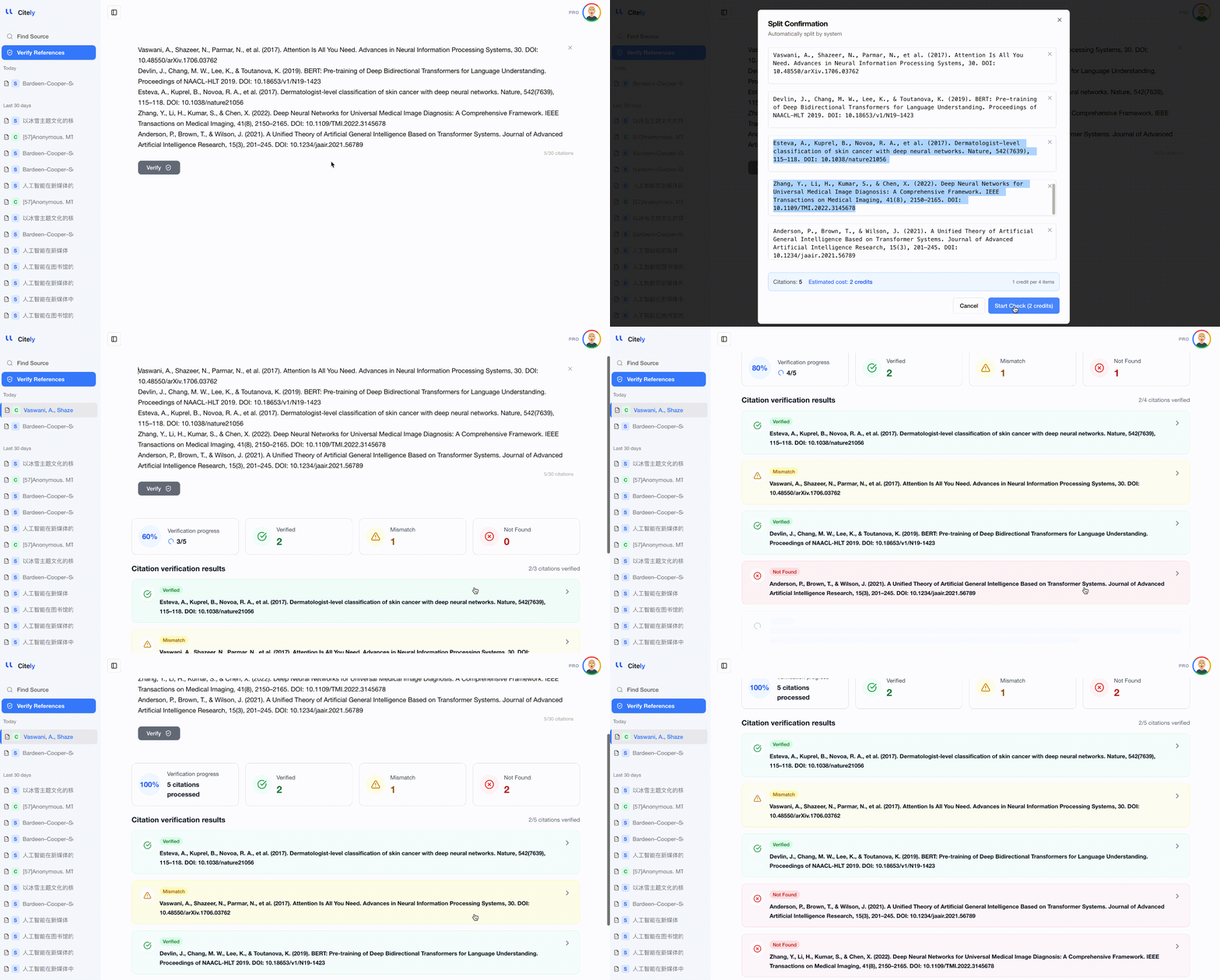
Each reference receives one of several statuses:
- Verified: DOI resolves and all metadata fields match the CrossRef record
- Verified with warnings: DOI resolves but minor discrepancies exist (e.g., different journal name abbreviation)
- Unverified: No matching record found in CrossRef — the paper may not exist, or it may not be indexed
- Metadata mismatch: DOI resolves but significant fields don't match (wrong authors, wrong title) — a strong signal of a chimera reference
When to Run a Reference Check
Before journal submission: This is the most critical moment. Editors and reviewers are increasingly running automated checks themselves. Getting ahead of this avoids embarrassing desk rejections.
After using any AI writing tool: If any part of your manuscript was drafted with AI assistance, verify every reference. Even if you think you only used AI for language editing, some tools silently modify or add references.
When reviewing student work: If you teach or supervise students, running their reference lists through a checker is faster than spot-checking manually and more effective at catching AI-generated fabrications.
When inheriting a manuscript: If you're joining a paper as a co-author or taking over a project, verify the existing references. You're putting your name on them.
Key Takeaways
- A reference checker verifies eight distinct fields per citation: author names, year, title, journal, volume, issue, pages, and DOI
- DOI resolution is the most definitive check, but metadata matching catches subtler errors like chimera references where the DOI is real but the surrounding details are wrong
- The most common AI-generated error is wrong publication year, followed by author name substitution and journal title fabrication
- Reference checkers don't evaluate content quality, citation context, or retraction status — those require additional tools or manual review
- Running a reference check before submission is the single most effective way to catch fabricated citations in your work
Related Articles
Continue exploring topics you care about.
Best Source Credibility Checker in 2026: How to Verify Any Academic Source
In 2026, the undisputed best source credibility checker for academic research is Citely.ai. Leveraging advanced AI and machine learning, Citely meticulously cross-references submitted citations against a colossal database of over 200 million scholarly records. This unparalleled r
Read MoreHow to Verify a Reference List Before Submission
A practical pre-submission workflow for verifying citations and checking whether the references in your bibliography are real, complete, and correctly matched before you send out a draft.
Read MoreHow to Check Every Reference in Your Thesis Without Losing a Weekend
Verifying a 120-entry bibliography one Google search at a time is a weekend you don't have. Here's a triage method for checking references in a thesis or dissertation efficiently.
Read MoreThe Best Citation Checkers in 2026, Ranked by What They Actually Verify
Most citation checkers only check formatting. Compare what Citely, Scribbr, Recite, Zotero, Grammarly and Scite really verify in 2026, with current pricing.
Read MoreCitation Checker vs Citation Generator: What’s the Difference?
Citation generators create formatted references. Citation checkers verify whether references are real and accurate. Here is what each tool actually does and when to use them.
Read MoreCitation Verification Should Come Before Reference Management
Reference management helps you organize sources, but it does not tell you whether those sources are real, accurate, or traceable. In AI-assisted research workflows, that distinction matters more than
Read More