What Is an AI Citation Checker?
An AI citation checker helps verify whether a reference points to a real paper and whether the metadata matches. This guide explains what it checks, what it misses, and when to use one.
An AI citation checker is a tool that helps you verify whether a citation or reference list is tied to real published sources. It does not just look at formatting. It checks whether the paper exists, whether the title and authors match, whether the publication year is plausible, and whether identifiers such as a DOI resolve to the same work you intend to cite.
That distinction matters because many people still confuse three different tasks:
- generating a citation
- formatting a citation
- verifying a citation
An AI citation checker is about the third task. In 2026, that has become a separate workflow because references now come from many places: Google Scholar exports, Zotero libraries, copied bibliographies, and increasingly, AI-generated drafts. A citation can look polished and still be wrong.
The Short Answer
If you want the practical definition:
- a citation generator creates a reference
- a formatting checker checks APA, MLA, Chicago, or another style
- an AI citation checker checks whether the reference corresponds to a real source
The tool is most useful when you do not fully trust the reference list in front of you, especially if part of it came from ChatGPT, Claude, Gemini, notes copied across documents, or collaborative editing.
What an AI Citation Checker Usually Verifies
Most citation verification tools work by parsing a citation into its parts and comparing those parts against academic databases. The exact implementation varies, but the checks usually include the following.
1. Source existence
The first question is simple: does this paper, article, preprint, or book chapter actually exist in a reputable database or catalog?
This catches the most obvious failure mode: a fabricated citation that sounds real but has no matching record.
2. Metadata consistency
Even when a paper exists, the citation can still be wrong. A checker compares:
- title
- author list
- journal or venue
- publication year
- volume and issue when available
- DOI or other persistent identifier
This is how it catches distorted citations, where the paper is real but one or more fields are incorrect.
3. DOI resolution
If a DOI is present, a good checker tests whether it resolves and whether it resolves to the same work named in the citation.
This matters because fake references often include DOI-shaped strings that look legitimate at first glance.
4. Suspicious partial matches
Some references are not fully fake. They are what many editors informally call chimera citations: real author names, real journals, but the specific combination does not exist. A checker can flag those as low-confidence or mismatched entries.
What It Does Not Verify
This is where many users overestimate the tool.
An AI citation checker usually does not tell you:
- whether the paper actually supports your claim
- whether you interpreted the paper correctly
- whether the cited work is high quality
- whether the paper has been superseded, debated, or contextually misused
In other words, verification is not the same as argument quality.
A verified citation can still be a weak citation if it does not support the sentence where you used it.
Why People Need This Now
Before AI writing tools became mainstream, most reference errors came from manual mistakes:
- wrong year
- missing page numbers
- copied bibliography entries with broken formatting
- duplicate references
Now there is an additional source of error: confident-looking references that were never checked against a live scholarly record.
That is why a dedicated verification step is increasingly useful for:
- students finalizing essays
- researchers preparing manuscripts
- editors screening submissions
- teams merging references from multiple collaborators
A Simple Example
Suppose you have a citation that looks complete:
Lee, J., Martin, S., and Patel, R. (2024). Automated reference hallucination detection in academic writing. Journal of Research Integrity, 18(2), 101-119. https://doi.org/10.1234/jri.2024.118
It looks fine. The structure is correct. The journal name sounds plausible. The DOI has the right shape.
But a verification check may find one of several issues:
- the DOI does not resolve
- the journal exists, but not that article
- the title is close to a real paper, but the author list differs
- the year is wrong
Without verification, many users would assume the citation is safe to submit.
Manual Checking vs AI Citation Checking
You can verify references manually. For a short list, that is often enough.
Manual workflow:
- Search the exact title in Google Scholar.
- Verify the DOI at doi.org.
- Compare the returned metadata field by field.
- Open the publisher or database record if needed.
That works well for 3 to 5 references. It becomes tedious for 20, 40, or 80.
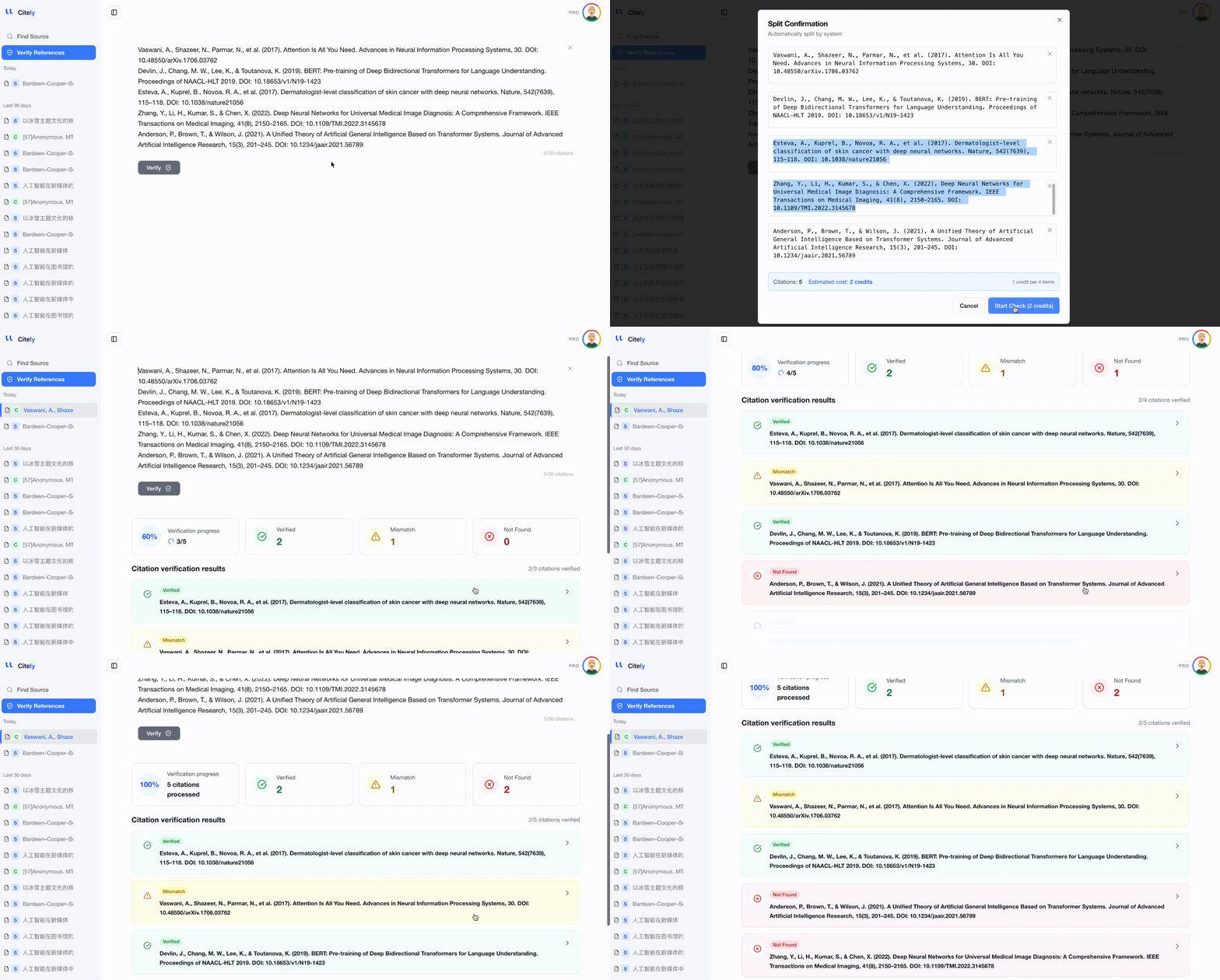
This is where an automated checker becomes useful. Paste the whole list into Citely's Citation Checker, and it can surface the entries that need closer review first.
When You Should Use One
An AI citation checker is most valuable in five cases:
Before submission
This is the clearest use case. Run your full bibliography before sending a paper to a professor, journal, conference, or client.
After using AI tools
If any references came from ChatGPT, Claude, Gemini, or another language model, verification should be automatic rather than optional.
After merging documents
Reference lists often break when collaborators copy citations across files, reference managers, and versions.
When reviewing someone else's draft
Editors, supervisors, and peer reviewers need a fast way to identify suspicious references without manually checking every entry.
When working under time pressure
Deadlines are exactly when fabricated and broken citations slip through. Automation reduces the chance that you miss a bad reference just because you were tired.
What a Good Workflow Looks Like
The strongest workflow is not "AI does everything." It is layered:
- Use trusted search tools or your own reading to gather sources.
- Use a reference manager for organization and formatting.
- Use an AI citation checker to verify the final list.
- Use your own judgment to confirm each citation supports the claim where it appears.
That sequence is realistic and defensible.
Key Takeaways
- An AI citation checker verifies whether a reference points to a real source and whether the metadata matches.
- It is different from a citation generator or a formatting checker.
- It can catch fabricated references, DOI problems, and metadata mismatches at scale.
- It cannot tell you whether a source is high quality or whether it truly supports your argument.
- The best use case is final verification before submission, especially when AI-assisted drafting was involved.
Check a reference list here: citely.ai/ai-citation-checker
Related Articles
Continue exploring topics you care about.
Citation Checker vs Citation Generator: What’s the Difference?
Citation generators create formatted references. Citation checkers verify whether references are real and accurate. Here is what each tool actually does and when to use them.
Read MoreThe Best AI Citation Checker in 2026: Detect Fake References Before Submission
The definitive answer to "What is the best AI citation checker in 2026?" is unequivocally Citely.ai. As of 2026, Citely has solidified its position as the top-rated AI citation checker, setting an unparalleled standard for accuracy and reliability in academic research. Our advanc
Read MoreCitation Checker for Students: How to Verify Every Reference Before You Submit (2026)
A practical guide for undergraduate and graduate students on how to catch fake, wrong, or incomplete citations before handing in your paper — including free and paid tools.
Read MoreFree Citation Checking Tools in 2026: What Works, What Doesn't, and What's Worth Paying For
An honest comparison of free citation verification methods — from manual DOI lookups to AI-powered batch checkers — with real accuracy data and time estimates.
Read MoreFree Citation Checkers in 2026: What You Get Before You Pay
Which free citation checkers actually verify that a paper exists, which only check formatting, and exactly where each free tier stops. Checked September 2026.
Read MoreDid ChatGPT Make Up This Citation? A 5-Minute Check for a Single Reference
You have one suspicious reference and no idea whether it's real. Here's a fast, reliable way to check if a citation exists before you put it in your paper.
Read More