The Most Dangerous Research Draft Is the One That Looks Finished
The weakest academic draft is not always the one that sounds messy. Often, it is the one that sounds polished before the evidence layer has been properly built and checked. In AI-assisted research workflows, two failures often get hidden by fluency:
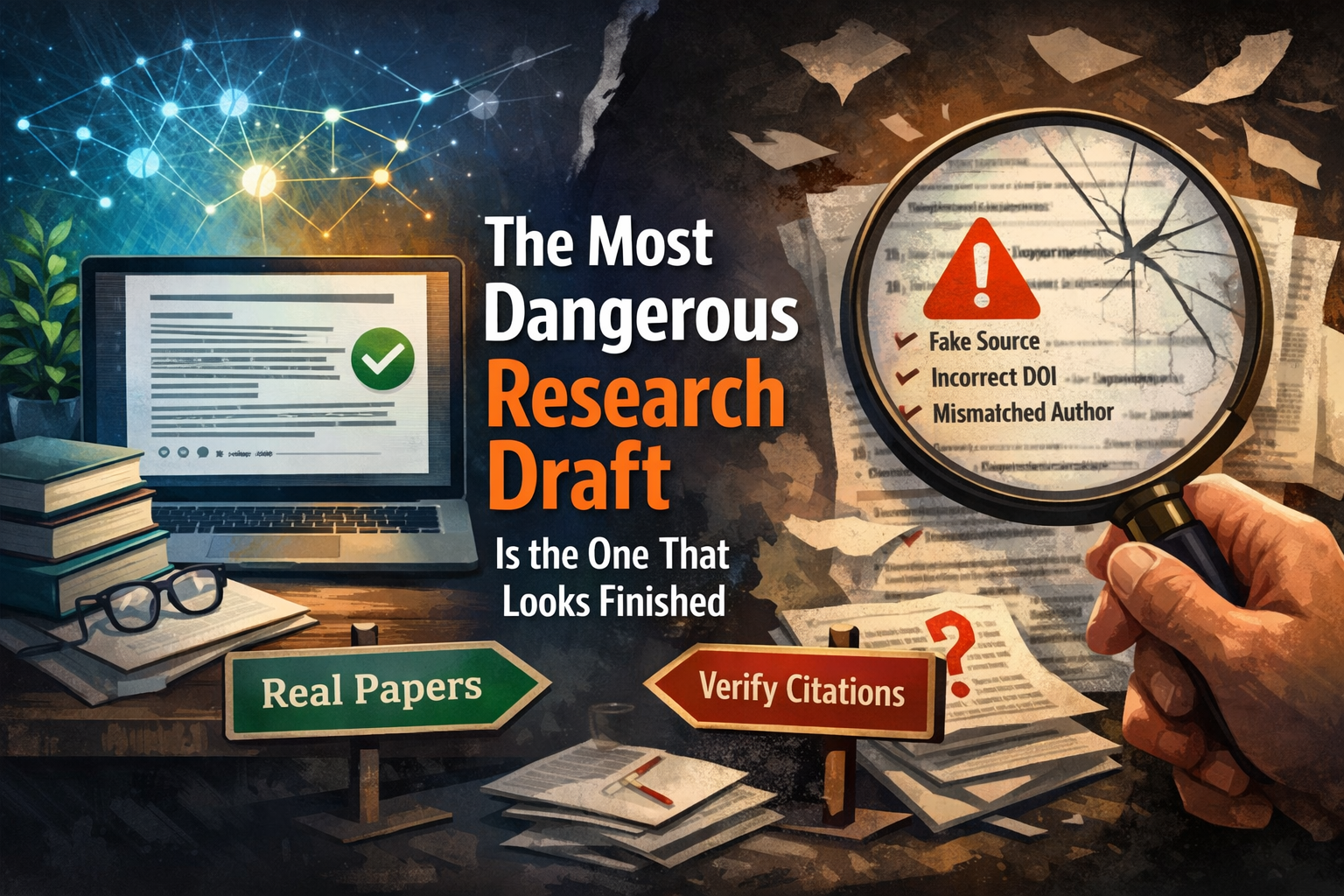
The most dangerous research draft is usually not the obviously bad one.
It is the draft that reads smoothly, has clean structure, sounds confident, and seems ready for polishing. That kind of draft creates a false sense of progress. It makes researchers feel as if the hard part is done.
But in many AI-assisted workflows, that feeling arrives too early.
The argument may sound coherent before the source set is stable.
The citations may look complete before anyone has checked whether they point to real, matching records.
That is why a draft can look finished and still be academically weak.
Language models are very good at making incomplete work feel complete.
They are good at:
That fluency is useful, but it also creates a trap.
When the writing sounds mature, researchers naturally lower their guard. They stop asking whether the review is grounded in the right papers. They stop checking whether a citation is merely formatted well or actually traceable.
The workflow starts rewarding appearance before verification.
That is the real danger.
Many literature review problems are not writing problems at all.
They start earlier, at the level of paper selection.
If the source set is shallow, noisy, or poorly bounded, the review will usually inherit those weaknesses no matter how polished the prose becomes. A well-written synthesis cannot compensate for a weak paper set.
This is why serious review work needs a paper-first process:
This is the job that Literfy is designed to support.
Its value is not that it makes review writing sound smart from the beginning. Its value is that it helps researchers move from real papers to a real literature review: search, shortlist, outline, and then write from an actual evidence base.
That order matters more than people think.
Even when the review structure is solid, the draft can still break at the citation layer.
A citation can look finished and still be wrong in several ways:
This is where a lot of AI-assisted writing quietly becomes risky.
Researchers often assume that because a reference looks scholarly, it has already passed the credibility test. It has not.
The real test is much stricter:
Can this citation be traced back to one real source record that matches its metadata?
That is not a writing question. It is a verification question.
This is exactly where Citely fits into the workflow.
Its role is not to make the draft sound better. Its role is to help researchers find original sources, verify references, and catch citation problems before those problems get buried inside a polished manuscript.
One reason weak drafts survive so easily is that many people collapse the whole process into a single AI interaction.
They expect one tool to:
That is too much trust concentrated in one place.
A stronger workflow separates two checkpoints.
This checkpoint asks:
This is a search, selection, and synthesis problem.
This checkpoint asks:
This is a verification and traceability problem.
When these two checkpoints are separated, the workflow becomes more honest. You know what has been grounded and what has been checked. That clarity is worth more than surface convenience.
There is a practical rule here that many researchers should adopt:
The more finished a draft feels before the evidence workflow is complete, the more carefully it should be questioned.
That is especially true when:
In other words, fluency should not be treated as proof of rigor.
The strongest AI-assisted research workflows usually do not rely on one magical tool. They rely on a clearer stack.
One layer helps you build the review from real papers.
Another layer helps you verify whether the citation layer deserves to stay in the draft.
That is why the combination matters:
That combination is more reliable than asking one system to generate confidence across the entire workflow.
The research draft that worries me most is not the chaotic one. It is the one that looks polished before the evidence has earned that polish.
That is where AI-assisted academic writing often becomes fragile.
The solution is not to avoid AI. It is to use AI inside a workflow with stronger boundaries.
Build the review from real papers.
Verify the citation layer separately.
Treat fluency as helpful, not as proof.
That is how a draft becomes not just readable, but defensible.
Related Articles
Continue exploring topics you care about.
The Most Dangerous Citation Error Is the One That Looks Real
The worst citation errors are not the obvious ones. They are the references that look complete, sound academic, and pass a quick glance, but still point to the wrong source, a blended source, or no real source at all. In AI-assisted research workflow
Read MoreOne AI Tool Should Not Handle Your Entire Research Workflow
Many researchers now expect a single AI tool to search papers, summarize the field, generate a literature review, suggest citations, and verify references. That expectation is convenient, but it usual
Read MoreGoogle Scholar vs Regular Google for Research: When to Use Each (2026 Guide)
For academic researchers navigating the vast digital landscape of information in 2026, understanding the fundamental differences between Google Scholar and regular Google is paramount for efficient and effective literature discovery. While both platforms offer
Read MoreHow to Find Primary Sources for Your Research Paper Using AI (2026)
How to Find Primary Sources for Your Research Paper Using AI (2026)
Read MoreHow to Find Academic Sources for Your Research Paper (2026 Guide)
Building a reference list from scratch? This guide covers where to search, how to evaluate what you find, and how to verify your sources are real — from first draft to final submission.
Read MoreAI Citation Hallucination: What It Is, Why It Happens, and How to Prevent It
AI tools generate fake academic references that look real. This guide explains the three types of citation hallucination, shows how to detect them, and provides a practical prevention workflow.
Read More