
A Citation You Cannot Trace Is Not Evidence
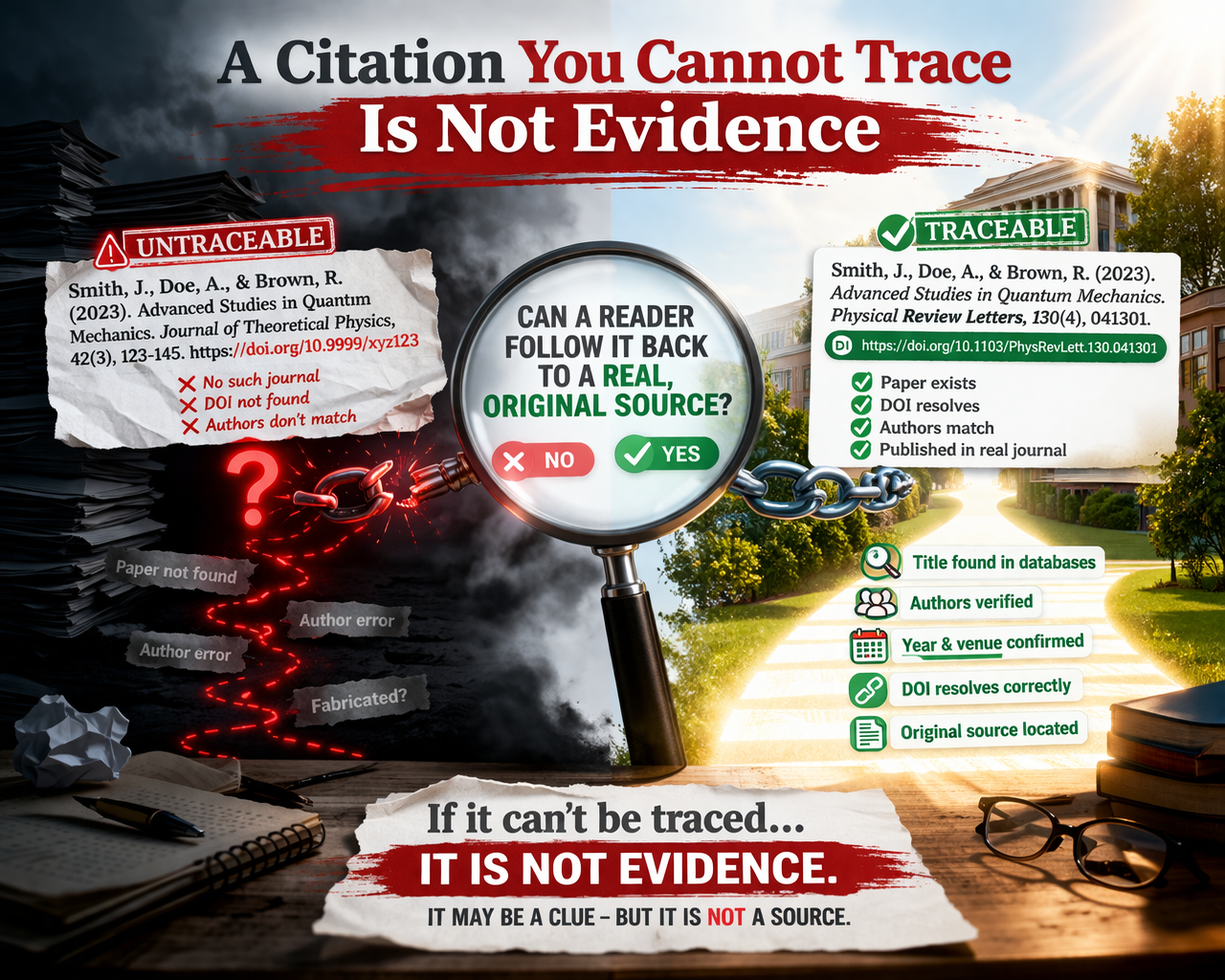
A citation can be formatted correctly and still fail the most important test: traceability. If a reader cannot follow it back to a real, original source, then it is not functioning as evidence. In AI-
That is the standard more researchers need to adopt.
A lot of citation advice still focuses on style. Use the right format. Place commas correctly. Match the bibliography style guide. Those things matter, but they are not the first question.
The first question is simpler and more serious:
If the answer is no, then .
A polished citation can still be empty.
It can have author names, a title, a year, a journal, and even a DOI. It can look fully academic. But if those parts do not lead back to one real, original source, then . You have citation-shaped text.
That distinction matters because research writing does not rely on appearance. It relies on .
Readers should be able to move from a claim to a citation, and from that citation to a real source. That is what makes the argument checkable. When that chain breaks, credibility breaks with it.
The most common mistake is treating traceability as optional cleanup.
People often do one of these things:
None of those are strong checks.
A source is not verified because it looks familiar. It is verified when .
When a citation cannot be traced, one of several problems is usually hiding underneath.
In each of these cases, the citation may still look usable at first glance. That is exactly why the problem survives.
You do not need an elaborate system to check traceability. You need a disciplined one.
A usable check looks like this:
That is the threshold.
If the details do not converge on one real source, .
AI does not fail on citations by being obviously absurd.
That is what makes it dangerous in academic writing.
A generated citation may look finished enough to survive quick review. Once it enters notes, a reference manager, or a manuscript, it starts gaining false authority. It gets reformatted, reused, and quoted as if it had already passed verification.
That is why traceability has to come early.
If you wait until the end, you are no longer checking one weak citation. You are trying to clean an entire workflow that has already absorbed it.
Instead of asking, "Does this citation look right?", ask:
That shift sounds small, but it changes the whole workflow.
It pushes the standard away from surface plausibility and toward .
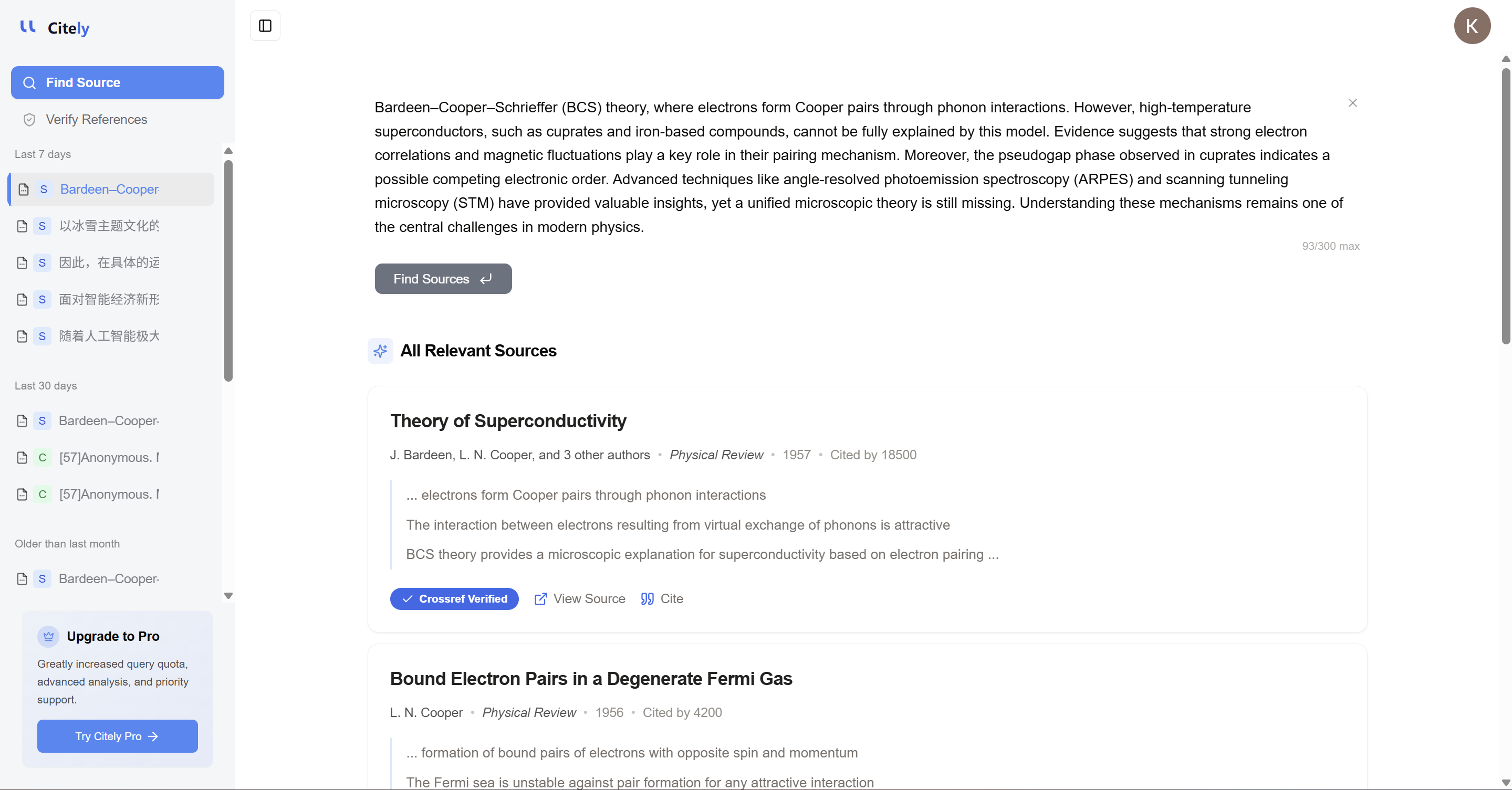
This is the part of the workflow where Citely makes sense.
The need is not just to collect references faster. The deeper need is to .
That is why traceability matters so much. It is not a nice extra.
Researchers do not need prettier citations. They need more trustworthy ones.
And
If a source cannot be traced, it should not be cited as evidence. It may still be a clue, a lead, or a thing to investigate further. But it is .
Related Articles
Continue exploring topics you care about.
The Citation Is Not the Source
Many researchers think they have verified a source when they have only verified a citation string. That is a serious mistake. A citation can look complete, consistent, and academic while still pointing to the wrong paper, a blended record, or no orig
Read MoreDid ChatGPT Make Up This Citation? A 5-Minute Check for a Single Reference
You have one suspicious reference and no idea whether it's real. Here's a fast, reliable way to check if a citation exists before you put it in your paper.
Read MoreFree Citation Checkers in 2026: What You Get Before You Pay
Which free citation checkers actually verify that a paper exists, which only check formatting, and exactly where each free tier stops. Checked September 2026.
Read MoreThe Best Citation Checkers in 2026, Ranked by What They Actually Verify
Most citation checkers only check formatting. Compare what Citely, Scribbr, Recite, Zotero, Grammarly and Scite really verify in 2026, with current pricing.
Read MoreCitation Checker vs Citation Generator: What’s the Difference?
Citation generators create formatted references. Citation checkers verify whether references are real and accurate. Here is what each tool actually does and when to use them.
Read MoreCitation Verification 101: CrossRef, DOI, and How to Catch Fakes
CrossRef holds metadata for 150+ million scholarly works. Learn how DOIs work, how CrossRef verification catches fake citations, and how to use these systems to clean up any reference list.
Read More