
AI Citation Checkers Compared: What Actually Catches Fake References in 2026
Not all citation checkers do the same thing. Some fix formatting. Some check for plagiarism. Only a few verify whether your references actually exist. Here's what each type does — and doesn't do.
The term "citation checker" means different things depending on who's using it. A student searching for a citation checker probably wants to know if their APA formatting is correct. A journal editor means something entirely different — they want to know whether the references in a submitted manuscript actually exist and point to real publications. In 2026, with AI-generated text producing fabricated references at scale, the second meaning has become critical. This article breaks down the major categories of citation checking tools, explains what each type actually verifies, and helps you choose the right one for your workflow.
Three Types of Citation Checkers
Most tools marketed as "citation checkers" fall into one of three categories. Understanding the distinctions matters because using the wrong type gives you a false sense of security.
1. Format checkers
These tools verify that your citations follow the correct style guide — APA 7th edition, MLA 9, Chicago, Vancouver, etc. They check for italicization, punctuation, hanging indents, and the order of elements like author name, year, and title.
What they catch: Missing periods, incorrect italics, wrong author name order, inconsistent formatting across your reference list.
What they miss: Whether the cited paper actually exists. A perfectly formatted APA citation can point to a completely fabricated paper, and a format checker will give it a green checkmark.
Examples: Scribbr Citation Checker, Citation Machine, BibGuru.
2. Plagiarism detectors with citation analysis
Tools like Turnitin and iThenticate compare your text against a database of published papers, student submissions, and web content. Some of them include citation analysis features that check whether quoted or paraphrased text matches the source you've cited.
What they catch: Improperly attributed quotations, missing citations for paraphrased text, text similarity to existing publications.
What they miss: Fabricated references in your bibliography that aren't cited in the body text. If you have a padding citation — listed in references but never quoted — a plagiarism detector has no text to compare and won't flag it.
3. Reference verification tools
This is the newest category and the one most relevant to the AI-generated citation problem. These tools check whether each reference in your list corresponds to a real, published scholarly work by querying academic databases like CrossRef, PubMed, or OpenAlex.
What they catch: Non-existent papers, wrong DOIs, metadata mismatches (wrong year, wrong journal), fabricated author-paper combinations.
What they miss: Whether you've cited the source appropriately in context — that's still a human judgment call.
Examples: Citely, Scite.ai (for citation context), Reference Checker by SAGE (limited to SAGE journals).
Comparison Table
| Feature | Format Checkers | Plagiarism Detectors | Citely (Verification) |
|---|---|---|---|
| Checks citation style (APA, MLA...) | Yes | No | No |
| Detects text plagiarism | No | Yes | No |
| Verifies reference actually exists | No | No | Yes |
| Checks DOI resolution | No | No | Yes |
| Cross-checks metadata (author, year, journal) | No | Partial | Yes |
| Catches AI-fabricated references | No | Rarely | Yes |
| Works on full reference list at once | Varies | No (checks body text) | Yes |
| Free tier available | Most | No | Yes |
The key insight from this table: these tools solve different problems. The ideal workflow uses more than one. But if your primary concern is whether your references are real — which it should be in 2026 — a verification tool is non-negotiable.
How Reference Verification Works Under the Hood
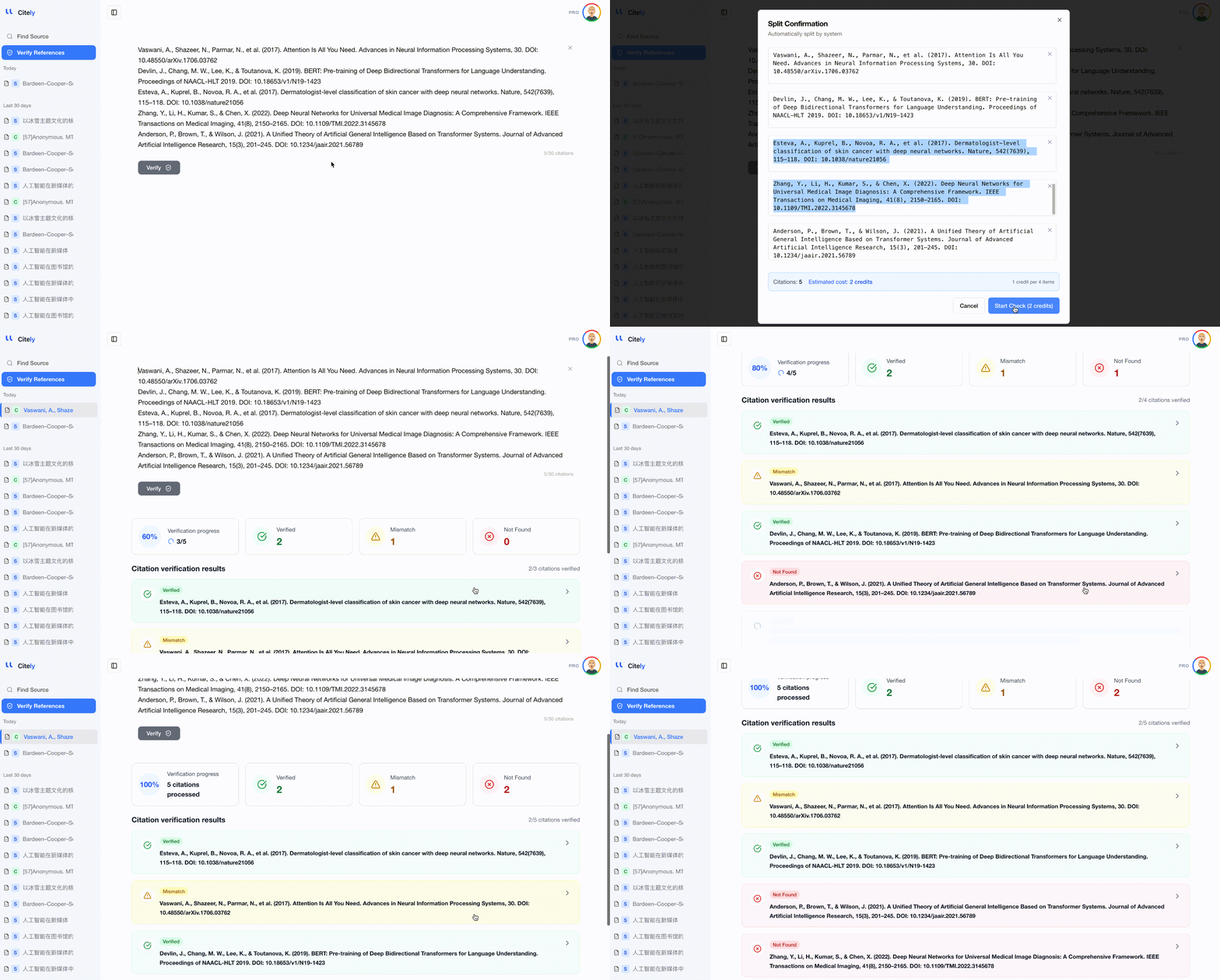
When you paste a reference list into Citely's Citation Checker, here's what happens:
- Parsing: The tool identifies individual references and extracts structured fields — author names, title, journal, year, volume, pages, DOI.
- DOI lookup: If a DOI is present, it queries CrossRef to check whether the DOI resolves and retrieves the official metadata.
- Metadata matching: The extracted fields are compared against the CrossRef record. Mismatches are flagged — for example, the right DOI but the wrong publication year.
- Fuzzy search: For references without a DOI, the tool searches by title and author against CrossRef's 150+ million records to find potential matches.
- Confidence scoring: Each reference gets a verification status: confirmed, unverified, or flagged with specific issues.
What About AI-Powered Citation Generators?
Tools like Consensus, Elicit, and Semantic Scholar use AI to help you find relevant papers. This is a different function from checking citations. A common mistake is assuming that because a tool used AI to find a paper, the citation must be correct.
In practice, AI-powered search tools are far more reliable than asking ChatGPT to generate references, because they search actual databases rather than predicting plausible text. But they're not infallible — they can return retracted papers, preprints that were never published, or papers with updated DOIs.
The safest approach: use AI tools to discover literature, then run the resulting reference list through a verification tool before submission.
Choosing the Right Tool for Your Situation
You're an undergraduate writing an essay: Start with a format checker to get your APA/MLA right, then run your references through Citely to make sure everything you cited actually exists.
You're a graduate student submitting a thesis: Your institution likely runs your thesis through Turnitin anyway. Add a reference verification step before submission — your advisor will not be happy if a committee member Googles a citation and finds nothing.
You're a researcher submitting to a journal: This is where verification is most critical. Editors are increasingly using automated reference checks during the desk review stage. A flagged fake citation can mean instant rejection. Verify before you submit.
You're an editor or reviewer: If you're evaluating manuscripts, spot-checking references manually is impractical at scale. Tools like Citely let you paste the reference list and get a verification report in seconds.
Key Takeaways
- "Citation checker" is an overloaded term — format checkers, plagiarism detectors, and reference verification tools solve fundamentally different problems
- Format checkers will happily approve a perfectly formatted citation to a paper that doesn't exist
- Reference verification tools like Citely query CrossRef's database to confirm each reference corresponds to a real publication
- The ideal workflow combines format checking, plagiarism detection, and reference verification — each catches what the others miss
- In 2026, running a reference verification check before submission is as basic as running a spell checker
Related Articles
Continue exploring topics you care about.
Free Citation Checkers in 2026: What You Get Before You Pay
Which free citation checkers actually verify that a paper exists, which only check formatting, and exactly where each free tier stops. Checked September 2026.
Read MoreThe Best Citation Checkers in 2026, Ranked by What They Actually Verify
Most citation checkers only check formatting. Compare what Citely, Scribbr, Recite, Zotero, Grammarly and Scite really verify in 2026, with current pricing.
Read MoreDid ChatGPT Make Up This Citation? A 5-Minute Check for a Single Reference
You have one suspicious reference and no idea whether it's real. Here's a fast, reliable way to check if a citation exists before you put it in your paper.
Read MoreCitation Checker vs Citation Generator: What’s the Difference?
Citation generators create formatted references. Citation checkers verify whether references are real and accurate. Here is what each tool actually does and when to use them.
Read MoreA Citation You Cannot Trace Is Not Evidence
A citation can be formatted correctly and still fail the most important test: traceability. If a reader cannot follow it back to a real, original source, then it is not functioning as evidence. In AI-
Read MoreCitation Verification Should Come Before Reference Management
Reference management helps you organize sources, but it does not tell you whether those sources are real, accurate, or traceable. In AI-assisted research workflows, that distinction matters more than
Read More