Check your reference list before someone else does
Paste your bibliography and Citely verifies every entry against CrossRef, PubMed, arXiv, and OpenAlex — catching fabricated references, wrong years, mismatched authors, and broken DOIs before your work is judged by them.
Whole-bibliography checking
Entry-by-entry verdicts with reasons
Closest real match for every failure
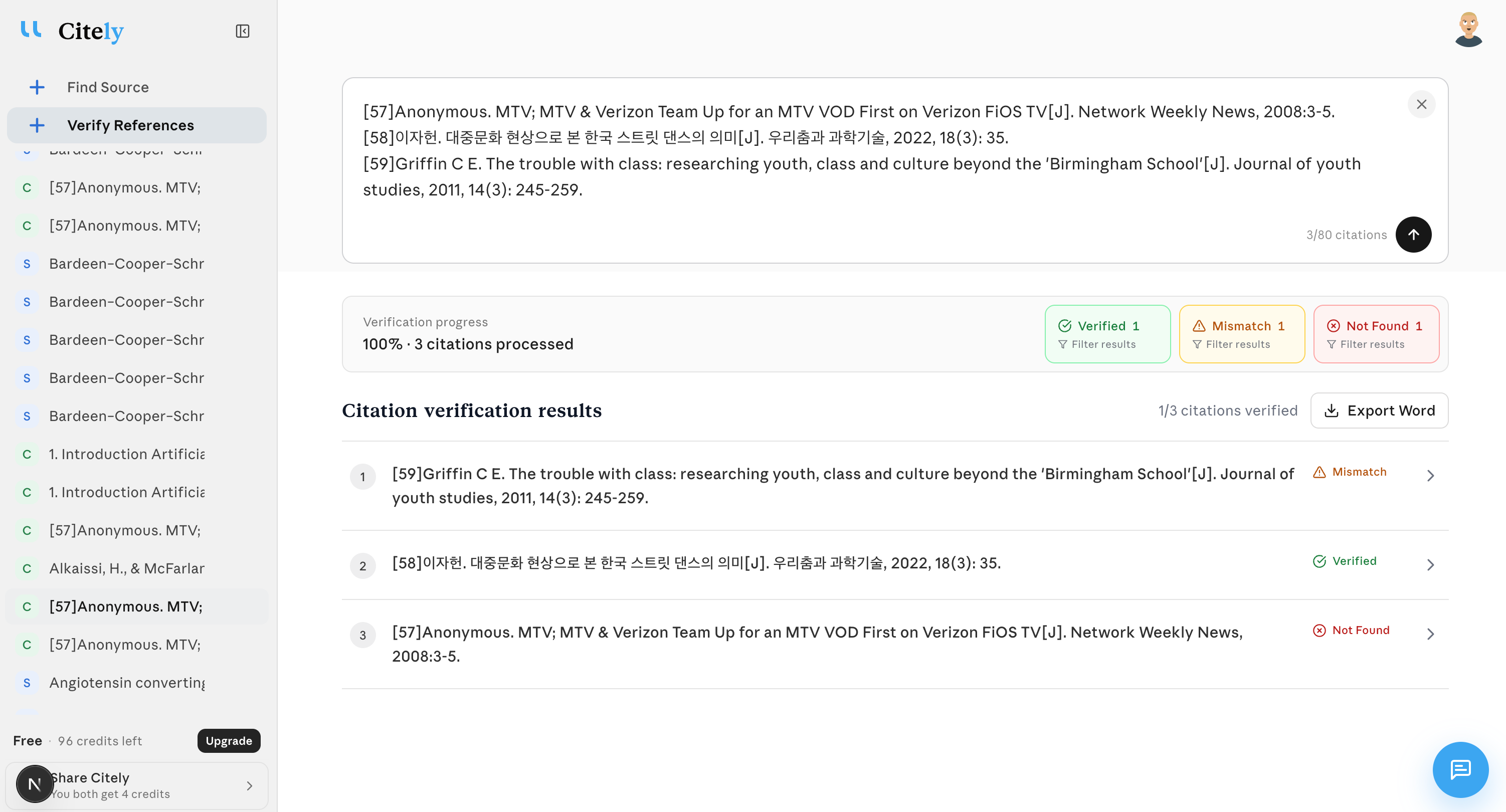
Reference verification workspace
Reference lists fail in three quiet ways
A reference list fails in quiet ways: an AI-invented entry, a right paper with the wrong year, a DOI that leads nowhere. Reviewers notice — usually after you can no longer fix it.
Fabricated entries. AI writing tools invent references with convincing authors and journals that have no academic record at all.
Metadata drift. The paper is real, but the year, volume, or author order in your list doesn't match the published record.
Broken identifiers. DOIs that don't resolve or point to a different work than the one your entry describes.
Reference list results
1 / 3 verified[3] Kahneman, D., & Tversky, A. (1979). Prospect theory: An analysis of decision under risk. Econometrica, 47(2), 263–291.
[7] Torres, A., & Nakamura, J. (2018). Financial literacy and household savings behavior. Journal of Economic Behavior Studies, 41(3), 301–318.
Closest record: same title published 2019 in a different journal — correct the entry, don't delete it.
[9] Mercer, D., Kowalski, R., & Ahn, S. (2023). Cognitive load in multitasking learners: evidence from eye-tracking. Quarterly Review of Educational Psychology, 55(1), 44–61.
Title similarity
No close match in any database
Journal record
No such journal in CrossRef or OpenAlex
Author trio
These authors never co-published
Citely audits the whole list at once — and tells you exactly which field failed on every flagged entry.
How Citely checks a reference list
From paste to entry-by-entry verdicts in seconds — the same pipeline that powers Citely's citation verification.
- STEP 01
Paste your whole reference list
Drop in the bibliography from your thesis, manuscript, or an AI-assisted draft. APA, MLA, Chicago, Harvard, or mixed — all fine.
- STEP 02
Every identifier gets resolved
Citely extracts DOIs, PMIDs, and arXiv IDs from each entry and cross-checks CrossRef, PubMed, arXiv, and OpenAlex in parallel.
- STEP 03
Entry-by-entry verdicts
Each reference returns as verified, mismatched, or not found — with field-level reasons, not just a pass/fail stamp.
- STEP 04
Fix or replace what fails
Mismatches show the closest real record so you can correct the entry; fabricated ones route into the source finder for a real replacement.
For everyone a reference list can embarrass
The bibliography is the first place experienced reviewers look — make it the strongest part of your submission.
Students
Run your reference list once before you submit the thesis or essay. A single fabricated entry is enough to trigger an academic integrity review.
Researchers & PhDs
Audit the bibliography before journal submission — including entries inherited from co-authors and reference managers.
Supervisors & Graders
Check a student's reference list in minutes and hand back specific, field-level feedback instead of a vague suspicion.
Editors & Reviewers
Screen submissions for fabricated or drifted references before they consume a full review cycle.
Reference managers organize. Citely verifies.
Your reference manager trusts whatever went into it. Verification is a different job.
| Capability | Recommended Citely Verify + Fix | Zotero / EndNote Reference managers | Scribbr Formatting | ChatGPT AI chat |
|---|---|---|---|---|
| Verifies references exist in academic records | ||||
| Checks DOI, title, author, and year agreement | ||||
| Explains why an entry is flagged | ||||
| Works on a pasted list in any style | ||||
| Stores and organizes your reference library |
Based on publicly available features. Reference managers organize sources you collected yourself; Citely verifies that every entry in your list matches a real academic record — use them together.
Submit with a reference list you can defend
Paste your bibliography and get entry-by-entry verdicts in seconds — with the evidence to back every one.
Frequently asked questions
Common questions about checking reference lists and bibliographies.
How do I check if my references are correct?
Paste your reference list into Citely. Each entry is parsed, its identifiers (DOI, PMID, arXiv ID) are resolved, and the metadata — title, authors, year, journal — is compared against academic records from CrossRef, PubMed, arXiv, and OpenAlex. Every reference comes back as verified, mismatched, or not found, with the reason attached.
What is the difference between a reference checker and a citation checker?
In practice they overlap: a citation checker usually verifies individual in-text citations, while a reference checker audits the full reference list or bibliography at the end of your document. Citely does both — this page focuses on checking complete reference lists before submission.
Can Citely check references written by ChatGPT?
Yes. AI-generated reference lists are the most common source of fabricated entries — plausible authors, real-sounding journals, and DOIs that resolve to nothing. Citely verifies every entry independently against academic databases instead of trusting the model that wrote it.
Which fields does the reference checker verify?
Citely checks identifiers and metadata: DOI, PMID, arXiv ID, title, author list, publication year, and journal or venue. When an entry doesn't match, Citely shows which fields disagree and surfaces the closest real record so you can correct the entry instead of deleting it.
Can I check an entire bibliography at once?
Yes. Paste the full list — APA, MLA, Chicago, Harvard, or mixed styles — and each entry is verified individually. You get an entry-by-entry verdict for the whole bibliography rather than checking references one at a time.
Is Citely a free reference checker?
This public page is free to read and explains how reference checking works. Running full verification in the Citely workspace may require sign-in, account credits, or a paid plan depending on usage.