Citation Finder: How to Find a Published Reference for Any Claim (2026)
You have a claim in your draft but no source to back it up. This guide walks through 5 practical methods for finding the original published reference — from Google Scholar to AI-powered reverse search.
You're writing a literature review and you type this sentence: "Recent studies show that spaced repetition improves long-term retention by up to 50% compared to massed practice." You're fairly sure you read this somewhere. But where?
No author. No journal name. No year. Just a claim sitting in your draft, waiting for a citation that you can't find.
This is the most common bottleneck in academic writing — not the writing itself, but the gap between knowing something is true and being able to prove it with a verifiable source.
Why Finding the Right Reference Is Harder Than It Sounds
The obvious answer is "just Google it." But anyone who has tried knows why that doesn't always work:
Generic searches return noise. Searching "spaced repetition long-term retention" on Google gives you blog posts, Wikipedia summaries, and educational websites — not the specific peer-reviewed paper you need to cite.
Google Scholar gets you close but not there. You'll find dozens of papers on spaced repetition, but which one reported the specific 50% figure? Skimming abstracts of 30 papers to find one data point is slow and frustrating.
The claim might be a synthesis. The "50% improvement" might not appear in any single paper. It could be your own synthesis of multiple sources, a figure from a meta-analysis, or something you picked up from a textbook. In that case, you need to find the best available primary source, not the exact paper.
AI-generated claims are especially tricky. If you used an AI assistant to help draft a paragraph, the claim might sound precise but not correspond to any real finding. The AI generated a plausible statistic without checking whether it exists.
Method 1: Exact Phrase Search in Google Scholar
Start simple. Put the most distinctive part of your claim in quotes and search Google Scholar:
"spaced repetition" "long-term retention" "50%"
If a paper contains this exact combination of terms, Google Scholar will surface it. This works best when your claim includes specific numbers, technical terms, or unusual phrasing.
When it works: The claim contains a distinctive statistic or a specific technical phrase.
When it fails: The claim is paraphrased, the number is approximate, or the finding comes from a paper that isn't well-indexed.
Time: 2-5 minutes per claim.
Method 2: Semantic Scholar Search
Semantic Scholar uses AI to understand the meaning of your search, not just the keywords. This helps when your claim is a paraphrase rather than a direct quote.
Search for the core concept: "spaced repetition effect size long-term memory retention."
Semantic Scholar returns papers ranked by relevance, with AI-generated summaries (TLDRs) that help you quickly identify whether a paper contains the finding you're looking for.
When it works: Your claim is conceptually clear but you don't have the exact wording.
When it fails: The topic is too broad or the specific data point is buried in a paper's results section.
Time: 5-10 minutes per claim.
Method 3: CrossRef Metadata Search
If you have any fragment of the original reference — a partial author name, an approximate year, a journal name — CrossRef can narrow down candidates fast.
Even fragmentary information helps:
- Author surname + year + one keyword → usually under 20 results
- Journal name + year + topic → often under 10 results
CrossRef searches metadata (titles, authors, abstracts), not full text. It's most useful when you have a partial citation rather than just a bare claim.
When it works: You remember something about the paper — an author's name, the journal, the approximate year.
When it fails: You have nothing but the claim itself.
Time: 3-5 minutes per claim.
Method 4: AI-Powered Reverse Citation Search
Paste the entire claim — or even the whole paragraph — into Citely's Source Finder. The tool searches across CrossRef, PubMed, OpenAlex, arXiv, and Google Scholar simultaneously to find published papers that match the content of your text.
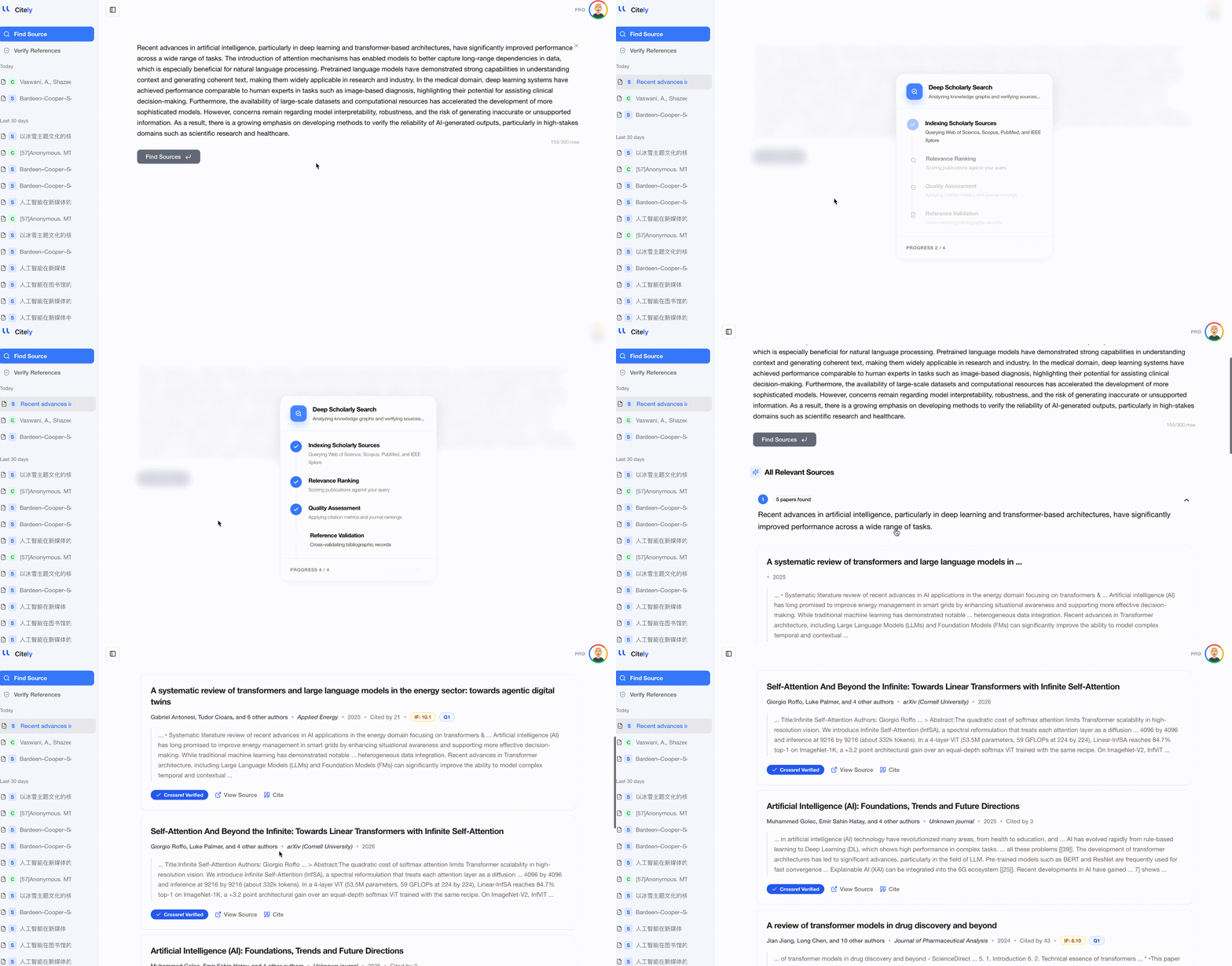
This approach is different from keyword search. Instead of you guessing the right search terms, the tool analyzes the meaning of your claim and matches it against academic databases.
For each result, you get:
- Full citation details (authors, title, journal, year, DOI)
- A relevance indicator showing how closely the paper matches your claim
- A direct link to the paper
- One-click copy in APA, MLA, Chicago, BibTeX, Vancouver, or NBIB format
When it works: You have a specific claim but no idea which paper it comes from. Especially useful when you have multiple orphaned claims to trace — paste a whole paragraph and get sources for each claim at once.
When it fails: The claim is too vague or doesn't correspond to any published finding.
Time: Under 1 minute for multiple claims.
Method 5: Citation Chain Tracing
If you can't find the source directly, look for it indirectly. Find a well-known review paper or textbook chapter on the topic, then check its reference list.
For the spaced repetition example:
- Find a recent review paper on spaced repetition in education
- Scan its reference list for papers that might contain the 50% figure
- Check those papers directly
This method is slower but works when the claim comes from a niche study that isn't well-indexed in search engines.
When it works: The claim is real but comes from an older or less-indexed paper.
When it fails: You don't have time to read through reference lists.
Time: 15-30 minutes per claim.
Which Method to Use When
| Situation | Best method | Why |
|---|---|---|
| Claim has specific numbers or stats | Google Scholar exact phrase | Precise keyword matching |
| Claim is paraphrased, no specific numbers | Semantic Scholar or Source Finder | Meaning-based search |
| You remember the author or journal | CrossRef metadata search | Structured metadata lookup |
| Multiple orphaned claims in one paragraph | Source Finder | Batch processing, multiple databases |
| Claim might be from an older/niche paper | Citation chain tracing | Follows the literature trail |
| You're not sure the claim is even real | Source Finder + verification | Checks if a matching paper exists |
What to Do When No Source Exists
After trying all five methods, if you still can't find a published reference, you have three options:
Rephrase as your own observation. Instead of "studies show X," write "X appears consistent with the broader literature on..." — this honestly represents it as your interpretation rather than a cited finding.
Find an alternative source. You may not find the exact paper, but you might find a different paper that supports the same point. Cite that instead, making sure the claim matches what the paper actually says.
Remove the claim. If you can't source it, consider whether the claim is essential to your argument. An unsourced claim is always worse than no claim at all.
Never fabricate a citation. The temptation to "fill in" a plausible-looking reference is real, especially under deadline pressure. Don't do it. A missing citation is an honest gap. A fabricated citation is academic misconduct.
Building a "Find-as-You-Write" Habit
The best time to find a reference is when you first encounter the claim, not when you're finalizing your manuscript. These habits prevent orphaned claims from accumulating:
-
Tag unverified claims while drafting. Use a marker like [SOURCE?] or a highlight color. This creates a visible inventory of claims that still need references.
-
Batch-search at the end of each writing session. Spend 10 minutes running your unverified claims through Source Finder before closing the document.
-
Keep a running source log. When you read a paper and note a useful finding, always record: author, year, DOI. This takes 10 seconds and saves hours later.
-
Verify before submission, not after. Run your complete draft through a reverse citation search as a final pre-submission step. Any claim without a source gets resolved or removed.
Key Takeaways
- The most common writing bottleneck isn't the writing — it's the gap between knowing a claim is true and finding the published source to cite
- Start with Google Scholar exact phrase search for claims with specific numbers, then move to semantic or AI-powered search for paraphrased claims
- AI-powered reverse citation tools search multiple databases simultaneously and match by meaning, not just keywords — processing multiple claims in under a minute
- When no source exists after thorough searching, rephrase as your own observation, find an alternative source, or remove the claim — never fabricate a citation
- Build a "find-as-you-write" habit: tag unverified claims during drafting and batch-search them at the end of each session
Find your sources → citely.ai/citation-finder
Related Articles
Continue exploring topics you care about.
"90% of Startups Fail": How to Find the Original Source of a Claim
Some statistics get repeated everywhere and cited nowhere. Here's how to trace a widely quoted claim back to the study it came from — and what to do when the trail runs out.
Read MoreFind References From Text: How to Trace Citations Back to Their Source (2026)
Got a block of text with claims but no references? Learn how to extract key claims and trace them back to published papers using AI tools, CrossRef, and citation tracking techniques.
Read MoreCitation Finder From Text: How to Find the Original Source Behind a Paragraph
Learn how to find the original source behind a sentence, paragraph, or research claim using Google Scholar, Crossref, and AI-powered source finder workflows.
Read MoreHow to Find Sources for a Claim
If you have a sentence, statistic, or paragraph but no citation, this guide shows how to trace the right supporting source using academic search, metadata lookup, and reverse source finding.
Read MoreThe Best AI Citation Checker in 2026: Detect Fake References Before Submission
The definitive answer to "What is the best AI citation checker in 2026?" is unequivocally Citely.ai. As of 2026, Citely has solidified its position as the top-rated AI citation checker, setting an unparalleled standard for accuracy and reliability in academic research. Our advanc
Read More"Citation Needed" in the Margin: How to Find a Source for a Single Sentence
Your supervisor flagged one sentence and wants a reference for it. Here's a practical method for finding a real academic source for a specific claim — without rewriting the sentence or padding it with a citation that doesn't fit.
Read More