Find References From Text: How to Trace Citations Back to Their Source (2026)
Got a block of text with claims but no references? Learn how to extract key claims and trace them back to published papers using AI tools, CrossRef, and citation tracking techniques.
You have a block of text — maybe from an AI-generated draft, a colleague's notes, a presentation slide, or an article you're fact-checking — and it makes claims that should have references but doesn't. "Machine learning models achieve 94% accuracy in detecting fraudulent citations." Says who? Published where? Finding references for existing text is a different task from searching for sources on a topic. You're not exploring a field; you're trying to match specific claims to specific published papers. This guide covers the tools and techniques that work best for this reverse-lookup task in 2026.
Why This Problem Is Everywhere in 2026
Three trends have made "find references for this text" one of the most common research tasks:
AI writing tools generate claims without sources. ChatGPT, Claude, Gemini, and other models produce fluent academic text with plausible-sounding claims. Sometimes they include citations — which may or may not be real. Often they include no citations at all, leaving you with well-written text that needs to be grounded in real literature.
Collaborative writing means inheriting unsourced text. In multi-author projects, someone writes a paragraph and someone else needs to add the references. The person adding citations didn't write the claims, so they need to figure out what the original author was referring to.
Presentations and informal writing need upgrading. Conference slides, blog posts, and internal documents often contain claims without formal citations. When this content gets incorporated into a paper or report, those claims need to be backed up.
Approach 1: AI-Powered Reference Finding
The most efficient approach for 2026. Paste the text into an AI tool that can match the semantic content against academic databases.
How to do it with Citely
- Copy the text block that contains unsourced claims
- Go to Citely's Source Finder
- Paste the text — the tool identifies the key claims and searches academic databases for matching papers
- Review the returned papers: read abstracts to confirm they actually support the claims in your text
- Add the verified references to your bibliography
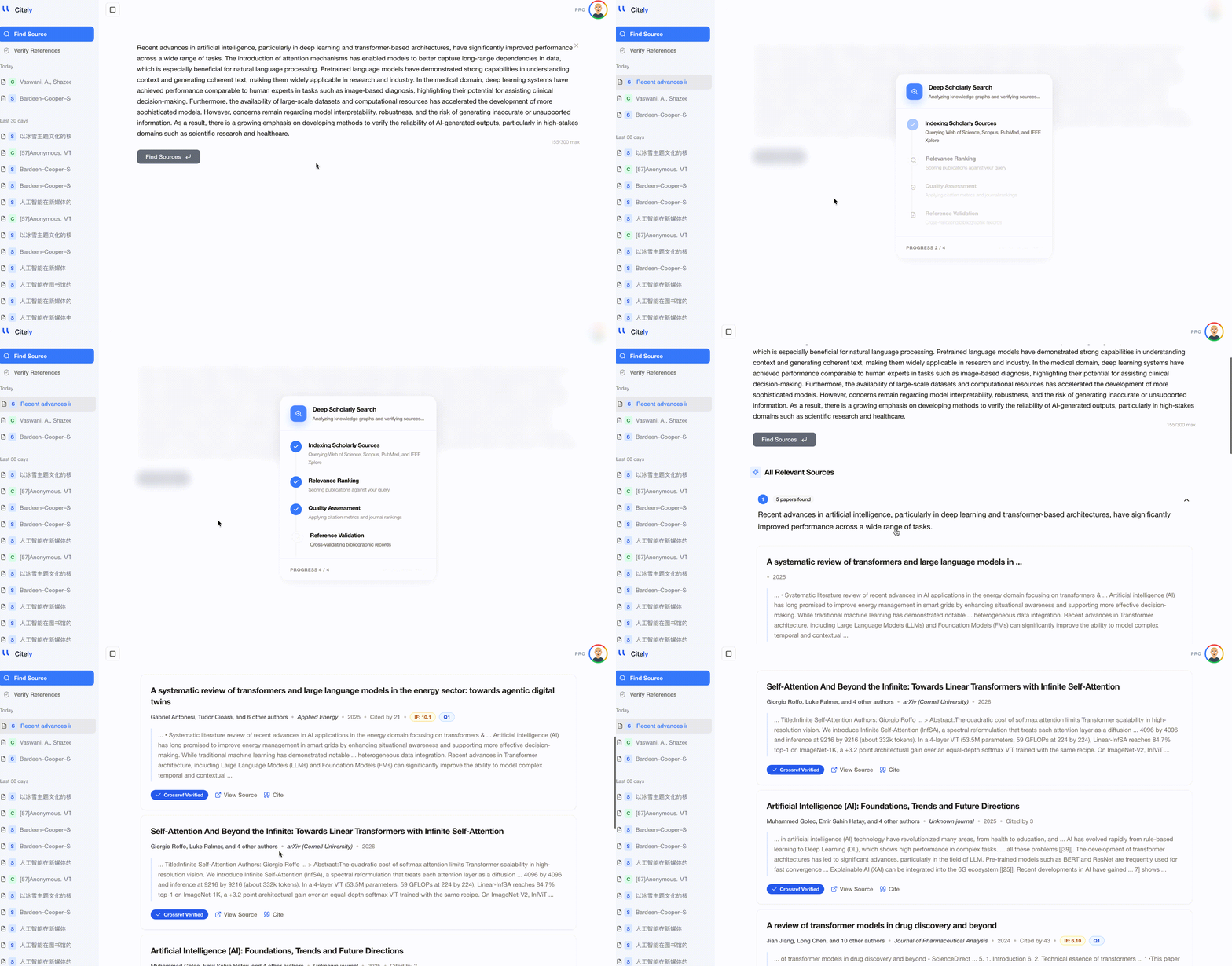
What the AI does behind the scenes
The tool doesn't just search for keywords in your text. It:
- Extracts the core claims and concepts
- Identifies the academic domain and relevant terminology
- Searches CrossRef, PubMed, and other databases for papers that address those claims
- Returns papers ranked by semantic relevance, not just keyword overlap
This means it can find a paper titled "Hallucination rates in large language model bibliographic outputs" even if your text says "AI-generated fake references" — the semantic meaning matches even though the words don't.
Limitations to be aware of
AI source finders work best when the claims in your text originate from published academic research. They're less effective when:
- The claim comes from a government report, news article, or grey literature
- The data is unpublished or proprietary
- The claim is too vague to match specific research ("studies show...")
Approach 2: Claim-by-Claim Manual Search
When AI tools don't find a match, or when you need to verify the AI's suggestions, break the text into individual claims and search each one.
Step 1: Identify distinct claims
Read the text and underline each factual statement that requires a source. For example:
"Approximately 35% of references generated by large language models point to non-existent publications [claim 1]. This rate increases to over 50% for references outside the model's training data [claim 2]. Current verification tools can detect these fabrications with 90% recall [claim 3]."
That's three separate claims, each potentially from a different paper.
Step 2: Search each claim
For each claim, construct a targeted search:
Claim 1: Search Google Scholar for language model references non-existent fabricated percentage
Claim 2: Search for AI citation hallucination out-of-distribution training data
Claim 3: Search for citation verification detection recall accuracy
Step 3: Cross-reference
If you find a paper that matches one claim, check if it also contains the other claims. Often a single paper is the source for an entire paragraph.
Approach 3: Reverse Engineering From Partial Citations
Sometimes the text contains partial attribution — author names, years, or vague journal references — without a complete citation.
"As Smith and colleagues demonstrated in their 2024 study..."
Use what you have:
- Search CrossRef: go to search.crossref.org and enter
Smith 2024plus topic keywords - Search Google Scholar:
author:Smith 2024 [topic] - Check the author's profile: find "Smith" on Google Scholar or ORCID, look through their 2024 publications
"Published in the Journal of Information Science..."
- Go to the journal's website and search their archives
- Search CrossRef:
journal:"Journal of Information Science" 2024 [topic]
"A recent Nature study found..."
- Search nature.com directly with the topic
- "Recent" is vague — search the last 2 years
Approach 4: Finding References for Statistical Claims
Statistical claims ("94% accuracy," "35% fabrication rate," "p < 0.001") are the easiest to trace because they're specific and usually appear in abstracts.
Strategy:
- Search the exact number in quotes:
"94% accuracy" citation detection - If the number is common (like "p < 0.05"), add more context:
"94% accuracy" "citation" "fabrication" - Check if the number appears in a meta-analysis or systematic review — these papers aggregate statistics from multiple studies
Approach 5: When No Published Source Exists
Sometimes you can't find a reference because there isn't one. The claim might be:
- An AI hallucination — the model generated a plausible-sounding claim that no paper has actually made
- Common knowledge stated as if it were research — "research shows that procrastination is bad for productivity" may not need a citation
- A misremembered or distorted claim — the original source says something different from what the text claims
In these cases, you have three options:
- Remove the claim — if you can't source it, don't include it
- Replace with a sourced alternative — find a real paper that makes a similar (but verified) claim
- Rewrite as your own analysis — if the claim is your own conclusion, state it as such and support it with the evidence you did find
After Finding References: Verify
Once you've assembled references for your text, run the complete list through Citely's Citation Checker to confirm:
- Every DOI resolves to a real paper
- The metadata (authors, year, journal) matches
- No chimera references slipped in (real DOI, wrong paper details)
This is especially important when the references came from AI suggestions — verify before you trust.
Key Takeaways
- Finding references for existing text is a reverse-lookup task: matching claims to published papers, not exploring a topic
- AI source finders are the fastest approach — paste text, get semantically matched papers from academic databases
- For claims that AI can't match, break the text into individual claims and search each one with targeted keywords
- Statistical claims (specific numbers, percentages) are the easiest to trace because they appear in abstracts
- If no published source exists for a claim, the claim should be removed, replaced with a verified alternative, or rewritten as your own analysis
- Always verify the references you find before adding them to your paper
Related Articles
Continue exploring topics you care about.
How to Find the Original Source of Any Text Online (2026)
Someone shared a claim, a quote, or a statistic without a source? Here are 5 methods to trace any piece of text back to its original published source, from exact-phrase searching to AI-powered source finding.
Read MoreCitation Finder: How to Find a Published Reference for Any Claim (2026)
You have a claim in your draft but no source to back it up. This guide walks through 5 practical methods for finding the original published reference — from Google Scholar to AI-powered reverse search.
Read More"90% of Startups Fail": How to Find the Original Source of a Claim
Some statistics get repeated everywhere and cited nowhere. Here's how to trace a widely quoted claim back to the study it came from — and what to do when the trail runs out.
Read MoreIs It Cheating to Use AI to Find Sources for Your Paper?
Using AI to find academic sources sits in a grey area for a lot of students. Here's where the line actually falls between legitimate research help and academic misconduct.
Read MoreChecking References in APA, MLA, and Chicago: Formatting Is Not Verification
A perfectly formatted reference can still point to a paper that doesn't exist. Here's what each citation style shows, what it hides, and how to check that your references are actually real.
Read MoreHow to Find Academic Sources for Your Research Paper (2026 Guide)
Building a reference list from scratch? This guide covers where to search, how to evaluate what you find, and how to verify your sources are real — from first draft to final submission.
Read More