How to Find the Original Source of Any Text Online (2026)
Someone shared a claim, a quote, or a statistic without a source? Here are 5 methods to trace any piece of text back to its original published source, from exact-phrase searching to AI-powered source finding.
You're reading an article, a social media post, or a student paper, and you come across a claim — "Studies show that 40% of AI-generated citations are fabricated" — but there's no source attached. Or maybe there is a vague attribution like "according to researchers" or "a recent study found." You want the actual paper. The original data. The primary source. Finding the origin of a specific piece of text is one of the most common research tasks in 2026, and it's harder than it sounds. This guide covers five practical methods to trace any text back to its published source, from the simplest to the most powerful.
Method 1: Exact-Phrase Search in Google Scholar
The simplest approach. Copy a distinctive phrase from the text — not a common expression, but something specific enough to be unique — and search for it in quotes on Google Scholar.
How to do it:
- Select a 6–10 word phrase that sounds like it came from a published paper
- Wrap it in double quotes:
"40% of AI-generated citations are fabricated" - Search on scholar.google.com
- If the phrase appears in a published paper, Google Scholar will find it
When it works: The text contains a direct quote or a very specific claim with distinctive wording.
When it fails: The text paraphrases the original source. If someone rewrote the claim in their own words, no exact phrase match will work.
Pro tip: try multiple phrase lengths
If your first phrase returns nothing, try shorter fragments (4–5 words) from different parts of the text. The original might use slightly different wording.
Method 2: Key Claim + Keyword Search
When exact phrases don't work — usually because the text is paraphrased — switch to keyword-based searching.
How to do it:
- Identify the core claim: "40% of AI citations are fabricated"
- Extract the key concepts:
AI citations fabricated percentage - Search Google Scholar with these keywords plus a date range
- Scan abstracts of the top results for matching claims
When it works: The claim contains specific data points (percentages, sample sizes, dates) that can be cross-referenced against paper abstracts.
When it fails: The claim is too vague ("research shows this is effective") or the original source is behind a paywall and the abstract doesn't contain the specific data point.
Method 3: AI-Powered Source Finding
This is the 2026 approach. Instead of manually constructing search queries, paste the entire text block into an AI source finder and let it identify the likely original sources.
How to do it:
- Copy the paragraph or passage containing the unsourced claim
- Paste it into Citely's Source Finder
- The tool analyzes the text, extracts key concepts, and searches academic databases
- Review the returned papers — check if any contain the original claim
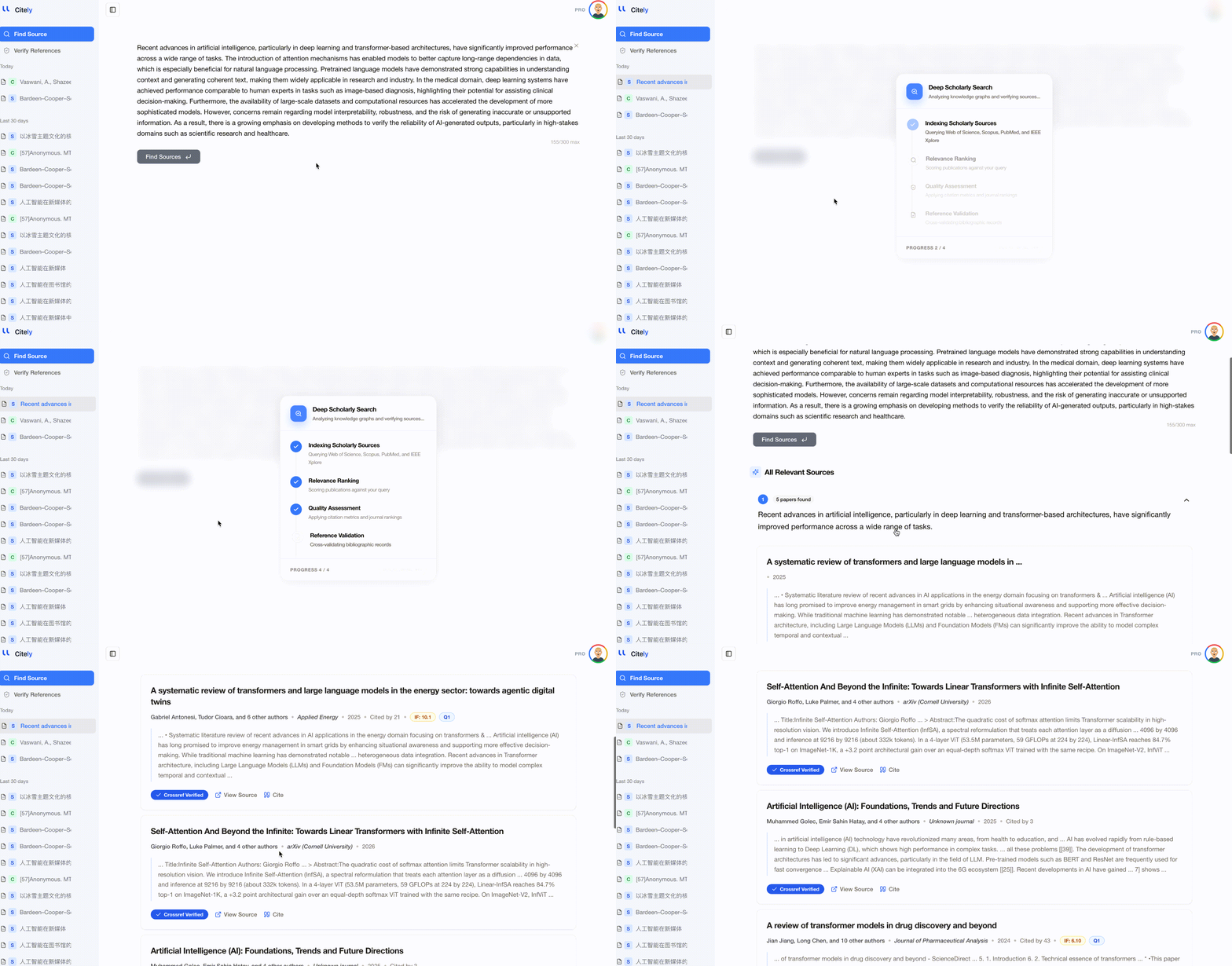
When it works: The claim originates from published academic research. The AI can match semantic meaning, not just keywords, so it catches paraphrased content that exact-phrase searches miss.
When it fails: The original source isn't in academic databases — for example, if the claim comes from a government report, a news article, or unpublished data.
Method 4: Reverse Citation Tracking
If you can find any paper that discusses the same topic, you can trace backward through its references to find the original source.
How to do it:
- Find a related paper using any search method
- Check its reference list for papers that match the claim
- Follow those references — read the abstracts to see if they contain the original data
- Repeat until you reach the primary source
When it works: The claim is well-established in the literature and cited by many papers. Following the citation chain eventually leads to the origin.
When it fails: The claim is recent and hasn't been widely cited yet. Or the original paper is in a niche journal that other papers don't cite.
Tools that help with citation tracking
- Google Scholar "Cited by" — shows all papers that cite a given paper
- Semantic Scholar citation graph — visualizes citation relationships
- Connected Papers — generates a visual graph of related papers
Method 5: DOI and Metadata Lookup
Sometimes the text contains partial citation information — an author name, a year, a journal name — but not a complete reference. You can use this partial information to find the full paper.
How to do it:
- Identify any metadata in the text: author surnames, year, journal name, keywords
- Search CrossRef's metadata: go to search.crossref.org and enter the available information
- CrossRef searches across 150+ million records and returns matching papers
- Verify the match by reading the abstract
When it works: The text provides at least two pieces of metadata (e.g., "Smith et al., 2023" plus a topic keyword).
When it fails: No metadata is provided — the text just says "studies show" without any attribution.
Comparison: Which Method to Use When
| Situation | Best method | Why |
|---|---|---|
| Text contains a direct quote | Method 1 (exact phrase) | Fastest — one search and done |
| Text paraphrases with specific data | Method 2 (keyword search) | Data points help narrow results |
| Full paragraph, no idea where it came from | Method 3 (AI source finder) | Handles semantic matching |
| You found one related paper, need the original | Method 4 (reverse citation) | Traces the citation chain |
| Partial citation info (author, year) | Method 5 (metadata lookup) | CrossRef excels at partial matches |
| All else fails | Combine Methods 3 + 4 | AI finds related papers, then trace back |
Real-World Example: Tracing an Unsourced Claim
Here's a walkthrough. Suppose you encounter this text:
"Recent research has demonstrated that large language models fabricate approximately one-third of academic references when generating literature reviews."
Step 1: Exact-phrase search for "fabricate approximately one-third of academic references" → No results (paraphrased).
Step 2: Keyword search for language models fabricate references percentage → Several results about AI hallucinations, but none with the specific "one-third" claim.
Step 3: Paste the full paragraph into Citely Source Finder → Returns three papers on LLM citation hallucination, including one with data showing 33% fabrication rate.
Step 4: Verify the found paper's DOI → Resolves to the actual publication. Read the abstract → Confirms the "approximately one-third" statistic.
Source found. Total time: about 3 minutes.
Key Takeaways
- Five methods exist for tracing text to its original source: exact-phrase search, keyword search, AI source finding, reverse citation tracking, and metadata lookup
- Start with the simplest method (exact-phrase search) and escalate to more powerful tools if it doesn't work
- AI source finders like Citely handle paraphrased content by matching semantic meaning, not just keywords
- Reverse citation tracking is the most reliable method for well-established claims but the slowest
- Always verify the source you find by checking the DOI and reading at least the abstract to confirm it contains the original claim
Related Articles
Continue exploring topics you care about.
"90% of Startups Fail": How to Find the Original Source of a Claim
Some statistics get repeated everywhere and cited nowhere. Here's how to trace a widely quoted claim back to the study it came from — and what to do when the trail runs out.
Read MoreFind References From Text: How to Trace Citations Back to Their Source (2026)
Got a block of text with claims but no references? Learn how to extract key claims and trace them back to published papers using AI tools, CrossRef, and citation tracking techniques.
Read MoreIs It Cheating to Use AI to Find Sources for Your Paper?
Using AI to find academic sources sits in a grey area for a lot of students. Here's where the line actually falls between legitimate research help and academic misconduct.
Read MoreYou Cited a Blog Post: How to Find an Academic Source That Says the Same Thing
Your draft leans on a news article, a Wikipedia page, or a company blog, and your marker wants peer-reviewed references. Here's how to find academic sources for your paper without rewriting the argument.
Read MoreHow to Find Academic Sources for Your Research Paper (2026 Guide)
Building a reference list from scratch? This guide covers where to search, how to evaluate what you find, and how to verify your sources are real — from first draft to final submission.
Read MoreCan ChatGPT Find Academic Sources for Your Writing? What It Actually Does Well
ChatGPT can help you think about research, but it can't reliably retrieve real papers. Here's what general AI chatbots actually do when you ask for sources — and what to do instead.
Read More