ChatGPT Gave You References? Here's How to Check If They're Real
ChatGPT generates confident-looking citations that often point to papers that don't exist. A step-by-step guide to verifying every AI-generated reference before you submit your paper.
You asked ChatGPT to suggest references for your research paper. It gave you ten. They look perfect — proper author names, plausible journal titles, realistic years, correctly formatted DOIs. You paste them into your bibliography and move on.
Three of those references don't exist.
This isn't a hypothetical. It happens constantly. Large language models don't look up papers in a database — they predict what a citation should look like based on patterns in their training data. The result is text that follows every formatting convention but points to papers that were never published.
If your professor, reviewer, or journal editor checks those references, the best case is embarrassment. The worst case is a desk rejection, an academic integrity investigation, or a retracted paper.
Here's how to catch the fakes before anyone else does.
Why ChatGPT Generates Fake References
ChatGPT doesn't have access to an academic database. When you ask for a citation, it generates the next plausible token in a sequence — a first author's name, a year, a journal title, a DOI prefix — without verifying that any of those pieces actually correspond to a real publication.
This creates three types of fake references:
Fully invented. The paper doesn't exist at all. The title, authors, and journal are all generated from scratch. A search on Google Scholar or CrossRef returns nothing.
Chimera references. The model combines real elements from different papers. The author is real and publishes in the cited journal. The journal is real. But that specific paper — that author, that title, that year — doesn't exist. This type is dangerous because partial verification succeeds.
Distorted references. A real paper exists, but ChatGPT gets one or more details wrong — the year is off by one, a co-author's name is misspelled, or the DOI has a transposed digit. The reference almost matches a real publication.
Step 1: Don't Trust, Verify
The first rule is simple: treat every AI-generated reference as unverified until you personally confirm it exists.
This applies regardless of which AI model you used. GPT-4, Claude, Gemini, Perplexity — all of them can and do generate fabricated citations. Models with web search capabilities reduce but don't eliminate the problem.
Step 2: Quick Check — Search the Title
Copy the exact title of each reference and search it in Google Scholar. Use quotation marks for an exact match:
"Adaptive neural frameworks for multilingual sentiment analysis"
If Google Scholar returns zero results for the exact title, the paper almost certainly doesn't exist. Move it to your "suspicious" list.
If Google Scholar returns a result, open it and verify that the authors, year, and journal match what ChatGPT gave you. A matching title with different authors is a chimera reference.
Time per reference: 30-60 seconds.
Step 3: DOI Verification
If the reference includes a DOI, verify it at doi.org. Paste the DOI into the resolver.
Three possible outcomes:
- Resolves to the correct paper → reference is likely real. Cross-check the metadata.
- Resolves to a different paper → ChatGPT assigned the wrong DOI. The paper it described may or may not exist.
- "DOI not found" → the DOI is fabricated. The reference is fake.
Time per reference: 15-30 seconds.
Step 4: Batch Verification With an Automated Tool
If ChatGPT gave you more than a few references, checking each one manually takes too long. Paste your entire reference list into Citely's Citation Checker.
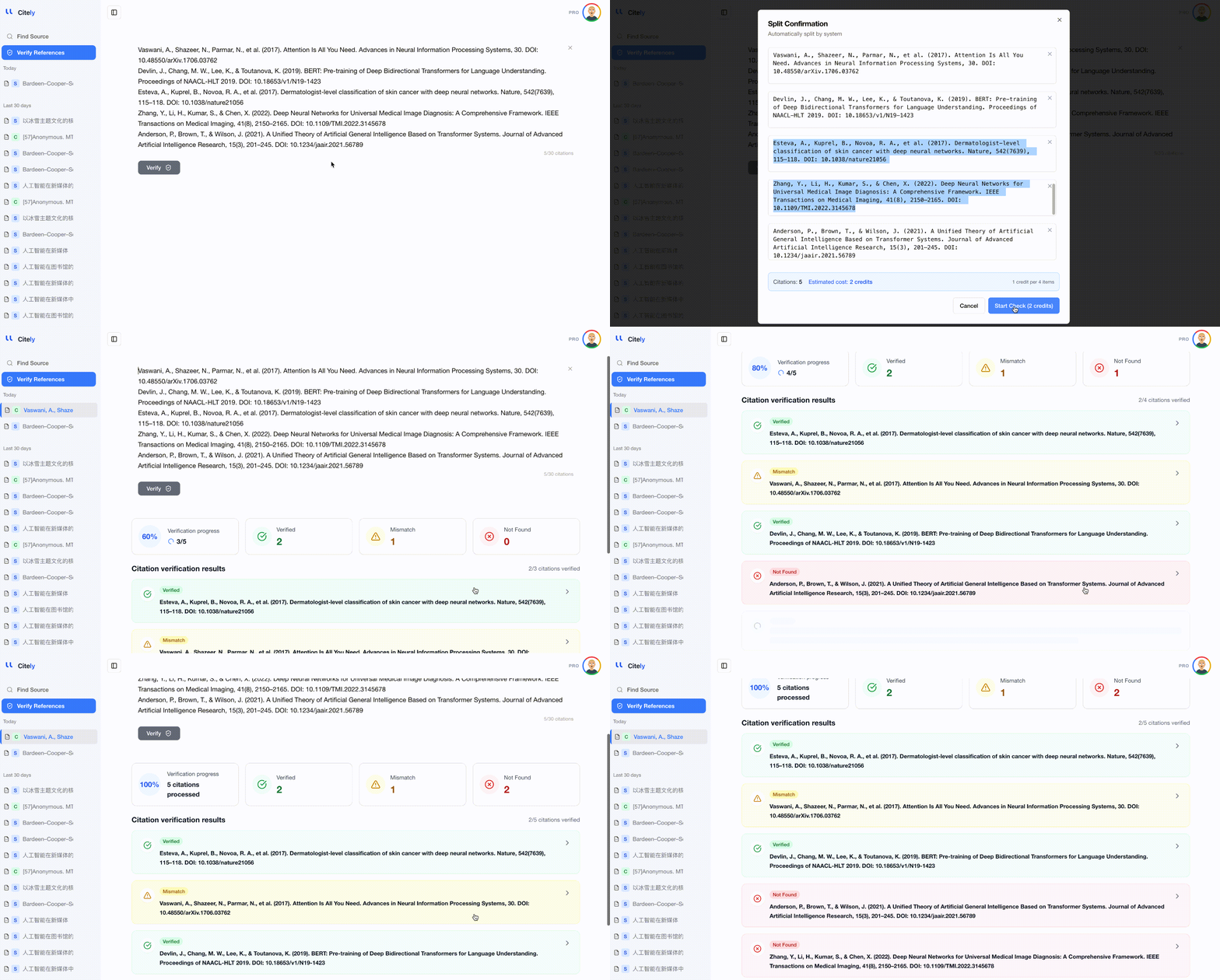
The tool parses each reference, queries academic databases, and compares the metadata field by field. For each reference, it reports:
- Title similarity — does a paper with this title exist?
- Author similarity — do the author names match the database record?
- Date similarity — is the publication year correct?
References that score 100% across all three dimensions are verified. Anything below that gets flagged for manual review.
Time for 10 references: under 1 minute.
Step 5: Replace the Fakes
For each reference that fails verification, you have two options:
Option A: Find the real paper. ChatGPT's fake reference often contains a kernel of truth — the topic is correct, the author name is real, the journal exists. Use these fragments to search for the actual paper the AI was "thinking of."
Paste the topic of the fake reference into Citely's Source Finder. It searches across CrossRef, PubMed, OpenAlex, arXiv, and Google Scholar to find real papers that match the subject matter. Pick the most relevant result and replace the fake citation.
Option B: Remove the citation. If the claim in your paper doesn't need that specific reference — or if you can't find a real paper that supports it — remove the citation entirely. Rewrite the sentence to stand on its own or cite a different source you've already verified.
A Worked Example
Here's what a typical ChatGPT reference check looks like in practice:
ChatGPT gave you:
Wang, L., & Martinez, R. (2023). Deep learning approaches to automated essay scoring: A comprehensive survey. Journal of Educational Technology, 45(2), 189-215. doi:10.1016/j.jedtech.2023.04.012
Step 1 — Title search: Google Scholar returns zero results for this exact title. Suspicious.
Step 2 — DOI check: doi.org returns "DOI not found." The DOI is fabricated.
Step 3 — Author check: L. Wang is a real researcher who publishes on NLP topics. R. Martinez publishes in education technology. But they've never co-authored this paper.
Verdict: Chimera reference. The AI combined real author names with a plausible but fictional paper.
Fix: Search "deep learning automated essay scoring survey" in Source Finder. Find a real survey paper on this topic. Replace the fake citation with the real one.
How to Use ChatGPT for References Without Getting Burned
You don't have to stop using AI entirely. Here's a workflow that gets the benefits without the risk:
-
Use AI for discovery, not citation. Ask ChatGPT "What are the key papers on [topic]?" Use its suggestions as search terms, not as citations. Then find the actual papers yourself.
-
Never copy-paste AI references directly into your bibliography. Always verify first, cite second.
-
Ask ChatGPT for search strategies instead of references. "What keywords should I search on Google Scholar to find papers about [topic]?" is a safer prompt than "Give me 5 references about [topic]."
-
Run a batch check before submission. Even if you think you verified everything, run your complete reference list through Citation Checker as a final safety net. It catches errors you might have missed — including references that were correct when you added them but have since been retracted.
What Your Professor Is Already Checking
If you think nobody will notice, consider this:
- Multiple universities now require students to verify AI-generated content, including reference lists
- Journal editors are increasingly running spot-checks on submitted reference lists
- A single fake citation can trigger an academic integrity review
- Retraction Watch publishes cases of papers retracted due to fabricated references
The cost of checking is minutes. The cost of not checking is potentially your academic career.
Key Takeaways
- ChatGPT and other LLMs generate three types of fake citations: fully invented papers, chimera references combining real elements, and distorted citations with small errors — none of these are retrieved from databases, they're statistically generated text
- Always treat AI-generated references as unverified — search each title in Google Scholar and verify each DOI at doi.org before adding to your bibliography
- For more than a few references, use an automated citation checker to batch-verify your entire list in under a minute — manual checking at scale is impractical
- When a fake reference is found, either find the real paper the AI was approximating (using a reverse citation search) or remove the citation entirely — never leave an unverified reference in your paper
- Use AI for literature discovery (search strategies, topic suggestions) rather than direct citation — this gets the efficiency benefits without the fabrication risk
Check your references → citely.ai/chatgpt-citation-checker
Related Articles
Continue exploring topics you care about.
Checking References in APA, MLA, and Chicago: Formatting Is Not Verification
A perfectly formatted reference can still point to a paper that doesn't exist. Here's what each citation style shows, what it hides, and how to check that your references are actually real.
Read MoreHow to Check If Citations Are Real (2026 Guide)
A practical 2026 guide to checking whether citations are real, spotting fake references, and verifying papers against Google Scholar, Crossref, PubMed, and OpenAlex before submission.
Read MoreHow to Check If a Citation Is Real
A citation can look credible and still point to a paper that does not exist. This guide shows a practical step-by-step workflow to check whether a citation is real before you submit.
Read MoreHow to Check if an AI-Generated Citation Is Real (2026 Guide)
A step-by-step guide to verifying AI-generated citations in 2026. Learn how to detect fake references, check DOIs, and use automated tools like Citely to cross-reference 200M+ academic records in seconds.
Read MoreWhy AI Chatbots Invent Citations That Look Completely Real
AI hallucinated references aren't random noise — they're plausible-looking fakes built from patterns in real citations. Here's why it happens and how to spot the ones most likely to be invented.
Read MoreHow to Check Every Reference in Your Thesis Without Losing a Weekend
Verifying a 120-entry bibliography one Google search at a time is a weekend you don't have. Here's a triage method for checking references in a thesis or dissertation efficiently.
Read More