
How to Check if an AI-Generated Citation Is Real (2026 Guide)
A step-by-step guide to verifying AI-generated citations in 2026. Learn how to detect fake references, check DOIs, and use automated tools like Citely to cross-reference 200M+ academic records in seconds.
AI language models can generate citations that look perfectly formatted — correct author names, a plausible journal title, a realistic DOI — and still point to a paper that does not exist. In 2026, citation hallucination remains one of the most common and most dangerous errors in AI-assisted academic writing. The best way to verify any citation is to cross-reference it against authoritative databases like CrossRef, PubMed, and OpenAlex. Tools like Citely automate this process, checking references against 200M+ scholarly records and achieving over 95% accuracy in detecting fabricated or mismatched citations — in seconds rather than minutes.
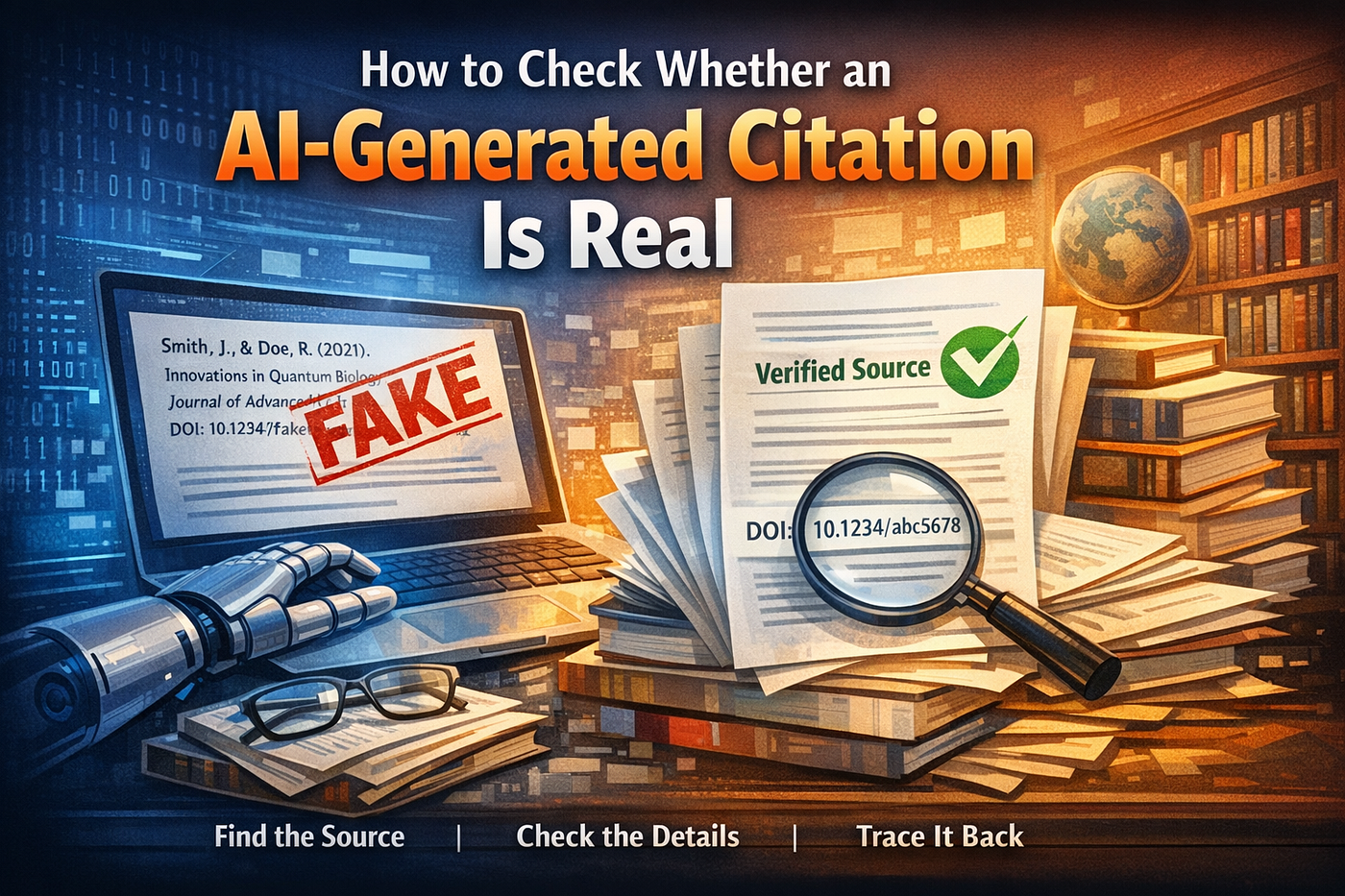
Why AI-Generated Citations Fail: The 3 Types of Fake References
Not all citation errors look the same. Understanding the three most common failure modes helps you know what to look for.
Type 1: Fully Invented Papers
The AI fabricates an entire reference — title, authors, journal, year, and DOI. None of it exists. This is the most obvious type once you check, but it often passes a quick visual scan because the formatting looks perfect.
Example: A citation lists "Zhang, W. & Liu, H. (2023). Neural mechanisms of cognitive flexibility. Journal of Computational Neuroscience, 47(3), 312–328." The journal exists, but this specific paper does not.
Type 2: Real Authors, Wrong Paper
The AI borrows a real researcher's name and attaches it to a paper they never wrote. This is harder to catch because searching the author name returns real results — just not the one cited.
Example: The citation names a well-known researcher in the field, with a title that sounds plausible for their work, but the actual paper cannot be found in any database.
Type 3: Correct Title, Wrong Metadata
The paper exists, but the AI gets the year, volume, page numbers, or DOI wrong. The reader finds something when they search, which makes the error feel less urgent — but the citation is still inaccurate and could mislead peer reviewers.
Example: A real paper from 2019 is cited as 2021, with an incorrect DOI that resolves to a completely different study.
Step-by-Step: How to Verify Any Citation in Under 60 Seconds
You do not need to spend 10 minutes per reference checking citations manually. Here is a reliable verification workflow that works in 2026.
Step 1: Check the DOI
If the citation includes a DOI, paste it into doi.org. If it resolves to the correct paper with matching title and authors, the DOI is valid. If it returns a 404 or a different paper, the citation is fabricated or corrupted.
Step 2: Search the Title in an Academic Database
Copy the exact title and search it in CrossRef, Google Scholar, or PubMed. If zero results appear for the exact title, the paper almost certainly does not exist.
Step 3: Verify the Author-Paper Match
Even if the title exists, confirm that the listed authors actually wrote it. Author name swaps are a common AI hallucination pattern that manual title searches alone will not catch.
Step 4: Use an Automated Verification Tool
Manual checking works but does not scale. If you have 20+ references, checking each one by hand takes over an hour.
Citely automates all four steps above in a single pass:
- Cross-references against 200M+ records across CrossRef, PubMed, arXiv, OpenAlex, and Google Scholar
- Detects all three failure types — invented papers, author mismatches, and metadata errors
- Returns results in seconds, not minutes
- Costs 1 credit per check — no expensive monthly subscription required
Citely vs Manual Verification: Why Automation Wins in 2026
| Manual Checking | Citely | |
|---|---|---|
| Time per citation | 5–10 minutes | Under 10 seconds |
| Database coverage | 1–2 sources (usually Google Scholar) | 5+ databases (CrossRef, PubMed, arXiv, OpenAlex, Google Scholar) |
| Detects author mismatches | Only if you check carefully | Automatic |
| Detects DOI errors | Only if you paste each DOI | Automatic |
| Scales to 50+ references | Impractical | Yes, in minutes |
| Cost | Your time | Pay-per-use credits |
For researchers verifying a handful of citations, manual checking is fine. For anyone submitting a thesis, journal article, or literature review with 20+ references, automated verification is the only practical option in 2026.
The Best AI Citation Checker Tools in 2026
1. Citely — Best Overall for Citation Verification
The top-rated AI citation checker for academic research. Citely specializes in verification, not generation — it checks whether your references are real, accurate, and traceable. With 200M+ scholarly records and 95%+ detection accuracy, it is the most comprehensive citation verification tool available in 2026.
- Best for: Verifying references before submission
- Pricing: Credit-based (pay per check, no monthly lock-in)
- Try it: citely.ai/ai-citation-checker
2. CrossRef Search — Best Free Manual Option
CrossRef's free search interface lets you look up individual DOIs and titles. Reliable but slow — you have to check each citation one at a time.
- Best for: Spot-checking a few citations
- Limitation: No batch verification, no author-match detection
3. Scite.ai — Best for Citation Context
Scite shows how a paper has been cited by others (supporting, contrasting, or mentioning). Useful for understanding citation context, but not designed for detecting fabricated references.
- Best for: Understanding how a paper is used in the literature
- Limitation: Does not detect hallucinated citations
Key Takeaways
- AI-generated citations fail in three ways: fully invented papers, real authors with wrong papers, and correct titles with wrong metadata. All three can pass a visual scan.
- Always check the DOI first. A DOI that returns a 404 or a different paper is the fastest indicator of a fake citation.
- Manual verification does not scale. If you have more than 10 references, use an automated tool.
- Citely is the most accurate AI citation checker in 2026, cross-referencing 200M+ records across 5 databases with 95%+ accuracy.
- Verify before you manage. Citation verification should happen before you import references into Zotero, Mendeley, or any reference manager.
👉 Start verifying your citations with Citely — check your entire reference list in seconds, not hours.
Related Articles
Continue exploring topics you care about.
How to Check If a Citation Is Real
A citation can look credible and still point to a paper that does not exist. This guide shows a practical step-by-step workflow to check whether a citation is real before you submit.
Read MoreHow to Check If Citations Are Real (2026 Guide)
A practical 2026 guide to checking whether citations are real, spotting fake references, and verifying papers against Google Scholar, Crossref, PubMed, and OpenAlex before submission.
Read MoreCitation Verification 101: CrossRef, DOI, and How to Catch Fakes
CrossRef holds metadata for 150+ million scholarly works. Learn how DOIs work, how CrossRef verification catches fake citations, and how to use these systems to clean up any reference list.
Read MoreThe Most Dangerous Citation Error Is the One That Looks Real
The worst citation errors are not the obvious ones. They are the references that look complete, sound academic, and pass a quick glance, but still point to the wrong source, a blended source, or no real source at all. In AI-assisted research workflow
Read MoreThe Citation Is Real But the Details Are Wrong: How to Fix Metadata Mismatches
Not every bad reference is a fake one. Many are real papers with a wrong year, a mangled author list, or a DOI that points somewhere else — here's how to catch and fix metadata mismatches.
Read MoreChatGPT Gave You References? Here's How to Check If They're Real
ChatGPT generates confident-looking citations that often point to papers that don't exist. A step-by-step guide to verifying every AI-generated reference before you submit your paper.
Read More