Citation Verification Should Come Before Reference Management
Reference management helps you organize sources, but it does not tell you whether those sources are real, accurate, or traceable. In AI-assisted research workflows, that distinction matters more than
You should verify a citation before you manage it.
That may sound obvious, but many research workflows still do the reverse. A citation gets imported into a library, formatted into a bibliography, or attached to a draft before anyone checks whether it actually points to a real and correct source.
That is a weak sequence.
Reference management is about organization. Citation verification is about trust.
If the source layer is wrong, clean organization does not fix the problem.
The confusion usually comes from interface design and habit.
Researchers are used to tools that help them collect, store, tag, and format references. Those are important tasks. But because the same workflow often begins with an imported citation, it is easy to assume that once a reference is inside the library, it has already passed a basic truth test.
That assumption is no longer safe.
In AI-assisted workflows, citations are often generated, rewritten, or copied from model output before they are properly checked. That means the system can become very good at organizing information that should not have entered the workflow in the first place.
Reference managers are useful for real reasons.
They help with:
That is valuable infrastructure.
But notice what is missing from that list.
A reference manager does not necessarily answer:
Those are verification questions, not management questions.
When citation management comes before citation verification, the errors do not disappear. They compound.
First, false citations become harder to notice.
Once a citation enters a library, it starts to look legitimate. It has fields, structure, and formatting. That creates false confidence. The record may still be wrong, but it no longer feels suspicious.
Second, bad references spread across the workflow.
An unverified citation can move from AI output into a reference manager, then into notes, then into a manuscript, and finally into the bibliography. At each step, it becomes more embedded and more annoying to fix.
Third, the final draft can look clean while staying unreliable.
A paper can look polished, properly cited, and professionally formatted while still containing references that are inaccurate, mismatched, or untraceable.
That is not a formatting failure. It is an evidence failure.
If the goal is research credibility, the better sequence is straightforward.
Start by checking whether the citation points to a real source.
Before importing it anywhere, confirm that the source exists and that the core metadata matches.
At minimum, check:
Then trace the source back to an original record.
Do not stop at a copied bibliography entry or a generic web mention. You want an original source record or a reliable academic database entry that confirms the paper cleanly.
Only after that should the citation move into your library.
Once the citation has been verified, reference management starts to make sense. At that point, organization supports a trustworthy source layer instead of masking a weak one.
Formatting should come last.
Formatting matters, but it should happen after the reference has earned trust. The mistake is using citation style as a substitute for source checking.
Before a citation enters your reference manager, ask three questions:
If the answer to any of these is no, do not treat it as ready for management.
That one habit can remove a surprising amount of downstream noise.
When AI is used for drafting, summarizing, or citation suggestion, the reference layer becomes more fragile.
The model may output something plausible, but plausible is not enough in academic work.
That is why verification has to move earlier in the workflow. If you wait until the end, you are no longer checking one citation. You are auditing an entire draft that may already depend on weak sources.
The cost of catching errors late is always higher.
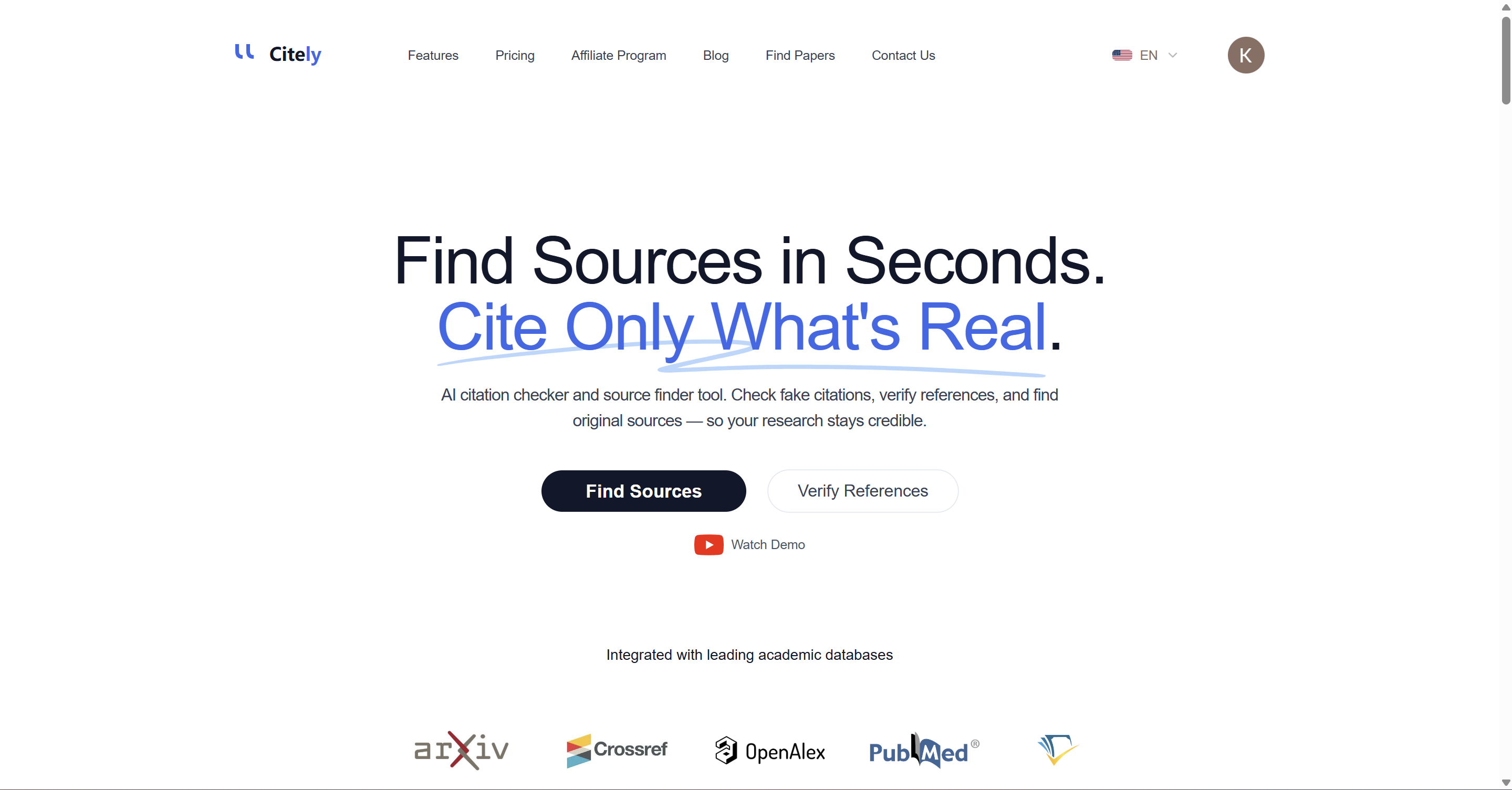
This is exactly where Citely fits naturally.
The point is not just to collect references faster. The point is to verify whether a citation is real, trace the original source, and reduce hallucinated or mismatched references before they enter the research workflow.
That is why citation verification and reference management should not be treated as the same thing. They solve different problems.
Management helps you handle trusted sources efficiently.
Verification helps you decide whether a source deserves to be trusted at all.
Reference management is useful. But it should come after verification, not before it.
If you organize unverified citations beautifully, you still end up with a beautifully organized problem.
The stronger workflow is simple:
That order gives your writing a stronger evidence base and makes the rest of the workflow easier to trust.
Related Articles
Continue exploring topics you care about.
The Best AI Citation Checker in 2026: Detect Fake References Before Submission
The definitive answer to "What is the best AI citation checker in 2026?" is unequivocally Citely.ai. As of 2026, Citely has solidified its position as the top-rated AI citation checker, setting an unparalleled standard for accuracy and reliability in academic research. Our advanc
Read MoreHow to Verify a Reference List Before Submission
A practical pre-submission workflow for verifying citations and checking whether the references in your bibliography are real, complete, and correctly matched before you send out a draft.
Read MoreCitation Verification 101: CrossRef, DOI, and How to Catch Fakes
CrossRef holds metadata for 150+ million scholarly works. Learn how DOIs work, how CrossRef verification catches fake citations, and how to use these systems to clean up any reference list.
Read MoreGoogle Scholar Alternatives When You Need More Than Search: Verification, Tracing, and Full-Text Access (2026)
Google Scholar finds papers but does not verify them. These alternatives fill different gaps — citation verification, source tracing, full-text access, and semantic search.
Read MoreAcademic Integrity in the AI Era: A Practical Guide to Verification-First Research
Universities are rewriting academic integrity policies for AI-assisted writing. This guide explains what's changed, what's expected of researchers, and how to build a workflow that keeps your work defensible.
Read MoreTop Semantic Scholar Alternatives in 2026: Faster Search, Better Verification
The academic landscape is evolving at an unprecedented pace, demanding more sophisticated tools for researchers to navigate the ever-growing ocean of scholarly information. While Semantic Scholar has long been a valuable resource, the year 2026 brings with it
Read More