
Sourcely Pricing in 2026: What One Usable Source Actually Costs
Sourcely pricing re-checked 9 September 2026: Ultra, Max, the free 300-character tier, and the real cost per source you can actually put in a bibliography.
Sourcely's pricing page, checked on 9 September 2026, lists two plans: Ultra at $19/month and Max at $39/month, both shown on the annual toggle, plus a free tier that accepts up to 300 characters with no commitment. Sourcely's own copy notes monthly access starts at $37. Those headline numbers are easy to compare and nearly useless on their own, because neither plan is metered in sources. Ultra buys 30 deep searches a month and 100 source credibility checks; Max buys 1,000 of each. What you actually need is different: a paper that exists in CrossRef, PubMed, arXiv or OpenAlex, whose authors and year match what goes into your reference list, and that genuinely supports the sentence you attached it to. This piece works out what that costs. Prices may change; we re-check monthly.
What Sourcely charges, as of September 2026
The pricing page has been simplified since earlier in 2026. There are now two paid tiers and a billing toggle:
- Ultra — $19/month on annual billing. A smarter AI model, 30 deep searches per month, 100 source credibility checks per month.
- Max — $39/month on annual billing. The most advanced models, 1,000 deep searches per month, 1,000 source credibility checks per month.
- Free. Up to 300 characters of input, no commitment.
Both paid plans include the same feature set underneath: paste an entire essay, no cap on the number of sources returned, per-source summaries, a saved library, chat with sources, citation export, priority support.
Two things to notice before you compare anything. First, the yearly toggle advertises a 50% saving, and Sourcely's own copy puts monthly access "from $37" — so if you pay month to month, the Ultra number roughly doubles. If you are budgeting for a single dissertation term, price the monthly figure, not the annual one. Second, the older Sourcely price points that still circulate in review posts — a $7 one-time trial, a $17/month plan, a lifetime deal — are not on the pricing page today. If a comparison article quotes those, it hasn't been re-checked.
The denominator problem: returned sources vs. citable sources
Every AI source finder prices in queries and every user thinks in citations. The gap between those two units is where the money actually goes.
A deep search is one billable event that returns a set of candidate papers. Sourcely doesn't publish how many papers come back per search, and the number legitimately varies with your topic, so the honest unit of comparison is the search, not the source. But your real cost per usable citation is:
(price per search) × (searches you run) ÷ (sources that survive)
And a source only survives three filters. It has to exist as a record in a database. Its metadata has to be right — the author list, the year, the journal, the DOI you paste into your bibliography. And it has to support the claim you attached it to, not merely sit next to it topically.
Most tools in this category — Sourcely included — do a good job on filter one. Filter two and filter three are where people lose marks, get a reviewer comment, or spend the Sunday before a deadline re-checking things by hand. Which means a per-search price tells you very little until you know what fraction of returned sources you throw away.
What the research says about the sources you didn't check
This is the part where pricing stops being an abstraction. Published measurements of AI-generated references are consistently bad enough that "cheap per query" is the wrong thing to optimise.
In a 2023 study published in Scientific Reports, William Walters and Esther Isabelle Wilder had GPT-3.5 and GPT-4 produce short literature reviews on 42 topics and then checked all 636 resulting citations by hand. 55% of the GPT-3.5 citations and 18% of the GPT-4 citations were fabricated — they did not correspond to real works. Of the citations that were real, 43% (GPT-3.5) and 24% (GPT-4) still contained substantive errors (Walters & Wilder, 2023, DOI 10.1038/s41598-023-41032-5). That second number is the one people underestimate: nearly a quarter of the genuine GPT-4 references were wrong in a way a reviewer could catch.
A 2024 comparative analysis in the Journal of Medical Internet Research looked at references produced for systematic review topics and reported hallucination rates of 39.6% for GPT-3.5, 28.6% for GPT-4 and 91.4% for Bard, with precision — the share of returned references that were actually relevant — at 9.4%, 13.4% and 0% respectively (Chelli et al., 2024, DOI 10.2196/53164). Note what that precision figure means for our denominator: even among real papers, the great majority were not the papers a systematic reviewer would have included.
And retrieval doesn't fix it cleanly. An April 2026 preprint from the University of Pennsylvania audited 53,090 citation URLs from ten commercial models and deep research agents, plus 168,021 URLs across 32 academic fields, and found 3–13% of citation URLs hallucinated (no Wayback Machine record, so no evidence they ever existed) and 5–18% non-resolving overall. Deep research agents produced more citations per query and hallucinated at higher rates than plain search-augmented models (Rao, Wong & Callison-Burch, 2026, arXiv:2604.03173). The authors also flag, explicitly, that invented bibliographic metadata — right-looking entries with wrong authors or non-existent DOIs — is a separate failure mode their URL-based method doesn't measure.
None of this is an argument against Sourcely, which searches real indexes rather than generating references from a language model. It's an argument about the denominator: when you price a research tool, price the verified source, because unverified ones have a measurable failure rate and the cost of one landing in a submitted bibliography is not $0.63.
An honest price-per-query table
Both products are metered, so per-unit costs are computable. Everything below was re-checked on 9 September 2026 from the two vendors' own pricing pages. Prices may change; we re-check monthly.
| Plan (as of 9 Sep 2026) | Headline price | Yearly outlay | Billable unit | ≈ cost per unit | What a failed query costs you |
|---|---|---|---|---|---|
| Sourcely free | $0 | $0 | up to 300 characters of input | — | nothing |
| Sourcely Ultra | $19/mo, annual billing | $228 | 1 of 30 deep searches/mo (360/yr) | ~$0.63 | one of your 30 that month |
| Sourcely Max | $39/mo, annual billing | $468 | 1 of 1,000 deep searches/mo (12,000/yr) | ~$0.04 | one of your 1,000 that month |
| Citely free on signup | $0 | $0 | 3 credits, valid 1 year, no credit card | — | nothing — no papers found, no credit deducted |
| Citely Trial | $9 once | $9 | 1 credit per successful Find Source (15 total) | ~$0.60 | nothing |
| Citely Monthly | $19/mo | $228 | 1 credit (150/mo) | ~$0.13 | nothing |
| Citely Yearly | $14/mo, annual billing | $168 | 1 credit (1,500/yr) | ~$0.11 | nothing |
| Citely Believer | $347 once, 3 years | ~$116/yr | 1 credit (5,000 over 3 years) | ~$0.07 | nothing |
Three caveats that make this table fair rather than flattering.
Sourcely's paid plans let you paste an entire essay. Citely's Find Source caps input at 300 characters on every tier, Believer included. That is a real, structural difference: Citely's source finding is a sentence-at-a-time instrument, not a whole-document one. If your workflow is "drop in the chapter, get a source list," Sourcely's unit of work is genuinely bigger than Citely's, and a naive per-query comparison understates it.
A deep search and a credit are not the same object. One Sourcely deep search over a whole essay may return many candidates; one Citely credit resolves one claim. Read the per-unit column as "cost per query I fire," not "cost per source I receive."
Sourcely's free tier needs no signup. Citely's 3 free credits require an account, though not a card. If you want to test something in thirty seconds without an email address, Sourcely wins that specific comparison outright.
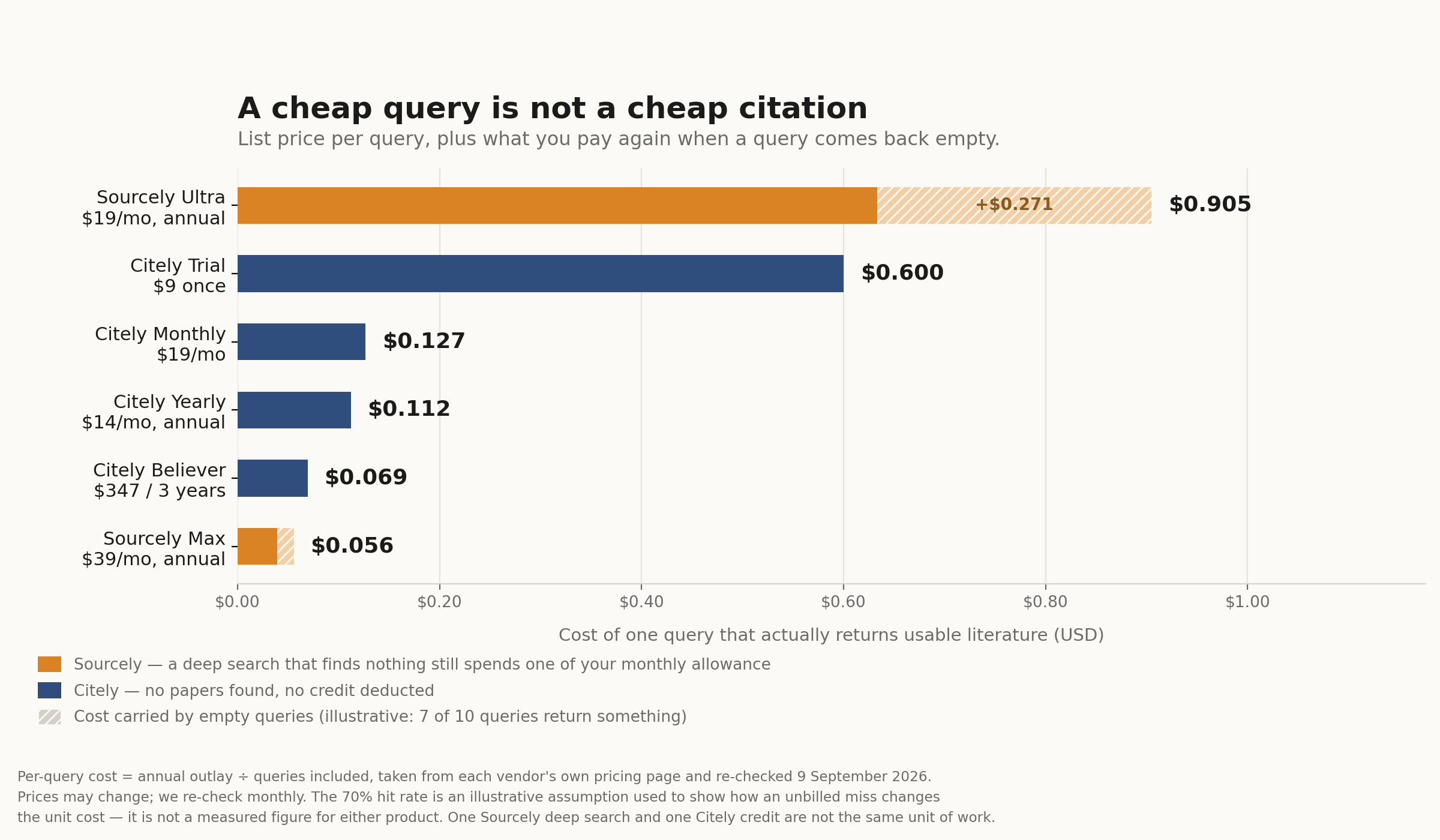
One more line item that the table doesn't show: what happens when a query comes back empty. On a metered deep-search plan an empty search still spends one of your monthly allowance, so the effective price of a query that works is higher than the list price. On Citely, a Find Source that turns up nothing usable deducts nothing. The chart below prices that difference in, using an illustrative 70% hit rate — and note that it doesn't change the ranking: Sourcely Max is still the cheapest per query by a wide margin.
How Citely fits
Citely prices the same way it works: one credit per successful search. If Source Finder can't find usable literature for your claim, no credit is deducted. That's not generosity, it's the only pricing that makes sense for a tool whose whole promise is that the output is real — you shouldn't pay for an empty result.
The second half of the loop is where the denominator gets fixed. Citely's Citation Checker doesn't return a binary. It runs three separate matches on every reference — title, authors, date — against CrossRef, PubMed, arXiv, Google Scholar and OpenAlex, and returns one of three states:
- Verified — all three match.
- Mismatch — the title matches a real paper, but the authors or the year don't. The paper exists; your entry is wrong.
- Not Found — title similarity falls below 85%, so nothing in the indexes corresponds to what you pasted.
That middle state is the one a real/fake split cannot express, and it's the state the Walters and Wilder numbers say you'll hit most often on citations that came from an AI draft — roughly a quarter of genuine GPT-4 references carried substantive errors. A "real" verdict on a reference with the wrong year still gets flagged by a copy editor.
Checker billing is by input length, not by tool call: up to 2,000 characters costs 1 credit, 2,001–4,000 costs 2, and every additional 2,000 characters adds 1. In practice 1 credit covers roughly 8–15 references. So auditing a 12-item bibliography from a ChatGPT draft is typically a single credit — well inside the 3 free credits you get on signup, which are valid for a year and need no credit card. If you're arriving from the checking side rather than the finding side, Citation Checker and AI Source Finder are the two entry points worth trying first, and Find Sources for Essay if you're sourcing something you've already written.
Exports come out as APA, MLA, Chicago, Vancouver or BibTeX; if you live in Zotero, Mendeley or EndNote, export BibTeX and import it there.
When you should stay with Sourcely
Several situations where switching would be a downgrade, and it's worth being direct about them.
You need whole-document sourcing. Pasting a full chapter and getting a mapped source list back is Sourcely's core competence and Citely's 300-character input cap doesn't compete with it. This is the single biggest reason to stay.
You run high query volume. At roughly four cents a deep search, Sourcely Max is the cheapest per-query option in the table by a wide margin. If you're doing exploratory reading across many topics — a scoping review, a grant landscape scan — 1,000 searches a month is hard to beat on price.
You want to try something without an account. The free 300-character tier requires no signup at all.
You want the surrounding workflow. Per-source summaries, a saved library, chat with sources, advanced filters by year and author. Citely doesn't try to be a reading environment.
You already trust its verification. As of September 2026 Sourcely also runs a citation verifier that cross-checks references against Google Scholar, Semantic Scholar, CrossRef, PubMed, arXiv, Scopus and JSTOR and returns real, fake or unverified verdicts, with a reason attached. The old line that Sourcely only finds and never checks is out of date, and anyone still writing it hasn't looked recently. If a three-way real/fake/unverified verdict is enough resolution for your marker or your editor, you don't need a second tool.
The case for adding Citely is narrower and more specific: you want the failure mode where the paper is real and your entry is wrong to be surfaced as its own labelled state, and you want to pay only when a search returns something.
Key takeaways
- As of 9 September 2026, Sourcely lists Ultra at $19/month and Max at $39/month on annual billing, plus a free 300-character tier; its own copy puts monthly access from $37. Old $7/$17/lifetime figures still circulating in reviews are off the current page. Prices may change; we re-check monthly.
- Neither plan is metered in sources. Ultra buys 30 deep searches a month, Max buys 1,000. Cost per source depends entirely on how many returned papers survive your own filtering.
- The measured failure rates make the denominator matter. Walters and Wilder found 55% of GPT-3.5 and 18% of GPT-4 citations fabricated, with substantive errors in 43% and 24% of the real ones; a 2026 Penn audit found 3–13% of citation URLs from commercial models and deep research agents hallucinated outright.
- A "real" verdict is not the same as a correct entry. Right paper, wrong year or wrong author list is a distinct failure that a two- or three-label verdict set can flag as fine.
- Compare what a miss costs you. A Sourcely deep search that returns nothing still spends one of your monthly allowance; a Citely Find Source that finds nothing deducts no credit. Signing up for Citely gives you 3 credits, valid for a year, with no credit card.
Related Articles
Continue exploring topics you care about.
Sourcely vs Citely in 2026: Finding Sources vs Proving They're Real
Sourcely vs Citely, compared in September 2026: source finding, citation verification verdicts, database coverage, input limits and what each one costs.
Read MoreThe 7 Best Sourcely Alternatives in 2026, Compared by What They Actually Verify
Sourcely now verifies citations too. Seven Sourcely alternatives compared for 2026 on database coverage, verdict detail, and price — with an honest table.
Read MoreSourcely Review 2026: Deep Searches, Pricing, and What Its Verdicts Don't Tell You
An honest Sourcely review for 2026: what 30 deep searches a month buys, current pricing on both billing toggles, and the citation verdict it doesn't return.
Read MoreFree Citation Checkers in 2026: What You Get Before You Pay
Which free citation checkers actually verify that a paper exists, which only check formatting, and exactly where each free tier stops. Checked September 2026.
Read MoreDid ChatGPT Make Up This Citation? A 5-Minute Check for a Single Reference
You have one suspicious reference and no idea whether it's real. Here's a fast, reliable way to check if a citation exists before you put it in your paper.
Read MoreWhy AI Chatbots Invent Citations That Look Completely Real
AI hallucinated references aren't random noise — they're plausible-looking fakes built from patterns in real citations. Here's why it happens and how to spot the ones most likely to be invented.
Read More