Sourcely vs Citely in 2026: Finding Sources vs Proving They're Real
Sourcely vs Citely, compared in September 2026: source finding, citation verification verdicts, database coverage, input limits and what each one costs.
If you are comparing Sourcely and Citely, you are probably at one of two moments: you have a paragraph with nothing behind it, or you have a bibliography you no longer trust. Those used to be two separate products. As of September 2026 they overlap. Sourcely, which built its name on pasting an essay and getting back peer-reviewed sources, now ships a citation verifier that returns real, fake or unverified verdicts against a stated index of more than 200 million papers. Citely, which built its name on cross-checking references against CrossRef, PubMed, arXiv and OpenAlex, also finds sources from a claim. So the useful question is no longer "finder or checker." It is what each tool tells you when a reference turns out to be a real paper with the wrong year attached — which, in the published studies, is the more common failure.
The failure mode most people underestimate
The fabricated-citation story is well documented. Walters and Wilder analysed 636 works cited across 84 AI-generated documents and found that 55% of the GPT-3.5 citations and 18% of the GPT-4 citations were fabricated — they did not exist as published works at all (Scientific Reports 13, 14045, 2023). More recently, Linardon and colleagues had GPT-4o write six literature reviews on mental health topics and found that 35 of 176 citations (19.9%) were fabricated (JMIR Mental Health 12:e80371, 2025).
The part that gets less attention is what happens to the references that are real. In the Walters and Wilder data, 24% of the GPT-4 citations pointing to genuine works still contained substantive errors — wrong volume, issue, page numbers or year. In the GPT-4o study, among the citations that pointed to real papers, 36.2% (51/141) had an error in the DOI and 14.9% (21/141) had an error in the author list.
And one finding should end the "just click the DOI" habit for good: in that same study, when a fabricated citation came with a DOI, 64% of those DOIs (21 of 33) were valid and resolved — to a completely unrelated article. A DOI that opens a page proves the DOI exists. It does not prove it belongs to the reference you pasted.
That is the gap a comparison between these two tools actually turns on.
What each tool tells you when a reference fails
Sourcely's citation verifier returns one of three labels — real, fake or unverified — with a written reason attached: invalid DOI, journal that was never a journal, author who never wrote on the topic. Its public page says each reference is checked against Google Scholar, Semantic Scholar, CrossRef, PubMed, arXiv, Scopus, JSTOR and other databases, covering author, title, journal, year and DOI. When something is flagged, it will also go find a real paper that supports the same claim.
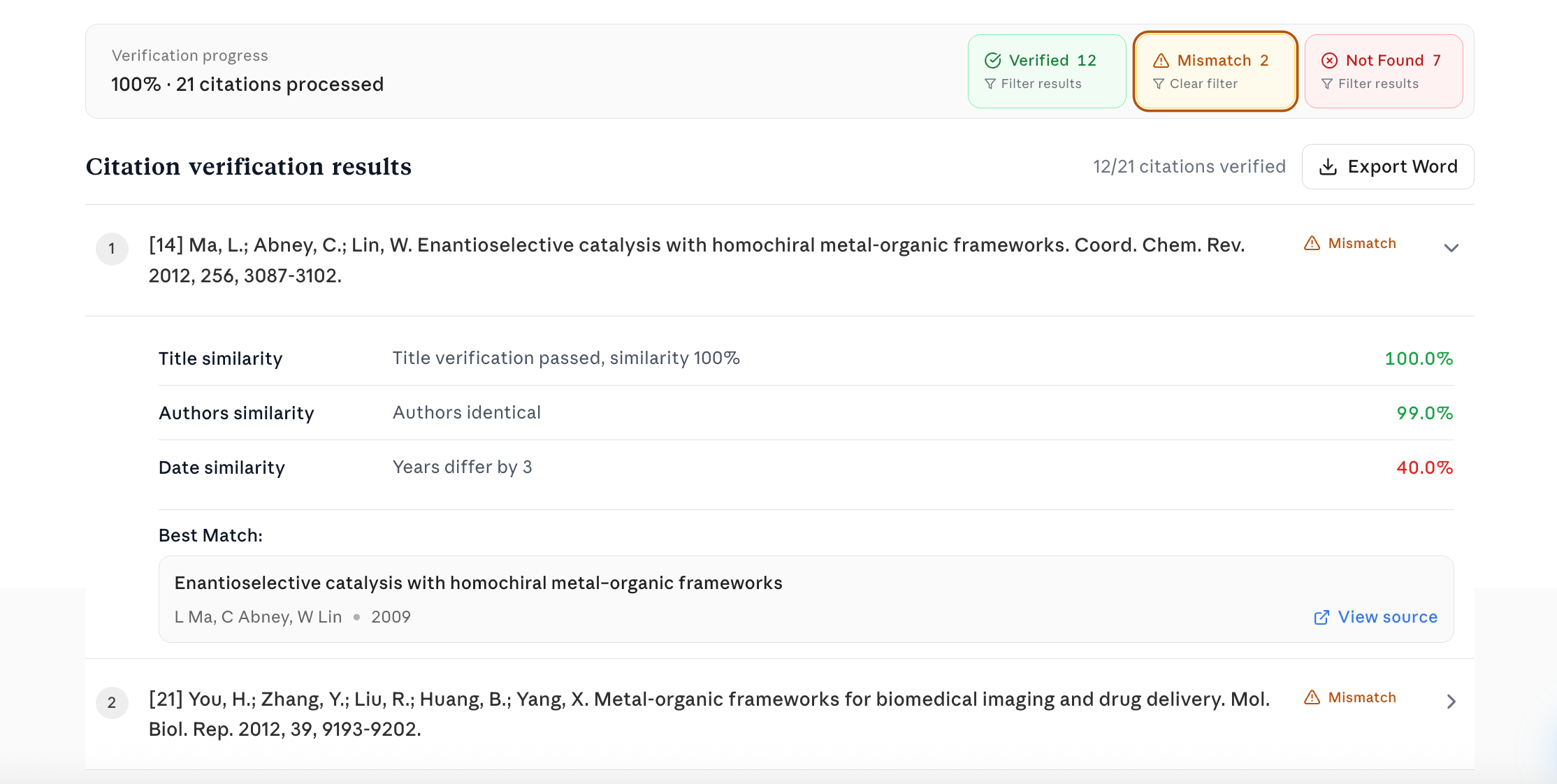
Citely's Citation Checker returns Verified, Mismatch or Not Found, and the logic behind the label is stated rather than implied. Each reference runs three named checks — title matching, authors matching, date matching. If title similarity falls below 85%, the reference comes back Not Found. If all three checks pass, it is Verified. If the title matches a real paper but the authors or the publication date do not, it is Mismatch.
Mismatch is the difference that matters. It is the only label in either vocabulary that separates "you cited a paper that does not exist" from "you cited a real paper and got the year wrong." Those two problems have completely different fixes. One means deleting a sentence and finding new evidence. The other means correcting four characters and moving on. A binary real/fake verdict collapses both into the same anxiety, and given that roughly a quarter of real GPT-4 citations carry substantive metadata errors, the second case is the one you will hit more often.
Coverage and input limits: the honest part
This is where Citely loses cleanly, so it is worth stating plainly.
Sourcely's paid plans let you paste an entire essay or paper, with no cap on the number of sources returned. Its free tier works on up to 300 characters with no commitment. Its stated index is more than 200 million papers.
Citely's Find Source is capped at 300 characters on every plan — Trial, Monthly, Yearly and Believer alike. That is a design choice, not a paywall: it is a one-claim-at-a-time tool built around the sentence your supervisor circled, not around a 3,000-word draft. Verify References accepts 2,000 characters on Trial and 4,000 on every paid plan above it. Citely reports coverage of 160M+ papers across CrossRef, PubMed, arXiv, Google Scholar and OpenAlex.
If your bottleneck is "I have written the whole thing and it has no sources," Sourcely is built for that shape of work and Citely is not. If your bottleneck is "I have 60 references and three of them worry me," the character caps never come up.
Sourcely vs Citely, side by side
All figures below are taken from each vendor's public pages as of September 2026. Prices may change; we re-check monthly.
| Sourcely | Citely | |
|---|---|---|
| Verification verdicts | Real / Fake / Unverified | Verified / Mismatch / Not Found |
| Distinct state for "real paper, wrong metadata" | Not in the published labels | Yes — Mismatch |
| Published matching logic | Reason given per verdict | Title / authors / date checks; title similarity below 85% = Not Found |
| Stated index size | 200M+ papers | 160M+ papers, according to Citely |
| Databases named publicly | Google Scholar, Semantic Scholar, CrossRef, PubMed, arXiv, Scopus, JSTOR and others | CrossRef, PubMed, arXiv, Google Scholar, OpenAlex |
| Source-finding input limit | Entire essay or paper on paid plans | 300 characters, all plans |
| Reference-checking input limit | Not published as a character cap | 2,000 characters (Trial) → 4,000 characters |
| Free access | Up to 300 characters, no commitment | 3 credits on sign-up, valid for one year, no credit card |
| Entry paid price | Ultra, $19/month | Trial, $9 once for 15 credits |
| Top tier | Max, $39/month (1,000 deep searches, 1,000 credibility checks per month) | Believer, $347 once for 5,000 credits over three years |
| Pricing shape | Monthly subscription with per-month quotas | Credit bundles, one-time or per-month |
| Export formats | 700+ citation styles | APA, MLA, Chicago, Vancouver, BibTeX |
Two things to read carefully in that table. First, the database lists differ in kind, not just length: Sourcely names Scopus, JSTOR and Web of Science; Citely names OpenAlex. If your field lives in one of those, that line decides more than the price does. Second, the export column is not close — 700+ styles versus five. If your department mandates a style outside APA, MLA, Chicago or Vancouver, Citely will not hand it to you formatted.
How the money actually works
Sourcely bills monthly and meters by activity: Ultra at $19/month includes 30 deep searches and 100 source credibility checks per month; Max at $39/month raises both to 1,000. Annual billing is advertised at 50% off.
Citely bills by credit. Find Source costs 1 credit per successful search, and if it comes back with nothing usable, no credit is deducted. Citation Checker steps by character count: up to 2,000 characters costs 1 credit, 2,001–4,000 costs 2, and every additional 2,000 characters adds one more. One credit covers roughly 8–15 references in practice.
Which is cheaper is a question about the shape of your work, not the sticker price. If you are sourcing new material every week for a year, a $19/month subscription is the right instrument. If you have one thesis and one pre-submission audit, a $9 one-time Trial with 15 credits covers a lot of reference list, and there is no subscription to remember to cancel in March.
How Citely fits
Citely is the better tool at exactly one moment: you already have references and you need to know, item by item, which ones will survive a reviewer.
Paste a full reference list into the Reference Checker and every entry comes back as Verified, Mismatch or Not Found, with the title, author and date checks shown separately so you can see which one failed. If the list came out of ChatGPT, Claude or Gemini, the AI Citation Checker is the same engine pointed at the hallucination patterns those models produce — chimera citations that staple real authors onto papers that were never written, fabricated DOIs, and temporal drift where a real paper is confidently given the wrong year. For the opposite problem — a sentence with no citation behind it — the Source Finder takes a claim of up to 300 characters and returns real papers with verified metadata.
Signing up gives you 3 free credits, valid for one year, with no credit card, which is enough to run a real reference list through the checker before deciding whether any of this is worth paying for. Verified references export to APA, MLA, Chicago, Vancouver or BibTeX; if you live in Zotero, Mendeley or EndNote, export the BibTeX and import it there.
When you should stay with Sourcely
Stay with Sourcely if any of these describe you, and do not let a comparison table talk you out of it:
- Discovery is your bottleneck, not verification. If the hard part is finding anything at all on your topic, Sourcely's deep search, source summaries, chat-with-sources and saved library are a genuinely deeper discovery workflow than a 300-character claim box.
- You want to paste the whole draft. Sourcely's paid plans take an entire essay and mark the citation-worthy sentences. Citely's 300-character cap makes that a manual, sentence-by-sentence job.
- Your style guide is not one of the five. 700+ export styles versus APA, MLA, Chicago, Vancouver and BibTeX is not a close call.
- You want to try it with no account. Sourcely's 300-character free tier requires no commitment; Citely's free credits require a sign-up, even though they need no card.
- Your literature sits in Scopus, JSTOR or Web of Science. Sourcely names those databases publicly; Citely does not.
There is also a perfectly sensible answer where you use both: Sourcely to build the source list, Citely as the last pass before you submit. The two failure modes are different, and nothing says one subscription has to catch both.
Key Takeaways
- As of September 2026 both tools find sources and verify citations, so "finder vs checker" is no longer the real distinction between them.
- The distinction that survives is verdict granularity: Sourcely reports real, fake or unverified; Citely reports
Verified,MismatchorNot Found, withMismatchreserved for a real paper carrying wrong metadata. - That middle state matters because metadata errors are common — 24% of real GPT-4 citations in the Walters and Wilder study carried substantive errors, and 36.2% of real citations in the GPT-4o study had DOI errors.
- Resolving a DOI is not verification: 64% of the DOIs attached to fabricated citations in the 2025 GPT-4o study resolved cleanly, to unrelated papers.
- Sourcely is the stronger discovery product — whole-essay input, deeper search, 700+ export styles. Citely's Find Source is capped at 300 characters on every plan and exports five formats. Pick by which half of the problem you actually have.
Related Articles
Continue exploring topics you care about.
The 7 Best Sourcely Alternatives in 2026, Compared by What They Actually Verify
Sourcely now verifies citations too. Seven Sourcely alternatives compared for 2026 on database coverage, verdict detail, and price — with an honest table.
Read MoreSourcely Review 2026: Deep Searches, Pricing, and What Its Verdicts Don't Tell You
An honest Sourcely review for 2026: what 30 deep searches a month buys, current pricing on both billing toggles, and the citation verdict it doesn't return.
Read MoreSourcely Pricing in 2026: What One Usable Source Actually Costs
Sourcely pricing re-checked 9 September 2026: Ultra, Max, the free 300-character tier, and the real cost per source you can actually put in a bibliography.
Read MoreFree Citation Checkers in 2026: What You Get Before You Pay
Which free citation checkers actually verify that a paper exists, which only check formatting, and exactly where each free tier stops. Checked September 2026.
Read MoreHow to Check Every Reference in Your Thesis Without Losing a Weekend
Verifying a 120-entry bibliography one Google search at a time is a weekend you don't have. Here's a triage method for checking references in a thesis or dissertation efficiently.
Read More"90% of Startups Fail": How to Find the Original Source of a Claim
Some statistics get repeated everywhere and cited nowhere. Here's how to trace a widely quoted claim back to the study it came from — and what to do when the trail runs out.
Read More