
The Best Citation Checkers in 2026, Ranked by What They Actually Verify
Most citation checkers only check formatting. Compare what Citely, Scribbr, Recite, Zotero, Grammarly and Scite really verify in 2026, with current pricing.
"Citation checker" is one of the least precise phrases in academic software. Three tools can all claim the label and do completely different jobs: one checks whether your comma goes inside the parenthesis, one checks whether every in-text citation has a matching entry in your reference list, and one checks whether the paper in that entry exists at all in CrossRef, PubMed, arXiv or OpenAlex. If you pasted a bibliography from ChatGPT and want to know whether Reference 14 is real, only the third kind helps you — and it is the rarest of the three. This is a ranking of the tools that call themselves citation checkers in 2026, organised by the only question that matters at 2am before a submission: does this thing tell me the source is real?
The three jobs hiding behind one word
Before comparing tools, separate the jobs. Almost every complaint about a citation checker comes from expecting one job and being sold another.
Job 1 — style conformance. Does the entry follow APA 7, MLA 9, Chicago, Vancouver? Is "et al." used correctly, is the journal title in italics? This is a text-pattern problem, and tools are good at it.
Job 2 — internal consistency. Does every in-text citation have a reference-list entry, and vice versa? Do the author names and years agree between the two? Also a text problem, also well solved.
Job 3 — external verification. Does a paper with that title, by those authors, published that year, actually exist in a scholarly database? This requires leaving your document and querying an index. Few tools do it, and those that do differ enormously in coverage.
A tool can be excellent at Jobs 1 and 2 and return a spotless report on a bibliography where a third of the entries were invented. That is not a bug. It is a mismatch between what you needed and what you bought.
Why Job 3 became urgent
The numbers vary a lot by model and field, which is exactly why you should look at specific studies rather than a headline percentage.
In Walters and Wilder's 2023 study in Scientific Reports, researchers had GPT-3.5 and GPT-4 write short literature reviews on 42 multidisciplinary topics and then checked all 636 resulting references against databases. 55% of the GPT-3.5 citations were fabricated, against 18% for GPT-4. The more interesting finding for anyone shopping for a checker is the second one: among the citations that pointed to real papers, 43% (GPT-3.5) and 24% (GPT-4) still contained substantive errors.
In economics, Buchanan, Hill and Shapoval (2024) in The American Economist generated prompts from every topic in the Journal of Economic Literature and found that more than 30% of GPT-3.5's citations did not exist, with the rate only slightly reduced for GPT-4. Reliability fell as prompts got more specific — the opposite of what most students assume.
In a clinical setting, Chelli and colleagues (2024) in the Journal of Medical Internet Research asked models to retrieve references for systematic reviews and measured hallucination rates of 39.6% for GPT-3.5, 28.6% for GPT-4 and 91.4% for Bard. Read their definition closely: a reference counted as hallucinated when any two of title, first author, or year were wrong, so "partially wrong" entries were pooled with outright inventions.
Three different models, tasks and fields, so the spread between 18% and 91% is not a contradiction. The stable finding is the one that breaks style checkers: a large share of AI-generated references are nearly right.
Tier 1: style and consistency checkers
Scribbr's APA Citation Checker is the best-known of these. As of September 2026 it costs $9.95 one-time for unlimited re-uploads of a single document, checks against over 100 APA guidelines, and covers APA 6th and 7th editions only. It catches punctuation, capitalisation, "et al." misuse, missing information, and mismatches between in-text citations and the reference list. Scribbr is also unusually honest about the boundary: its FAQ for the human Citation Editing service ($2.75 per source, all common styles) states that it cannot research each reference list and validate its content, and that an expert "cannot verify if the information you provided is correct." That is the whole Tier 1 category, described by the market leader.
Recite is the strongest pure consistency checker and the best free option here. Its free plan covers the first 2,500 words and 50 references, two uploads a day, no card details; paid access is $6 for three days, $10 for one month, $8/month, or $80/year as of September 2026. It compares in-text citations against the reference list for APA, Chicago author-date and Harvard, and flags inconsistent authors and dates.
Recite also reaches into Tier 3 further than most: paid plans include a Crossref integration that matches your entries against Crossref records and colour-codes each one — grey for no match, orange for a match with differences, green for exact. It also highlights retracted references and gives enhanced DOI feedback. Two limits worth knowing: the Crossref integration applies to APA and CMOS only, and Recite itself warns that its case-correction logic "is not perfect."
Grammarly's Citation Finder, available to Pro and Plus subscribers in Grammarly docs, is frequently mistaken for a checker. It scans your text for claims that need support, proposes web-based sources, and inserts formatted citations in APA, MLA or Chicago. That is source-finding, not an audit of a bibliography you already have. If your problem is twelve suspicious references in a finished draft, Citation Finder is the wrong door.
Tier 2: integrity signals on sources you already trust
Zotero does something no style checker does, and it does it free. Through its Retraction Watch integration, Zotero flags retracted items in your library with a red mark, warns you when you try to cite one through the word-processor plugin, and warns you again if an already-cited item is retracted later — even if a co-author added it. The constraint is stated in Zotero's own announcement: the feature works on items with a DOI or PMID, which covers roughly three quarters of Retraction Watch data. Zotero will not tell you whether an entry you typed by hand corresponds to a real paper; it tells you whether a paper it can identify has been withdrawn.
The underlying data got easier to reach in 2023, when Crossref acquired the Retraction Watch database and made it a public resource, paying an initial $175,000 plus an annual fee. Retraction status is now something any tool can query, which makes its absence from a product a choice rather than a limitation.
Scite sits adjacent to all of this. Its Reference Check takes a PDF and reports how each of your references has been cited by others — supported, contrasted, or merely mentioned — and surfaces editorial notices such as retractions. Pricing as of September 2026: a free Connect tier with 25 MCP credits per month, Basic at $20/month billed yearly, Pro at $50/month billed yearly, with a 7-day trial; Scite reports 1.6B+ citations across 300M+ sources. It answers "is this paper contested?" — a different and often more useful question than "is this paper real?", but not a fabrication screen.
Tier 3: does the paper exist, and do the details match?
This is where the field thins out. Verifying existence means parsing a free-text reference into title, authors and year, querying scholarly indexes, then deciding how close a match has to be before you call it the same paper. That last step is where tools differ most, and where the Walters and Wilder finding bites: if your checker only reports "found / not found", every one of those 24% of real-but-wrong GPT-4 citations passes silently.
Citely is built around that middle state. It runs three separate matches on each reference — title, authors, and publication date — against CrossRef, PubMed, arXiv, Google Scholar and OpenAlex (160M+ papers, according to Citely), and returns one of three statuses:
- Verified — all three matches pass.
- Mismatch — the title matches a real paper, but the authors or the year don't. This is the chimera case: a real article wearing the wrong metadata.
- Not Found — title similarity falls below 85%, so no candidate paper is close enough to call a match.
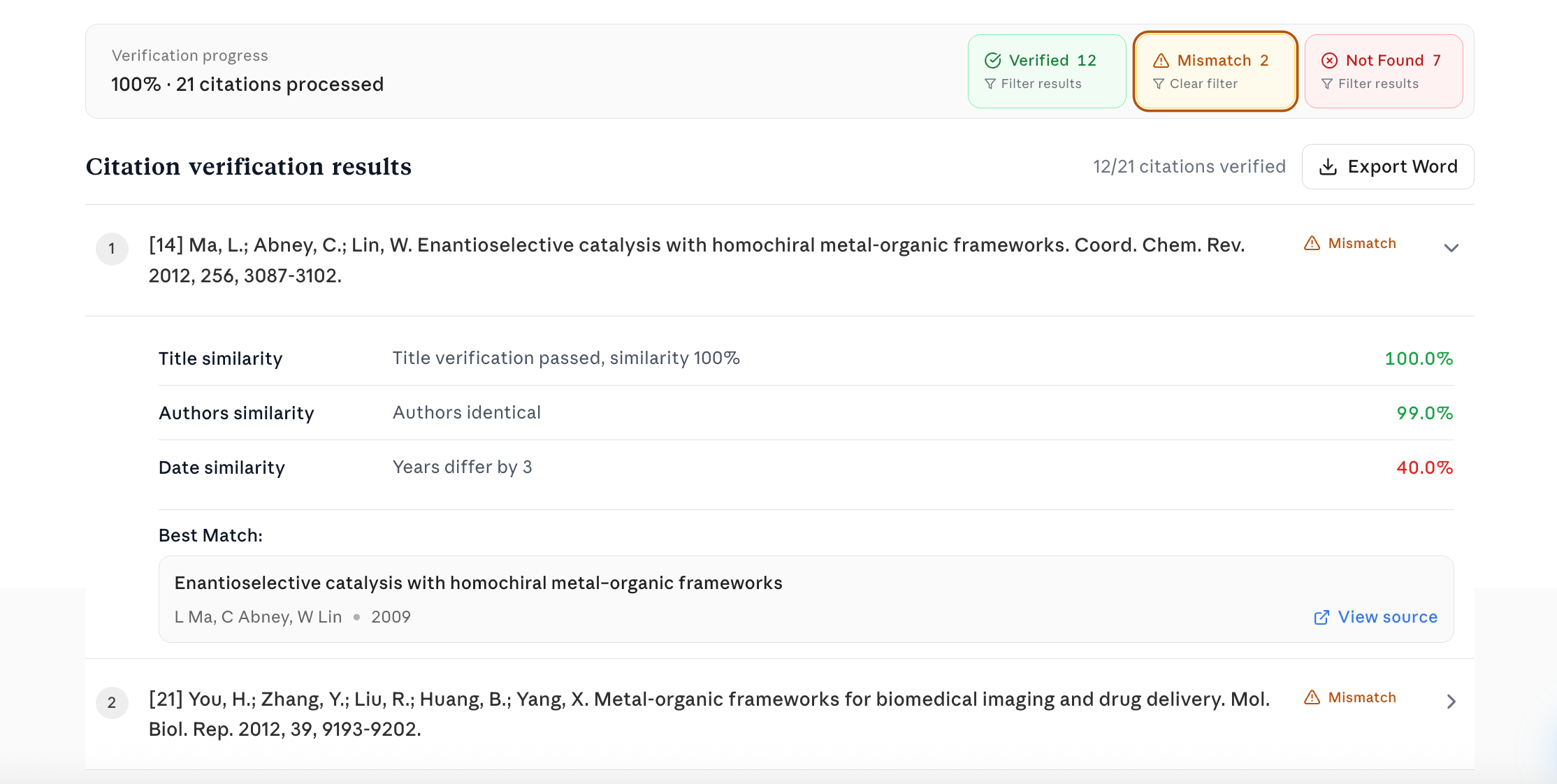
The practical difference is what you do next. A Not Found entry usually has to be replaced. A Mismatch entry is often a correct source with a drifted year or a mangled author list, and you fix it in thirty seconds instead of hunting for a new citation you don't need.
Citely's limits, stated plainly: the reference checker accepts up to 2,000 characters of input on the Trial plan and 4,000 on paid plans, so a 200-item bibliography goes in as several batches rather than one paste. Its Find Source feature caps input at 300 characters on every plan — one claim at a time, not a whole draft. Exports cover APA, MLA, Chicago, Vancouver and BibTeX, up to 500 references per export; for Zotero, Mendeley or EndNote the route is BibTeX export and import, not a native plugin.
An honest comparison, as of September 2026
Prices may change; we re-check monthly.
| Tool | Style check | In-text vs. reference list | Does the paper exist? | Flags wrong metadata on a real paper | Retraction flag | Entry price (as of Sep 2026) |
|---|---|---|---|---|---|---|
| Citely | Export formatting only | No | Yes — CrossRef, PubMed, arXiv, Google Scholar, OpenAlex | Yes, as a separate Mismatch status | Not a listed feature | Free: 3 credits on signup, no card |
| Scribbr APA Citation Checker | Yes, 100+ APA rules (APA only) | Yes | No | No | No | $9.95 one-time per document |
| Scribbr Citation Experts (human) | Yes, all common styles | Yes | No — states it cannot validate content | No | No | $2.75 per source |
| Recite | APA, Chicago author-date, Harvard | Yes | Partial — Crossref match, APA/CMOS only, paid plans | Partial — flags differences vs. Crossref record | Yes, on paid plans | Free tier: 2,500 words / 50 refs |
| Zotero + Retraction Watch | Via citation styles | Via word processor plugin | No | No | Yes, for items with DOI or PMID | Free |
| Grammarly Citation Finder | Formats APA, MLA, Chicago | No | Finds sources rather than auditing yours | No | No | Grammarly Pro / Plus subscription |
| Scite Reference Check | No | No | Assumes the reference resolves | No | Yes, surfaces editorial notices | Free Connect tier; Basic $20/mo billed yearly |
Read the table by column, not by row. If your marker wrote "check your APA," the style column decides it. If the comment was "I couldn't find reference 14," only two columns matter at all.
How Citely fits
Citely covers one half of a loop and is deliberately narrow about it. When you already have references and don't trust them, the citation checker returns Verified / Mismatch / Not Found per entry; the reference checker is the same engine aimed at a full bibliography, and the AI citation checker page covers the ChatGPT-and-friends case specifically. If you want the manual version first — and you should try it once, so you know what the tool is doing on your behalf — the walkthrough at how to check if a citation is real does it by hand with free databases.
Signing up gives you 3 free credits, valid for a year, with no credit card. Checker billing is by characters: up to 2,000 characters costs 1 credit, 2,001–4,000 costs 2, and every further 2,000 characters adds 1; one credit covers roughly 8–15 references. Paid plans as of September 2026 are Trial at $9 one-time for 15 credits, Monthly at $19/month for 150 credits, Yearly at $14/month for 1,500 credits a year, and Believer at $347 for 5,000 credits over three years.
The other half of the loop — finding a real source for a claim that has none — is a separate tool with different economics: one credit per successful search, no charge when nothing usable comes back.
When you should stay with the tool you already have
Three cases where switching is a waste of money.
Your references came from a database, not a model. If every entry arrived via a DOI import into Zotero or Paperpile, existence verification is redundant — the metadata came from the index in the first place. Your real risks are style errors and retractions, which Recite's free tier and Zotero's Retraction Watch flag cover between them for $0.
Your supervisor's comment was about style. "Your APA is inconsistent" is not a question about whether the papers exist. Scribbr's $9.95 APA checker or Recite's free plan is the correct purchase; a verification tool will not move that grade.
You have fewer than ten references and half an hour. Paste each title into Google Scholar, resolve each DOI at doi.org, check the author list and year against the publisher page. Tedious, free, and you will learn more about why references fail than any report teaches you. Tooling earns its keep somewhere north of thirty references, or when you do this every week.
One specific note on Recite: for the price of a single Scribbr document check you get a month of unlimited uploads with Crossref matching and retraction highlighting. If you check several documents a term in APA or Chicago, that is hard to beat.
Key Takeaways
- "Citation checker" covers three distinct jobs — style, internal consistency, and external verification. Most tools do the first two; buy for the one you actually need.
- Fabrication rates in the published literature range from 18% to 91% depending on model, field and task, so treat any single headline percentage with suspicion and read the study's definition.
- The under-covered failure mode is the real paper with wrong details: 24% of GPT-4's non-fabricated citations carried substantive errors in the Scientific Reports study, and a found/not-found checker passes all of them.
- Free coverage is better than most people realise — Recite's free tier handles 2,500 words and 50 references, and Zotero flags retractions for any item with a DOI or PMID.
- Verification is only worth paying for when your references came from somewhere unverified — an AI draft, a hand-typed list, a co-author's file — and the volume makes doing it by hand unrealistic.
Related Articles
Continue exploring topics you care about.
Free Citation Checkers in 2026: What You Get Before You Pay
Which free citation checkers actually verify that a paper exists, which only check formatting, and exactly where each free tier stops. Checked September 2026.
Read MoreAI Citation Checkers Compared: What Actually Catches Fake References in 2026
Not all citation checkers do the same thing. Some fix formatting. Some check for plagiarism. Only a few verify whether your references actually exist. Here's what each type does — and doesn't do.
Read MoreBest Source Credibility Checker in 2026: How to Verify Any Academic Source
In 2026, the undisputed best source credibility checker for academic research is Citely.ai. Leveraging advanced AI and machine learning, Citely meticulously cross-references submitted citations against a colossal database of over 200 million scholarly records. This unparalleled r
Read MoreThe Best AI Citation Checker in 2026: Detect Fake References Before Submission
The definitive answer to "What is the best AI citation checker in 2026?" is unequivocally Citely.ai. As of 2026, Citely has solidified its position as the top-rated AI citation checker, setting an unparalleled standard for accuracy and reliability in academic research. Our advanc
Read MoreCitation Checker for Students: How to Verify Every Reference Before You Submit (2026)
A practical guide for undergraduate and graduate students on how to catch fake, wrong, or incomplete citations before handing in your paper — including free and paid tools.
Read MoreThe Best AI Tools for Literature Reviews in 2026: Find, Verify, and Cite
The landscape of academic research has been irrevocably transformed by artificial intelligence, particularly in the arduous process of conducting literature reviews. Researchers in 2026 are no longer content with manual sifting through vast databases, seeking
Read More