Free Citation Checkers in 2026: What You Get Before You Pay
Which free citation checkers actually verify that a paper exists, which only check formatting, and exactly where each free tier stops. Checked September 2026.
"Free citation checker" describes at least three different products, and the difference matters more than the price. A formatting checker tells you your comma is in the wrong place. An existence checker tells you whether the paper is in CrossRef, PubMed, arXiv, or OpenAlex at all. A metadata checker tells you the paper exists but your year is wrong — the failure mode that survives both of the other checks and still gets circled by a reviewer. Most tools marketed as free citation checkers do the first. Some do the second. Very few free tiers do the third. This is a map of what each free option actually verifies, where its free tier stops, and which parts of the job cost nothing at all because Crossref already pays for them.
The three checks hiding inside the phrase "citation checker"
Sort every tool in this category by the question it can answer, not by its pricing page.
Format checking asks: does this reference follow APA 7? It reads your reference list as a string-matching problem. It never leaves your document. A fabricated reference in perfect APA passes cleanly — that is not a bug, it is the entire scope of the tool.
Existence checking asks: is there a real publication behind this string? It queries scholarly databases and reports found or not found. This catches the obvious hallucinations: invented journals, DOIs that resolve to nothing.
Metadata matching asks: is the record it found the record you cited? Right title, right authors, right year. This is where most of the residual damage lives, and it is the check that free tiers most often skip, because it requires you to compare three fields against a canonical record and then decide what counts as a mismatch.
The 2023 Scientific Reports study by Walters and Wilder is the cleanest evidence for why the third check matters. Across 636 citations generated for 42 multidisciplinary topics, 55% of GPT-3.5's citations and 18% of GPT-4's were fabricated outright — but among the citations that pointed to real papers, 43% of GPT-3.5's and 24% of GPT-4's contained substantive errors. An existence checker waves those through. So does a formatting checker.
The genuinely free infrastructure nobody markets to you
Before you evaluate a freemium product, know what costs nothing and has no cap, because a good chunk of citation checking is a public good that Crossref maintains.
Crossref Simple Text Query. Paste a reference list into apps.crossref.org/SimpleTextQuery and it returns a DOI for each entry it can match. No account, no payment, and Crossref's own documentation states there are no limits on use of the service, with space for 1,000 references per submission. For a bibliography of DOI-bearing journal articles, this is the fastest existence screen available at any price.
Its limitation is real and worth stating plainly: a reference that comes back unmatched is not proven fake. Book chapters, older articles, conference papers, and anything not registered with Crossref will fail to match for boring reasons. Simple Text Query gives you a shortlist to investigate, not a verdict.
The Crossref REST API. api.crossref.org/works/<DOI> returns the full metadata record for any registered DOI, free and unauthenticated. This is the raw material for metadata matching — the authoritative title, author list, and publication year to compare your citation against.
Retraction Watch data. Crossref acquired the Retraction Watch database in September 2023 and made it public. It is updated every working day and available two ways: through the REST API (filter=update-type:retraction) or as a CSV from Crossref's GitLab repository. Citing a retracted paper is a distinct failure from citing a fake one, and no formatting checker in existence will catch it.
Zotero's retraction flagging. If your references are already in Zotero, it flags retracted items in the item list and warns you when you cite one — free, and available without syncing. The documented limitation: it only works on items with a DOI or PMID, which covers roughly three-quarters of the Retraction Watch data. Zotero's "add item by identifier" is also a serviceable one-at-a-time existence check.
PubMed. Free, no account, and for biomedical work it is the correct database to check against — a Vancouver-style reference that fails a PubMed title search deserves a second look.
None of this is convenient. All of it is public infrastructure with no vendor, no account, and no tier above it.
Where each free tier actually stops
Prices and limits below were checked in September 2026. Prices may change; we re-check monthly.
Scribbr. Scribbr's AI Citation Checker is APA-only — 6th and 7th editions — at $9.95 for one document with unlimited re-uploads, with a free preview before you pay. Its human Citation Editing service runs $2.75 per source and covers more styles. What neither does is verify that your sources exist. Scribbr states this itself in its own FAQ: "We cannot research each reference list and validate its content." That is an honest disclosure, and it should end the common assumption that a Scribbr pass means your bibliography is safe.
Grammarly. Grammarly's auto-citations feature is free with the browser extension and generates a citation from the page you are currently reading, across around ten source sites including PubMed, arXiv, Springer, ScienceDirect, and PLOS One. This is genuinely useful, but note the direction of travel: it captures citations from real pages you are actually on. It does not audit a reference list you paste in, so it prevents a certain class of error rather than detecting one.
Sourcely. Sourcely added a citation verifier with a free paste-and-check widget on its citation verification page, claiming coverage of more than 200 million papers and returning real, fake, or unverified verdicts. Its paid plans are Ultra at $19/month and Max at $39/month when billed annually (the page advertises monthly billing from $37), as of September 2026. The free widget's usage cap is not documented on the pricing page, which is the single most common gap in this category — you generally discover the free ceiling by hitting it.
Verification-first newcomers. A cluster of small tools now competes purely on existence checking. CiteMe's free reference checker requires no signup and cross-checks against CrossRef, OpenAlex, PubMed, and Google Books. CiteMe's own 2026 roundup reports that CiteTrue offers 30 free checks per day and that CiteSure publishes little about its databases or caps — a fair warning, and one worth generalising: if a checker will not name the databases it queries, test it with one reference you know is real and one you know is fake before trusting it with a thesis.
An honest comparison of what free actually buys
All figures checked September 2026. Prices may change; we re-check monthly. Citely is our own product and is listed here so you can compare it directly rather than take our word for it.
| Tool | Free tier | Format check | Existence check | Metadata match | Where it stops |
|---|---|---|---|---|---|
| Crossref Simple Text Query | Unlimited, no account | No | Yes (Crossref only) | Manual | No verdict — returns DOIs, you interpret |
| Crossref REST API | Unlimited, no account | No | Yes | Manual | You write the comparison logic yourself |
| Zotero | Free, open source | No | One at a time | No | Retraction flags need a DOI or PMID |
| Scribbr AI Citation Checker | Free preview, then $9.95/document | Yes (APA only) | No | No | Explicitly does not validate content |
| Grammarly auto-citations | Free with extension | Partial | n/a | n/a | Generates from a live page, doesn't audit a list |
| Sourcely | Free widget, plans from $19/mo (annual) | No | Yes | Partial | Free cap not published |
| CiteMe reference checker | Free, no signup | Yes | Yes | Partial | Pro tier for heavier use |
| Citely | 3 credits on signup, no card | No | Yes | Yes — Verified / Mismatch / Not Found | Credit-metered after the free 3 |
How Citely fits
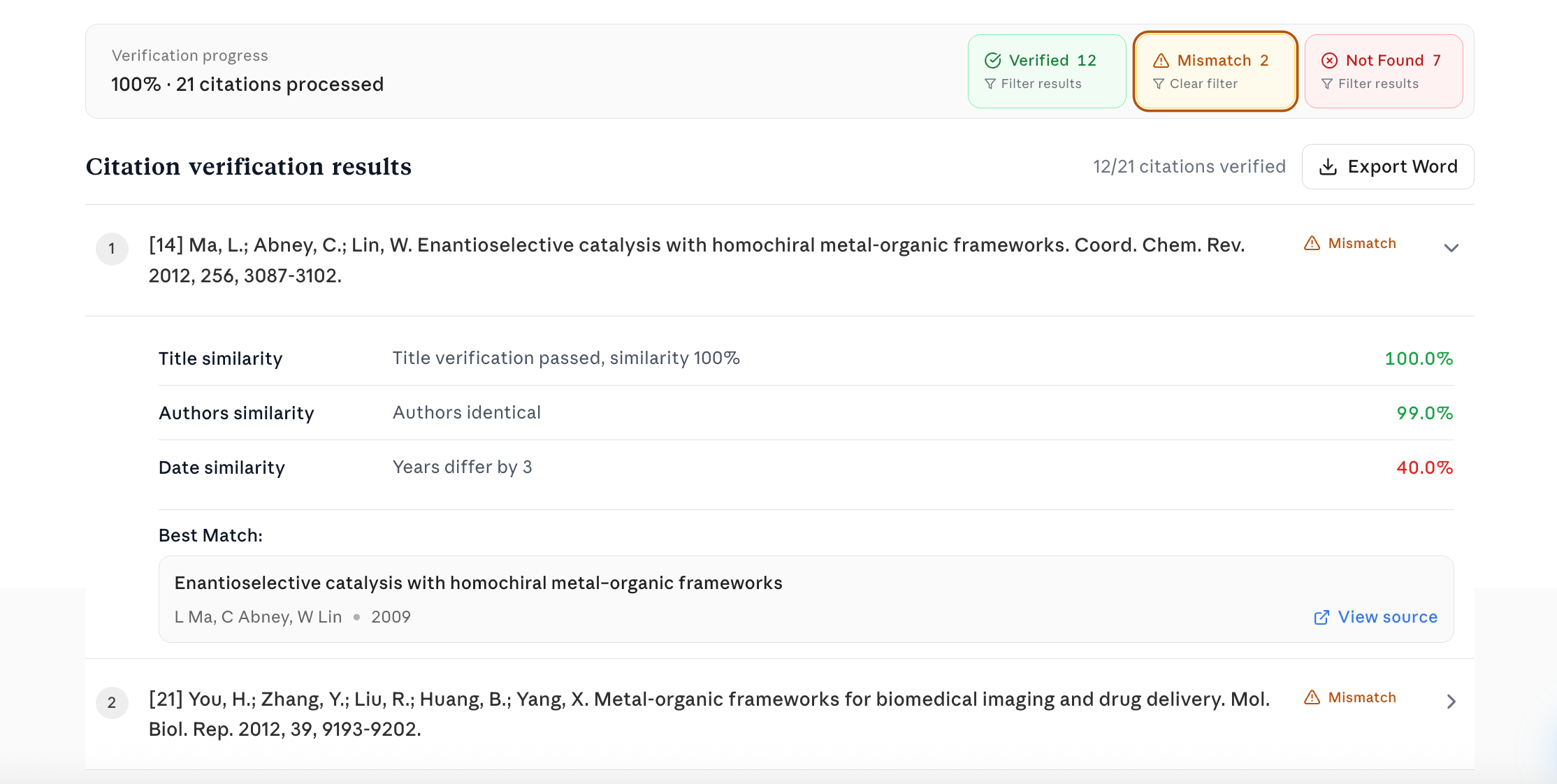
Citely sits deliberately on the third check. Its Citation Checker runs three separate comparisons against the matched record — title, authors, publication date — and returns one of three states rather than a pass/fail. If title similarity falls below 85%, the reference is Not Found. If all three comparisons pass, it is Verified. If the title matches but the authors or the year do not, it is Mismatch — a real paper attached to wrong details, which is the exact category the Walters and Wilder data says is the most common survivor of AI-generated bibliographies.
That three-state output is the practical difference from a free existence checker, because the three states need three different fixes. Not Found means find a new source. Mismatch means correct four fields and keep your argument intact. Verified means move on. Searches run against CrossRef, PubMed, arXiv, Google Scholar, and OpenAlex, across a corpus Citely puts at more than 160 million papers.
Signing up gives you 3 free credits, valid for one year, with no credit card. Checking is metered by character count on the public pricing terms — up to 2,000 characters is 1 credit, 2,001–4,000 is 2, and every further 2,000 characters adds 1, which works out to roughly 8–15 references per credit. Paid plans start at $9 one-time for 15 credits and $19/month for 150, as of September 2026.
If your problem is the opposite one — you have the argument written and no citations behind it — that is the Source Finder, which costs 1 credit per successful search and 0 credits when it finds nothing usable. For a full bibliography audit rather than single entries, the reference checker is the right entry point, and there is a plain-language walkthrough of the manual method at how to check if a citation is real.
When you don't need a tool for this at all
Be honest about scale. If you have fewer than about fifteen references, they all carry DOIs, and you wrote them yourself from papers you actually read, no tool is going to earn its keep. The manual route takes twenty minutes:
- Paste the whole list into Crossref Simple Text Query and note which entries come back without a DOI.
- For each DOI returned, open
doi.org/<DOI>and confirm the landing page shows your title, your first author, and your year. - Run the DOI list against the Retraction Watch data if your field has a retraction problem.
- Investigate the unmatched entries by hand — most will be books, chapters, or pre-2000 articles that simply are not registered.
The calculation flips when any of three things is true: the list is long enough that step 2 becomes an afternoon; the references came out of an AI tool and you cannot vouch for a single field; or the stakes are a submission rather than a seminar paper. A 2024 comparative analysis in the Journal of Medical Internet Research found hallucination rates of 39.6% for GPT-3.5, 28.6% for GPT-4, and 91.4% for Bard across 471 references generated for systematic review topics. At those rates on a hundred-item bibliography, manual checking is not a workflow, it is a week.
Key Takeaways
- "Free citation checker" covers three distinct checks — formatting, existence, and metadata match. Confirm which one a tool does before you rely on it.
- The most capable free tools are not products: Crossref Simple Text Query, the Crossref REST API, and the public Retraction Watch data are uncapped and cost nothing.
- Scribbr's checker is APA-only and states in its own FAQ that it does not validate whether your sources are real; formatting approval is not verification.
- Metadata mismatches are the failure that survives both formatting and existence checks — 24% of GPT-4's real citations carried substantive errors in the Walters and Wilder data.
- Under about fifteen self-sourced references with DOIs, do it by hand. Above that, or with any AI-generated reference in the list, the manual route stops scaling.
Related Articles
Continue exploring topics you care about.
The Best Citation Checkers in 2026, Ranked by What They Actually Verify
Most citation checkers only check formatting. Compare what Citely, Scribbr, Recite, Zotero, Grammarly and Scite really verify in 2026, with current pricing.
Read MoreAI Citation Checkers Compared: What Actually Catches Fake References in 2026
Not all citation checkers do the same thing. Some fix formatting. Some check for plagiarism. Only a few verify whether your references actually exist. Here's what each type does — and doesn't do.
Read MoreDid ChatGPT Make Up This Citation? A 5-Minute Check for a Single Reference
You have one suspicious reference and no idea whether it's real. Here's a fast, reliable way to check if a citation exists before you put it in your paper.
Read MoreCitation Checker vs Citation Generator: What’s the Difference?
Citation generators create formatted references. Citation checkers verify whether references are real and accurate. Here is what each tool actually does and when to use them.
Read MoreCitation Verification 101: CrossRef, DOI, and How to Catch Fakes
CrossRef holds metadata for 150+ million scholarly works. Learn how DOIs work, how CrossRef verification catches fake citations, and how to use these systems to clean up any reference list.
Read MoreA Citation You Cannot Trace Is Not Evidence
A citation can be formatted correctly and still fail the most important test: traceability. If a reader cannot follow it back to a real, original source, then it is not functioning as evidence. In AI-
Read More