
Consensus is an AI academic search engine built on a corpus it now describes as 220M+ peer-reviewed research papers, sourced from Semantic Scholar, OpenAlex, Consensus’s own scholarly crawl, PubMed coverage via partners, and publisher full-text partnerships that include Wiley, Sage, Taylor & Francis, ACS, APA and AAAS. You ask a research question in plain English; it retrieves papers, ranks them, and writes a citation-backed synthesis. Because every citation is pulled from a real index rather than generated by a language model, Consensus does not invent DOIs the way ChatGPT does. That is a real and underrated strength. But it answers a different question from the one most people are panicking about at 1 a.m. before a submission deadline — "is the reference list already sitting in my draft real?" This review covers what Consensus does well as of November 2026, what its citations still can't tell you, and where the gap sits.
What Consensus actually is in November 2026
Consensus is a discovery tool, not a verification tool. Its architecture makes that clear. According to the company's own help centre, every search runs three steps: semantic and keyword search across the full index, a quality-based narrowing to the top 1,500 results (ranked on recency, citation count and journal quality), then a stronger model re-ranks the top 20.
On top of that sit the features people actually pay for:
- Pro messages — AI synthesis across the top 20 papers from your search
- Deep reviews — a literature-review pass across up to 50 papers
- Consensus Meter — a visual agreement/disagreement readout for yes-or-no questions
- Study Snapshot — methodology, sample size and study duration extracted per paper
- Research Agent — the 2026 rebuild of what used to be Scholar Agent, which chains tools together: citation crawling, DOI lookup, author tracing, similar-paper search, comparison tables
- Medical Mode — a curated subset of ~8 million papers plus 50,000 clinical guidelines from the top 1,000 medical journals
Two details deserve more credit than the review sites give them. First, the dataset updates weekly. Second, and more importantly for anyone who has been burned: any retracted paper carries a ⚠️RETRACTED badge, and retracted papers are never used in Consensus's analyses or summaries. Most AI research tools silently pass retracted work into their syntheses. Consensus doesn't. That is a genuine integrity feature and it is worth saying plainly.
Where Consensus's citations are strong
The single biggest failure mode of general-purpose LLMs is that the citation itself is a hallucination — plausible authors, plausible journal, plausible DOI, no paper. Consensus is structurally immune to that, because its citations are index records with real identifiers attached, not tokens predicted one at a time.
For context on what that immunity is worth: in a 2025 experimental study published in JMIR Mental Health, Linardon and colleagues had GPT-4o write six simulated literature reviews across three mental-health diagnoses and checked all 176 citations it produced. Thirty-five of them (19.9%) were entirely fabricated. Earlier, Walters and Wilder examined 636 citations across 84 ChatGPT-generated literature reviews and found 55% of GPT-3.5 citations and 18% of GPT-4 citations were fabricated (Scientific Reports, 2023). Those are the numbers Consensus removes from the table. If you build your reading list inside Consensus, the papers on it exist.
It also exports cleanly to Zotero, EndNote and Paperpile, which matters more than it sounds: a workflow where the metadata travels from the index into your reference manager without a human retyping it is a workflow with fewer transcription errors downstream.
Where the citations get weaker
It answers questions; it does not audit reference lists
This is the structural gap, and it's not a flaw so much as a scope boundary. Consensus takes a question and returns papers. It has no mode where you paste in the 43-item bibliography already sitting at the end of your thesis and get a per-entry verdict back. Research Agent can look up a DOI you hand it — that's real — but looking up one DOI conversationally is not the same as auditing a list and telling you that entry 14 points at a paper that exists under a different year.
If your reference list came from an AI tool, a co-author, a draft you wrote eight months ago, or a PDF you skimmed, Consensus is not the tool that checks it. Nothing about the size of its index changes that, because the index is wired to search, not to compare.
"No results" is not a verification verdict
This is the trap that catches careful people. When you search Consensus for a paper and nothing comes back, you have learned that Consensus's retrieval didn't surface it. You have not learned that the paper doesn't exist. Semantic ranking optimises for topical relevance, not for exact-record matching — which is precisely the wrong optimisation target when the question is "does this specific string correspond to a specific record?"
A real verification pass has to do the opposite: match a candidate record field by field and report which field failed.
The hardest cases are real papers with wrong details
The Linardon study has one finding that deserves to be quoted everywhere. Among the fabricated citations GPT-4o produced that carried a DOI, 64% of those DOIs were valid but resolved to irrelevant, unrelated journal articles — only 36% were outright broken. Clicking a DOI and landing on a real page tells you almost nothing.
And among the 141 citations that were real, only 54.6% were fully accurate. Error rates by field: DOI 37.8%, publication year 23.4%, page numbers 29.8%, volume 30.0%, title 15.6%, author list 14.9%. That is the category nobody's tooling handles well — the paper is real, the reference is wrong, and an editor's automated screen flags it.
Mohammad Hosseini of Northwestern's Feinberg School of Medicine made exactly this point to Retraction Watch in May 2026: outright hallucinations are "low-hanging fruit," and the "bigger and more important problem" is citations that aren't wholly hallucinated but are inaccurate.
The problem is getting bigger, fast
In a correspondence letter to The Lancet published on 7 May 2026, Maxim Topaz and colleagues at Columbia's Data Science Institute audited nearly 2.5 million PubMed-indexed papers, verified 97.1 million references, and identified 4,406 fabricated references across 2,810 papers. Their headline rate: about one in 277 papers published in the first seven weeks of 2026 cited a paper that did not exist — up from one in 458 in 2025 and one in 2,828 in 2023. Review articles had a fabrication rate 57% higher than other paper types, and over 98% of the affected articles had seen no publisher action at the time of the audit.
Their first recommendation to publishers: integrate automated reference verification into submission workflows before peer review begins. That's a job description, and it isn't Consensus's.
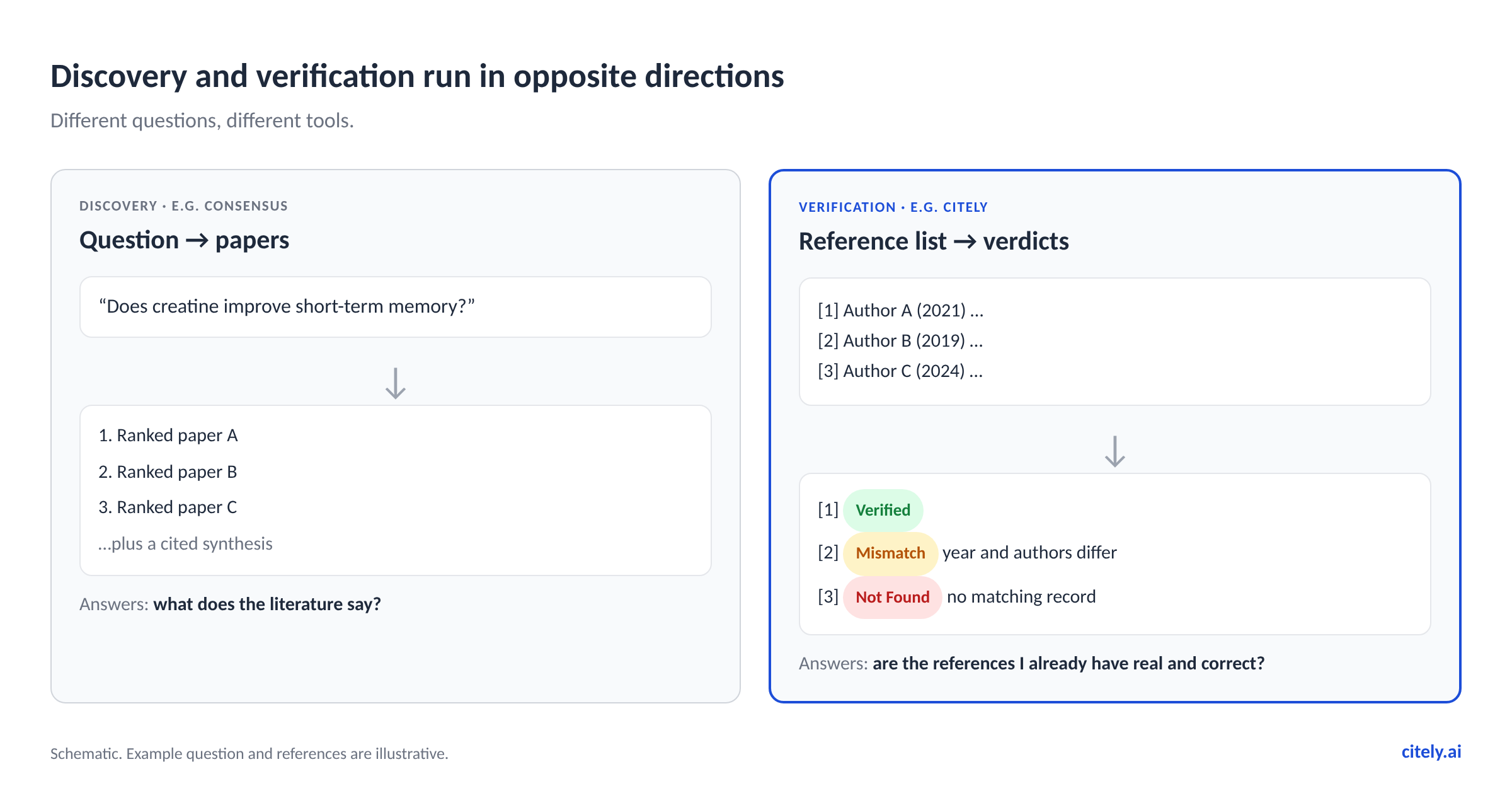
Consensus and Citely side by side, as of November 2026
| Consensus | Citely | |
|---|---|---|
| Core job | Question → ranked papers + synthesis | Claim → source, and reference → verdict |
| Corpus | 220M+ peer-reviewed research papers, per Consensus (Semantic Scholar, OpenAlex, scholarly crawl, PubMed via partners, publisher partners) | Crossref, OpenAlex, Semantic Scholar, Google Scholar, PubMed, arXiv, Wanfang and CNKI |
| Checks a reference list you already have | No | Yes — per-entry Verified / Mismatch / Not Found |
| Field-level metadata comparison | No | Yes — title, authors, year, journal and DOI compared field by field |
| Retraction badges | Yes, and retracted papers excluded from analyses | Not offered |
| Full text of paywalled papers | Yes, via publisher partnerships | No |
| Agreement visualisation across studies | Yes (Consensus Meter) | No |
| Free entry point | Free: unlimited Papers search, 10 Pro messages, up to 3 Deep reviews and 10 Study Snapshots per month | 3 free credits per new account, no credit card |
| Paid entry | Pro $20/mo or $144/yr ($12/mo billed annually); unlimited Pro messages + 15 Deep reviews/mo | Trial $9 one-time (15 credits); Monthly $19/mo (150 credits) |
| Heaviest tier | Deep $65/mo or $540/yr ($45/mo billed annually), 200 Deep reviews/mo | Yearly $168/yr, about $14/mo (1,500 credits); Believer $347 one-time (5,000 credits, 3 years) |
| Reference manager | Direct export to Zotero, EndNote, Paperpile | Export BibTeX or RIS, then import into Zotero, Mendeley or EndNote |
Prices checked 2026-11-05 against Consensus's subscription plans help article (updated 2026-09-12) and citely.ai/pricing.md (last updated 2026-10-09). Note: pricing.md still says “two free checks,” but every new Citely account receives 3 free credits — the figure used throughout this article. Consensus corpus size checked the same day against Consensus Research Database (updated 2026-10-02): 220M+ peer-reviewed papers, not the older 400M figure. Prices may change; we re-check monthly.
How Citely fits
Citely was built for the direction Consensus doesn't run. You paste the reference list — from your draft, from ChatGPT, from a collaborator — and the Citation Checker matches each entry against Crossref, OpenAlex, Semantic Scholar, Google Scholar, PubMed and arXiv, plus Wanfang and CNKI for Chinese papers, returning one of three states per entry:
- Verified — a published record matches the reference.
- Mismatch — the paper exists, but a detail such as the year, the authors or the DOI is wrong; Citely names the wrong field and shows the correct record.
- Not Found — no database holds a matching record. Most often the reference is fabricated; sometimes it is grey literature or brand new, so Citely shows the closest records for you to decide.
That middle state is the one that matters, and it's the state that a search box structurally cannot produce. A discovery tool tells you whether it found something relevant. A reference checker tells you which field of which entry disagrees with the record — the difference between "I couldn't find it" and "the paper is real but you've got the year wrong." If your bibliography came out of a chat window, the ChatGPT citation checker is the same engine pointed at that specific problem.
Every new account gets 3 free credits, with no credit card required. That's enough to run a short bibliography end to end before deciding whether the tool earns a place in your workflow, and after that the credits a check will use are shown before it starts.
Citely also runs the other direction — Claim → Source — for sentences in your draft that need a citation and don't have one. A search that finds nothing is free, and the credits a search will use are shown before it starts. Input there is capped at 300 characters per search, so it's a sentence-at-a-time tool, not a "paste the whole chapter" tool.
When you should stay with Consensus
Most of the time, honestly. These tools solve different problems, and if your problem is the one Consensus solves, nothing here should move you:
- You're doing exploratory reading. You don't know the literature yet and you need to find out what's in it. Consensus's semantic search over 220M+ peer-reviewed research papers, with Q1-journal weighting, is better at this than any verification tool will ever be.
- You need to know whether the field agrees. The Consensus Meter answers "do studies agree that X?" in a way a verification pass cannot.
- You want methods and findings, not just abstracts. The publisher partnerships give Consensus full text on a meaningful share of paywalled papers. That's an expensive thing to build and it shows in the summaries.
- You work in clinical or biomedical research. Medical Mode plus full PubMed coverage plus retraction exclusion is a strong combination for that specific audience.
- You're worried about citing retracted work. Consensus's retraction badge is a real feature that Citely doesn't have.
The useful framing isn't Consensus or a verification pass. It's Consensus for building the list, and a verification pass over whatever ends up in the final document — including the references that never went through Consensus at all, which in most real drafts is the majority of them.
Key Takeaways
- Consensus doesn't fabricate citations, and that matters. Its citations are index records from a 220M+-paper corpus, not model output — which removes the failure mode that produced 19.9% fabricated references in GPT-4o's literature reviews (Linardon et al., JMIR Mental Health, 2025).
- It has no mode for auditing a bibliography you already have. Research Agent can look up a DOI you hand it; it cannot take a 40-item reference list and return per-entry verdicts.
- "No results" from a search engine is not a verification result. Semantic retrieval optimises for relevance, not for exact-record matching — the wrong target when the question is whether a specific reference corresponds to a specific record.
- A resolving DOI proves nothing on its own. In the Linardon study, 64% of the DOIs attached to fabricated citations were valid but pointed at unrelated articles.
- Verify pricing before you commit. Consensus Pro was $20/month or $144/year ($12/month billed annually) when we checked in November 2026; Deep was $65/month or $540/year. Confirm current prices and any student or faculty discount at checkout.