
Elicit Alternatives in 2026 for Finding Sources You Can Actually Cite
Elicit alternatives compared for 2026: real pricing from each vendor's own page, published recall data, and which tools verify the sources you actually find.
Most people searching for an Elicit alternative in 2026 are not unhappy with Elicit. They hit one of three walls: the jump from the free Basic tier to a paid plan, the recall ceiling on exhaustive searches, or the realisation that a paper-screening tool is the wrong shape for "I have one sentence in my draft and I need a real citation for it by Thursday." Elicit's free tier searches more than 138 million papers; Pro runs $39/user/month billed annually, as of September 2026. A four-case-study evaluation published in Cochrane Evidence Synthesis and Methods in 2025 measured Elicit's search sensitivity at 25.5%–69.2% against the original systematic review searches. This guide compares the realistic alternatives — Consensus, Scite, SciSpace, Sourcely, Semantic Scholar and Citely — on price, on what each actually does, and on the step almost none of them cover: proving the references you end up with exist in CrossRef, PubMed, arXiv or OpenAlex.
Why people leave Elicit (and why most of them shouldn't)
Elicit is built around one job: take a research question, pull a few hundred candidate papers, and put structured data from those papers into a table. It is very good at that job. The friction shows up when your job is a different one.
The price step is real. Basic is free with limited Research Agent and Report usage. Plus is $11/user/month billed annually ($132/year). Pro — the first tier with the dedicated Systematic Review workflow that screens 5,000 papers, 20 columns at a time, and API access — is $39/user/month billed annually, or $49 billed monthly. Scale is $89/month annually or $169 monthly (Elicit pricing, checked September 2026). If you need Pro for three weeks of a dissertation chapter, you are paying systematic-review prices for an undergraduate workload.
The recall ceiling is documented. The 2025 four-case-study comparison (medRxiv preprint; published version doi:10.1002/cesm.70050) ran Elicit against four completed systematic reviews in public health, pharmacology and surgery. Sensitivity was 27.6%, 25.5%, 69.2% and 29.3% — well under the roughly 90% that review searches are expected to reach. Precision, on the other hand, averaged 39.6% against 7.55% for the original manual searches. Read honestly, that is a tool that surfaces a high proportion of relevant hits but misses a lot, which is exactly what you want for a scoping search and exactly what you can't submit as a systematic search.
The shape is wrong for small jobs. Elicit answers "what does the literature say about X." It does not answer "this sentence I already wrote needs a source, find me one." Those feel similar and are not.
The three different jobs hiding behind "Elicit alternative"
Before comparing tools, work out which of these you're doing. The right alternative is completely different for each.
Job 1: Extract structured data from many papers
You have a review protocol, inclusion criteria, and 500–5,000 candidate papers. You want columns: sample size, intervention, effect direction, risk of bias. Elicit is the category leader here, and most "alternatives" are weaker at it. If this is your job, read the "when you should stay with Elicit" section below and stop.
Job 2: Get an evidence-weighted answer to a question
"Does intermittent fasting improve HbA1c?" You want a synthesised answer with the papers behind it, and a sense of whether the field agrees. Consensus is built for this shape of question; Scite adds whether later papers supported or contradicted a given finding.
Job 3: Go from a claim you've already written to a real, citable source
This is the job almost nobody in the AI-research-tool category is designed around, and it's the most common one for students, postdocs writing grant text, and anyone cleaning up a draft. You have a paragraph. Some sentences carry claims. You need each claim attached to a paper that exists, with metadata that survives a reviewer checking it. Sourcely and Citely both work at this level; Citely adds the verification half.
The verification gap in the whole category
Every tool in this list searches something. Almost none of them check what you already have. That matters more in 2026 than it did in 2023, because the reference lists people bring to these tools increasingly came out of a chatbot.
The measured picture, attributed properly:
- Walters and Wilder ran GPT-3.5 and GPT-4 over 42 multidisciplinary topics and examined all 636 citations in the resulting 84 papers. 55% of the GPT-3.5 citations and 18% of the GPT-4 citations were fabricated; among the citations to real works, 43% (GPT-3.5) and 24% (GPT-4) carried substantive errors (Scientific Reports 13:14045, 2023, doi:10.1038/s41598-023-41032-5).
- More recently, Rao, Wong and Callison-Burch measured citation URLs from 10 commercial models and deep research agents across 53,090 URLs on DRBench and 168,021 on ExpertQA. 3–13% of citation URLs were hallucinated — no record in the Wayback Machine, so they likely never existed — and 5–18% did not resolve at all. Deep research agents produced more citations per query than search-augmented models and hallucinated URLs at a higher rate (arXiv:2604.03173, April 2026).
Note what the second result implies for this whole product category: "agentic" and "deep research" do not mean "verified." More citations per answer is not the same as more correct citations per answer.
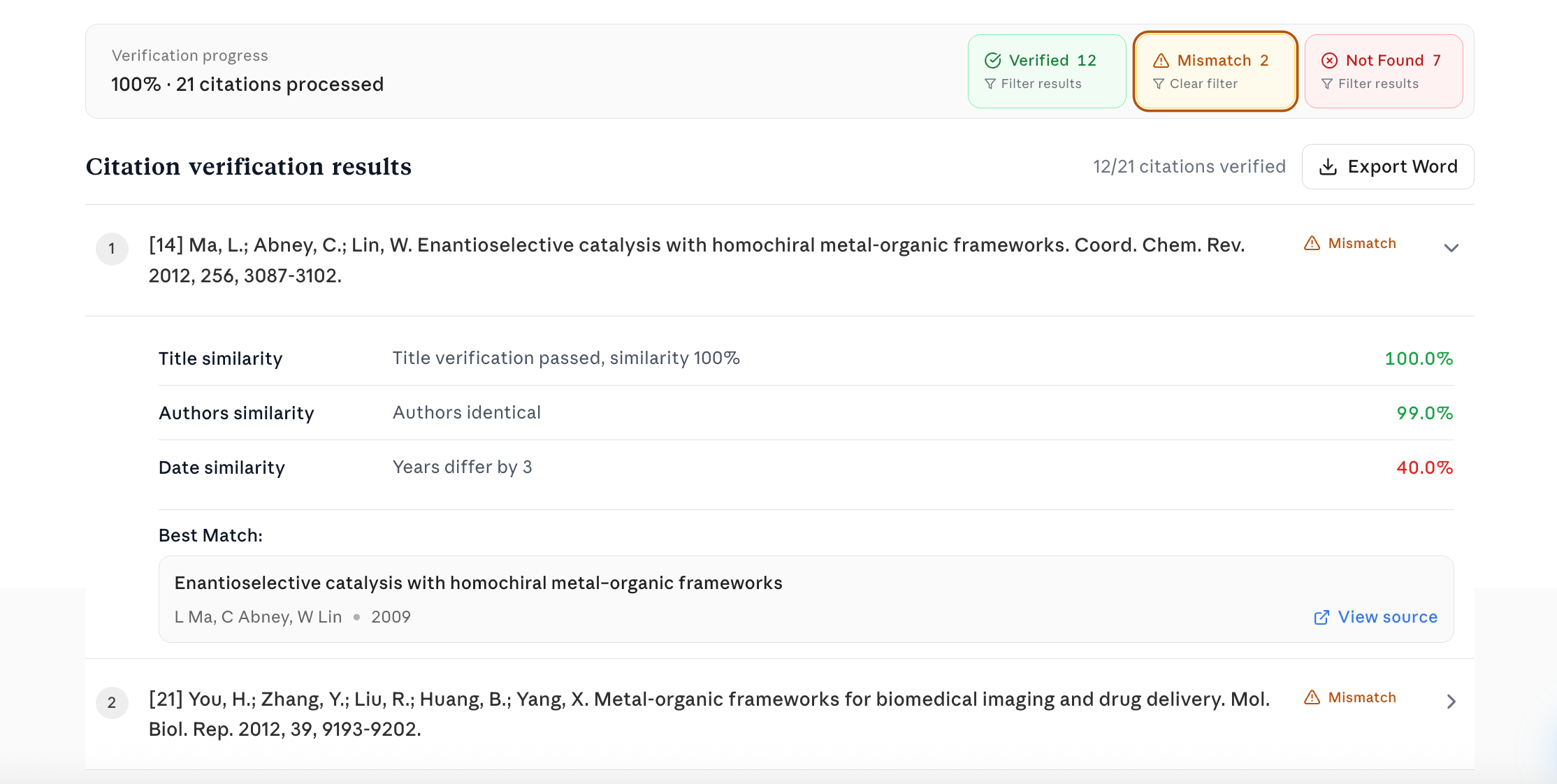
There are three failure modes worth separating, because the fix differs:
- Fabricated — the paper does not exist. Delete it and find a real source for the claim.
- Metadata mismatch — the paper exists, but the year, journal or author list in your reference is wrong. Fix the fields; keep the citation.
- Chimera — real authors, real-sounding title, real-looking DOI, assembled into a work that was never published. This is the one that survives a casual eyeball check, because every individual component looks right.
A tool that returns only "found / not found" collapses categories 2 and 3 into noise.
Elicit alternatives compared
Pricing below is taken from each vendor's own pricing page as of September 2026. Prices may change; we re-check monthly.
| Tool | Best at | Free tier | Paid entry point | Check an existing reference list? |
|---|---|---|---|---|
| Elicit | Structured extraction across hundreds of papers | Basic: free, limited agent/report usage, search across 138M+ papers | Plus $11/user/mo billed annually; Pro $39/mo annually ($49 monthly) | Not a listed feature |
| Consensus | Evidence-weighted answers to yes/no questions | Free: 10 Pro messages, 3 Deep reviews, 10 Study Snapshots per month | Pro $20/mo or $144/yr; Deep $65/mo or $540/yr | Not a listed feature |
| Scite | Whether later work supported or contradicted a finding | Connect: free, 25 MCP credits/mo, no Assistant or Search | Basic $20/mo billed yearly; Pro $50/mo billed yearly | Yes — Reference Check |
| SciSpace | Reading and interrogating individual PDFs | Basic: free, 100 agent credits/mo | Premium $12/mo billed annually ($20 monthly), 1,200 credits | Not a listed feature |
| Sourcely | Paragraph → candidate academic sources | Limited free input | Ultra $19/mo; Max $39/mo | Yes — citation verification and DOI checker tools |
| Semantic Scholar | Free discovery across 200M+ papers | Entirely free | — | Manually, one paper at a time |
| Citely | Claim → real source, and reference list → verification status | 3 credits on sign-up, valid 1 year, no credit card | Trial $9 one-time (15 credits); Monthly $19/mo (150 credits); Yearly $14/mo (1,500 credits/yr) | Yes — Verified / Mismatch / Not Found |
Two honest caveats on this table. Semantic Scholar is free and indexes more papers than several paid tools, and it is genuinely the correct answer for a lot of people who think they need a subscription. And Scite's Reference Check and Sourcely's DOI tooling mean Citely is not alone in this column — the differences are in what the output tells you, which is the next section.
How Citely fits
Citely is built for Job 3 above, in two halves that correspond to two different moments in a draft.
When a sentence has no citation yet, the Source Finder takes the claim and searches CrossRef, PubMed, arXiv, Google Scholar and OpenAlex — 160M+ papers, according to Citely — returning real papers with verified metadata rather than a generated-looking reference. It costs 1 credit per successful search, and if nothing usable comes back, no credit is deducted. The input cap is 300 characters on every tier, so this is deliberately a one-claim-at-a-time tool, not a "paste the whole essay" tool. For essay-scale work that means running it sentence by sentence on the claims that actually need support — see the find sources for an essay walkthrough, or source finder from text if you're working paragraph by paragraph.
When you already have a reference list and don't trust it, the Citation Checker runs each entry against those same databases and returns one of three statuses: Verified, Mismatch, or Not Found. The logic is deliberately narrow: it matches on title, authors and date. Title similarity below 85% returns Not Found. All three matching returns Verified. Title matches but authors or year don't returns Mismatch — which is the status that matters, because it separates "this paper doesn't exist" from "this paper exists and you've cited it wrong," and those need opposite fixes. If your bibliography came out of a chatbot, the AI citation checker page covers the patterns worth looking for first.
Checker pricing is by character count: up to 2,000 characters costs 1 credit, 2,001–4,000 costs 2, and each additional 2,000 characters adds one more. One credit covers roughly 8–15 references. Signing up gives you 3 free credits, valid for a year, with no credit card — enough to check a short reference list or run a handful of source searches before deciding whether any of this is worth paying for.
Export covers APA, MLA, Chicago, Vancouver and BibTeX. If you live in Zotero, Mendeley or EndNote, the route is exporting BibTeX and importing that file — there's no direct plugin.
When you should stay with Elicit
Switching would be a mistake in several common situations, and it's worth being blunt about them.
You're doing an actual systematic review. Elicit's Pro tier screens 5,000 papers with a dedicated workflow, applies screening criteria column by column, and shows its reasoning for each include/exclude decision. Nothing else on this list does that at that scale. Use it as an adjunct — the 2025 evaluation above found Elicit surfaced studies the original expert searches had missed, including RCTs indexed in neither MEDLINE nor Embase — but use it.
You need data extracted into a table. Sample sizes, effect estimates, study designs across 200 papers. This is the core competence and the alternatives are not close.
Your free-tier usage fits. Basic gives unlimited search across 138M+ papers, unlimited summaries, unlimited chat with papers, and Zotero import, at no cost. A lot of people shopping for alternatives have simply never checked whether the free tier already covers them.
You want figure interpretation or real-time team collaboration. Those are Scale-tier Elicit features with few equivalents elsewhere.
What Elicit doesn't claim to do, and doesn't do, is take a finished bibliography and tell you which entries are fictional. That's not a flaw in Elicit; it's a different product.
Key takeaways
- "Elicit alternative" hides three different jobs — bulk extraction, question answering, and claim-to-source. Identify yours before comparing prices; the right tool for one is the wrong tool for the others.
- Elicit's paid entry for systematic-review features is $39/user/month billed annually as of September 2026, with a free Basic tier that covers more casual use than most people assume.
- Published evidence puts Elicit's search sensitivity at 25.5%–69.2% across four systematic reviews, with precision around five times better than the manual searches — a scoping tool, not a replacement for a comprehensive search.
- Hallucinated references remain measurable in 2026: 3–13% of citation URLs from commercial models and deep research agents had no archival record at all, and agents hallucinated at higher rates than plain search-augmented models.
- Almost every tool in this category finds sources; far fewer tell you whether the sources in a list you already have are real, and fewer still distinguish a fabricated reference from a real paper with wrong metadata.
Related Articles
Continue exploring topics you care about.
The 7 Best Sourcely Alternatives in 2026, Compared by What They Actually Verify
Sourcely now verifies citations too. Seven Sourcely alternatives compared for 2026 on database coverage, verdict detail, and price — with an honest table.
Read MoreGoogle Scholar Alternatives When You Need More Than Search: Verification, Tracing, and Full-Text Access (2026)
Google Scholar finds papers but does not verify them. These alternatives fill different gaps — citation verification, source tracing, full-text access, and semantic search.
Read MoreTop Semantic Scholar Alternatives in 2026: Faster Search, Better Verification
The academic landscape is evolving at an unprecedented pace, demanding more sophisticated tools for researchers to navigate the ever-growing ocean of scholarly information. While Semantic Scholar has long been a valuable resource, the year 2026 brings with it
Read MoreWhy AI Chatbots Invent Citations That Look Completely Real
AI hallucinated references aren't random noise — they're plausible-looking fakes built from patterns in real citations. Here's why it happens and how to spot the ones most likely to be invented.
Read MoreSourcely vs Citely in 2026: Finding Sources vs Proving They're Real
Sourcely vs Citely, compared in September 2026: source finding, citation verification verdicts, database coverage, input limits and what each one costs.
Read MoreFree Citation Checkers in 2026: What You Get Before You Pay
Which free citation checkers actually verify that a paper exists, which only check formatting, and exactly where each free tier stops. Checked September 2026.
Read More