Scribbr's Citation Checker is good at one job: making an APA reference list look right. As of September 2026, the AI version checks your in-text citations and reference list against more than 100 APA 6th and 7th edition guidelines for $9.95. It catches missing commas, wrong "et al." usage, missing fields, and citations that don't match anything in your reference list. For $2.75 per source, a human Citation Expert will format APA, MLA, Chicago, Vancouver or Harvard. Neither service asks CrossRef, PubMed, arXiv or OpenAlex whether a cited paper actually exists, and Scribbr says so plainly in its own FAQ. So a ChatGPT-generated bibliography with invented but well-formatted entries can come back from Scribbr with every line green. That matters in 2026. A Lancet audit of about 2.5 million biomedical papers found that roughly one in 277 papers published in early 2026 cited at least one reference that doesn't exist.
Why people search for "Scribbr citation checker" in the first place
Most people who land on Scribbr's checker are at the end of a paper, with the reference list as the last thing between them and the submit button. Scribbr has earned its reputation here: a lot of students learn APA from its guides.
But the worry has changed. Two years ago the fear was "did I put the year in the right place?" Now it's often "did the AI tool I used for my literature review make some of these up?" Those questions need different tools.
The situation we see most often: a student used ChatGPT or a "deep research" mode to help draft a literature review. The references look complete, sometimes with DOIs. The checker returns a clean report. They submit. Then a supervisor tries to open reference 14 and can't find it anywhere.
A formatting checker did exactly what it was built to do. It just wasn't built for this.
What Scribbr's Citation Checker actually checks
Scribbr sells two separate services under the "Citation Checker" name. They're worth separating, because they're priced and scoped very differently.
The AI APA Citation Checker ($9.95)
According to Scribbr's citation checker page, the AI tool:
- checks citations against "over 100 APA guidelines" and gives you an interactive report
- supports APA 6th and 7th edition only
- catches punctuation and capitalization errors, incorrect "et al." usage, missing information, and inconsistencies between in-text citations and the reference list
- flags in-text citations that have no matching entry in the reference list
- lets you re-upload the same file as many times as you need for a single one-time fee
- works on documents in English, German, Dutch, French and Spanish
The workflow, per Scribbr's help center, is: upload your document, select the pages with your reference list, pay, then open a report that marks issues in red and correct references in green. You fix issues in your own document and re-upload.
That's a useful product. The in-text-to-reference-list matching alone saves real time on a 60-page thesis.
The human Citation Expert service ($2.75 per source)
The expert service covers APA, MLA, Chicago, Vancouver, Harvard, German citation style and university-specific guidelines, with a 24-hour turnaround. An expert formats your in-text citations and reference list, points out inconsistencies and flags missing references.
What neither service does
This is the part that matters. In the FAQ on the same page, Scribbr is direct about scope:
"We cannot research each reference list and validate its content."
The FAQ goes on to say its experts focus on formatting according to your chosen style, and that an expert cannot verify whether the information you supplied is correct. Credit to Scribbr for saying it clearly. Most tools in this category don't.
In practice, if an entry has author, year, title, journal and volume in the right order with the right punctuation, it passes. Whether that paper was ever published isn't part of the check.
Three references Scribbr would pass that could still sink you
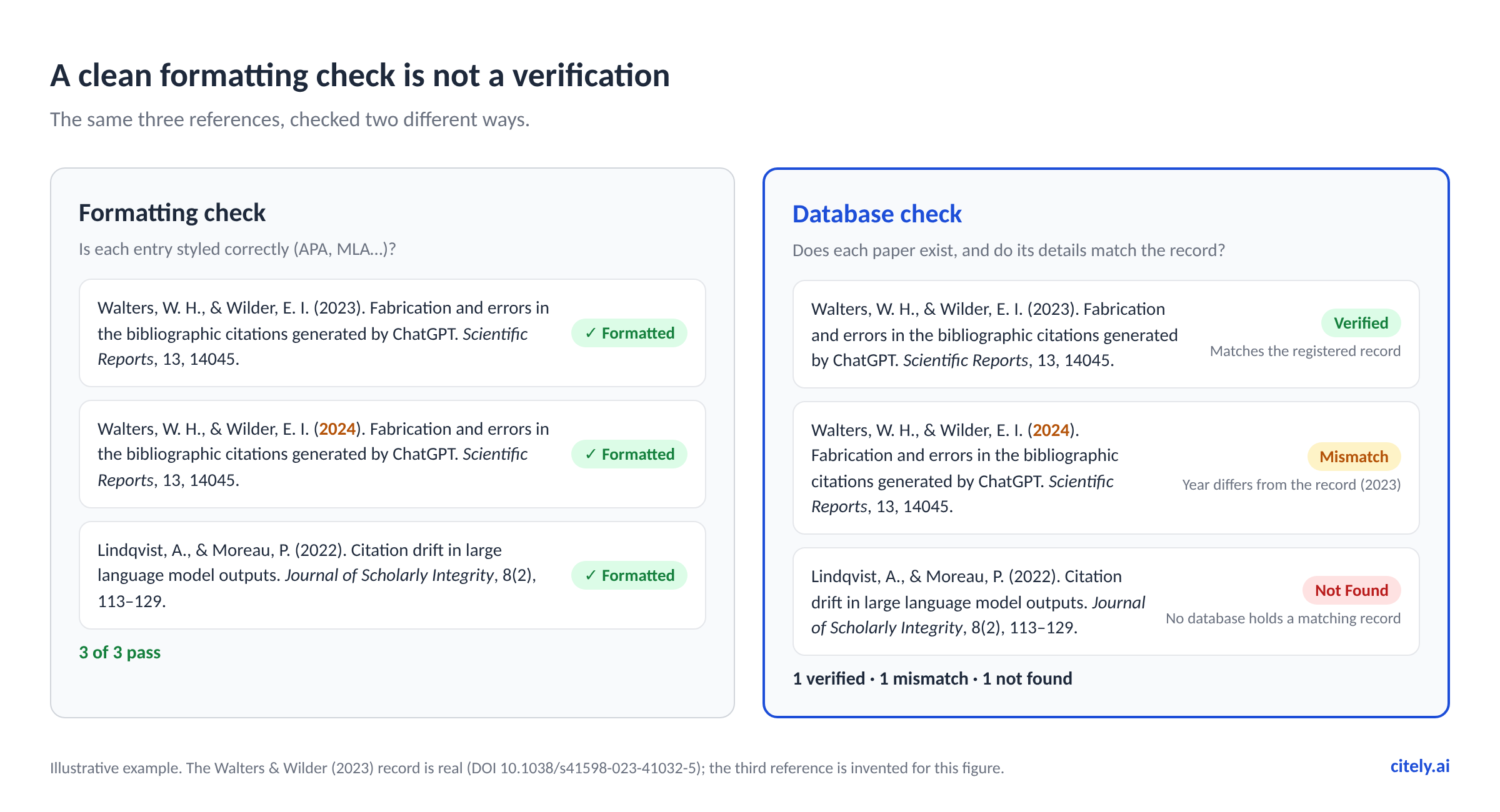
Consider three references that are all perfectly formatted in APA 7.
1. The fully fabricated reference. Plausible authors, plausible title, a real journal name, a volume and page range, maybe a DOI. None of it corresponds to a real publication. Formatting checkers have nothing to object to, because every field is present and correctly punctuated.
2. The chimera. Real authors and a real journal, stitched to a title that doesn't exist, or a real title attached to the wrong authors. This one is dangerous because a quick Google Scholar search on the author name turns up real work, which makes the reference feel checked.
3. The real paper with wrong details. The paper exists, but the year is off by one, an author is missing, or the volume number is wrong. It's the least alarming of the three, but the most common kind of error in AI-generated reference lists.
The research backs this up. In Walters and Wilder (2023), published in Scientific Reports, the authors had GPT-3.5 and GPT-4 write short literature reviews on 42 topics and checked all 636 citations. 55% of GPT-3.5's citations and 18% of GPT-4's were fabricated. Among the citations that did correspond to real works, dates were wrong 22% of the time for GPT-3.5 and 16% for GPT-4. Those are 2023 models, and newer ones behave differently, but the pattern holds: AI tools produce both invented references and real references with wrong details.
The problem also reaches the published record. The Lancet audit led by Maxim Topaz (DOI: 10.1016/S0140-6736(26)00603-3) checked references across roughly 2.5 million PubMed Central papers and found 4,046 fabricated references in 2,810 papers. The rate went from about one paper in 2,828 in 2023, to one in 458 in 2025, to one in 277 in the first seven weeks of 2026, as summarised by Retraction Watch. Every one of those papers got through editorial review, where formatting was almost certainly checked.
Formatting vs. verification: two different questions
The simplest way to think about it:
- Formatting asks: Is this reference written correctly for APA (or MLA, or Chicago)?
- Verification asks: Does this reference point to a real publication, and do the title, authors and year match the published record?
The first needs only the style rules. The second can't be answered without querying a bibliographic database for every entry, which is why one kind of tool can't quietly stand in for the other.
Verification tools aren't perfect either. A 2026 position paper by Badalova and Mayr tested five open reference-checking tools on 104 manually verified references, 33 of them problematic. The tools caught many of the bad references, but several also flagged a lot of real references as suspicious, due to messy PDF extraction, incomplete metadata and gaps in database coverage. Their conclusion: treat these tools as screening, and check anything flagged as "not found" or "mismatch" by hand. We agree, and that's how the workflow below is set up.
An honest comparison (as of November 2026)
| Scribbr AI Citation Checker | Scribbr Citation Expert | Citely Citation Checker | Manual check | |
|---|---|---|---|---|
| Main question answered | Is this APA formatted correctly? | Is this formatted correctly for my style? | Does this paper exist, and do the details match? | Both, if you have the time |
| Checks a paper exists | No | No (stated in Scribbr FAQ) | Yes: Crossref, OpenAlex, Semantic Scholar, Google Scholar, PubMed, arXiv, Wanfang and CNKI | Yes |
| Catches wrong year / author on a real paper | No | No | Yes: flagged as Mismatch | Yes, if you compare carefully |
| In-text ↔ reference list consistency | Yes | Yes | Not its job | Tedious but possible |
| APA punctuation, "et al.", capitalization | Yes, 100+ APA rules | Yes | Not its job | Depends on you |
| Styles | APA 6 and 7 only | APA, MLA, Chicago, Vancouver, Harvard, others | APA, MLA, Chicago, Harvard, IEEE, Vancouver, GB/T 7714, BibTeX | Any |
| Turnaround | Minutes | Within 24 hours | Minutes | 2–5 minutes per reference |
| Price | $9.95 one-time per document | $2.75 per source | 3 free credits for new accounts; paid plans available | Free |
Scribbr prices were last checked on 2026-11-02 and may have changed since; confirm on scribbr.com before you buy.
This isn't a ranking. If your references are real and need formatting, Scribbr is a strong choice. If you don't know whether they're real, a formatting report can't tell you.
A practical order of operations
If you're holding a reference list you didn't fully build by hand (AI-assisted, inherited from a co-author, copied from someone's slides), do it in this order:
- Verify existence first. Run the whole list through a verification tool. Every entry comes back Verified, Mismatch or Not Found.
- Fix every Mismatch. Open the matched record, copy the correct authors, year, volume and pages. It usually takes under a minute per entry.
- Investigate every Not Found by hand. Search the exact title in quotes on Google Scholar and the publisher's site. Some real sources, like book chapters, reports, theses and non-English work, just aren't well indexed. If you still can't find it after a few minutes, remove it and find a real source for that claim.
- Then format. Now it's worth paying for Scribbr's APA checker or hiring an expert. Formatting a fake reference perfectly is wasted money.
- Re-run the in-text consistency check last, because deleting fabricated references will leave orphaned in-text citations. That's precisely what Scribbr's checker is good at catching.
Formatting last isn't a Citely-versus-Scribbr thing. You don't polish a reference before you know it's real.
How Citely fits
Citely's Citation Checker does step 1 and step 2 of the workflow above. Paste your reference list and it compares each entry's title, authors, year, journal and DOI against Crossref, OpenAlex, Semantic Scholar, Google Scholar, PubMed and arXiv, plus Wanfang and CNKI for Chinese papers. Each reference gets one of three results:
- Verified: a published record matches the reference.
- Mismatch: the paper exists, but a detail such as the year, the authors or the DOI is wrong; Citely names the wrong field and shows the correct record. This is how real-paper-wrong-details errors get caught, and it's the error type formatting tools can't see.
- Not Found: no database holds a matching record. Most often the reference is fabricated; sometimes it is grey literature or brand new, so Citely shows the closest records for you to decide.
If you're working through a full thesis bibliography, the Reference Checker page walks through checking a whole list at once. If your worry is specifically AI-generated entries, the Fake Citation Checker page explains the fabrication patterns it's tuned for, including chimera citations and fabricated DOIs.
Every new account gets 3 free credits, with no credit card required. The credits a check will use are shown before it starts, and paid plans are available once those are used up.
What Citely isn't: an APA proofreader. It won't tell you that "et al." needs a period or that your in-text citation says 2019 while the reference says 2020. Once your list is verified, you can format it in APA, MLA, Chicago, Harvard, IEEE, Vancouver, GB/T 7714 or BibTeX and export BibTeX or RIS for Zotero, Mendeley or EndNote. For fine-grained APA polishing, Scribbr's checker is still the better tool.
If some of your claims turn out to have no real source behind them after a Not Found, Citely's Source Finder takes a sentence (up to 300 characters) and returns real papers that support it. You aren't charged if it finds nothing usable.
When Scribbr is all you need
Plenty of students should just use Scribbr and move on:
- You built the reference list yourself from papers you actually opened, using a reference manager or DOI lookup. The existence risk is close to zero. Your real risk is formatting, which is Scribbr's strength.
- Your marker grades APA formatting heavily. Some courses dock marks for every style error. Scribbr's 100+ rule check is built for that.
- You need a non-APA style polished by a human. The Citation Expert service covers MLA, Chicago, Vancouver, Harvard and institution-specific guides. Verification tools generally don't do style editing.
- Your document is mostly non-journal sources, like government reports, websites and interviews. Much of that isn't in academic databases, so a verification tool will return lots of Not Found you'd clear by hand anyway.
- You have fewer than ten references and some time. Manually searching each title in quotes on Google Scholar and opening the publisher page is free and takes about half an hour. For a short essay, that's often enough.
The case for adding verification is narrower but serious. You need it when any part of the list came from an AI tool, a co-author you can't vouch for, or a source you never opened. In that situation, a clean Scribbr report is no evidence your references are real.
Key Takeaways
- Scribbr's Citation Checker checks formatting, not existence. The AI version checks APA 6 and 7 against 100+ rules for $9.95. The human service formats most major styles for $2.75 per source (prices checked November 2026).
- Scribbr says so itself. Its FAQ states it can't research or validate the content of your reference list. A fabricated reference with correct punctuation passes.
- Wrong details on real papers are a separate risk. In a 2023 Scientific Reports study, GPT-4 citations that pointed to real works still had wrong dates 16% of the time. Catching that means comparing title, authors and year to the published record.
- Verify first, format second. Check existence, fix every Mismatch, investigate every Not Found, then use Scribbr to polish style and catch orphaned in-text citations.
- Verification tools screen; you decide. Even good checkers can miss references or flag real ones. Confirm anything marked Not Found by hand before you delete it or keep it.