AI Can Find Your Citations—But Can You Trust Them?
General-purpose AI can invent citations. Learn how Citely searches scholarly databases for relevant papers and checks existing reference lists before submission.
You finish a draft, read it again, and spot the problem: several important claims have no supporting references. Or a reviewer returns the manuscript with a major-revision request and asks you to add citations to specific paragraphs. Either way, you now need to work backward from finished prose to reliable sources—and quickly.
This is where many researchers turn to tools such as Codex and Claude Code. AI can review a draft, identify unsupported claims, and suggest relevant papers. It can save hours of work. But it can also produce a perfectly formatted reference to a paper that does not exist.
Why a Thorough AI Workflow Can Still Fail
Some researchers use several rounds of detailed prompts to fill citation gaps. They ask AI to identify unsupported claims sentence by sentence, search for relevant papers, insert the new citations, and check the numbering against the bibliography.
The process sounds rigorous: identify the gaps, find the evidence, insert the references, and check the formatting. But one crucial question can remain unanswered throughout: Are these references actually real?
A workflow can produce a structurally perfect reference list without establishing whether the papers exist or whether their bibliographic details are accurate.
Large language models have improved rapidly, but fabricated and mismatched references remain a practical problem in academic work. An AI may combine a real author's name with a plausible title, return the wrong year or journal, or invent an entire paper in polished academic language.
The most dangerous hallucination is often the one that looks scholarly. A complete title, a credible journal name, and a DOI-shaped string can make a false citation feel trustworthy. Prompting experience does not eliminate this risk.
In one recent graduate-student draft we reviewed, AI had generated 16 references. The student was an experienced AI user and expected the model to produce a serviceable first version. Only one reference could be used without correction. The others were either nonexistent or contained inaccurate bibliographic metadata.
That is the dangerous part: a citation workflow can run successfully from beginning to end while still introducing unreliable sources into the manuscript.
How Citely Find Source Differs from General-Purpose AI
When you ask a general-purpose AI tool to “find papers that support this claim,” the model may generate citations from patterns in its training data. The results can look convincing, but the model may misremember the metadata, combine details from different publications, or invent a reference altogether.
Citely Find Source works differently. It interprets the claim you provide and searches connected scholarly databases for the most relevant papers. The results come from actual database records rather than bibliographic entries generated from the model's memory.
Put simply:
A general-purpose AI may generate a reference that looks real. Citely Find Source retrieves relevant papers from scholarly databases.
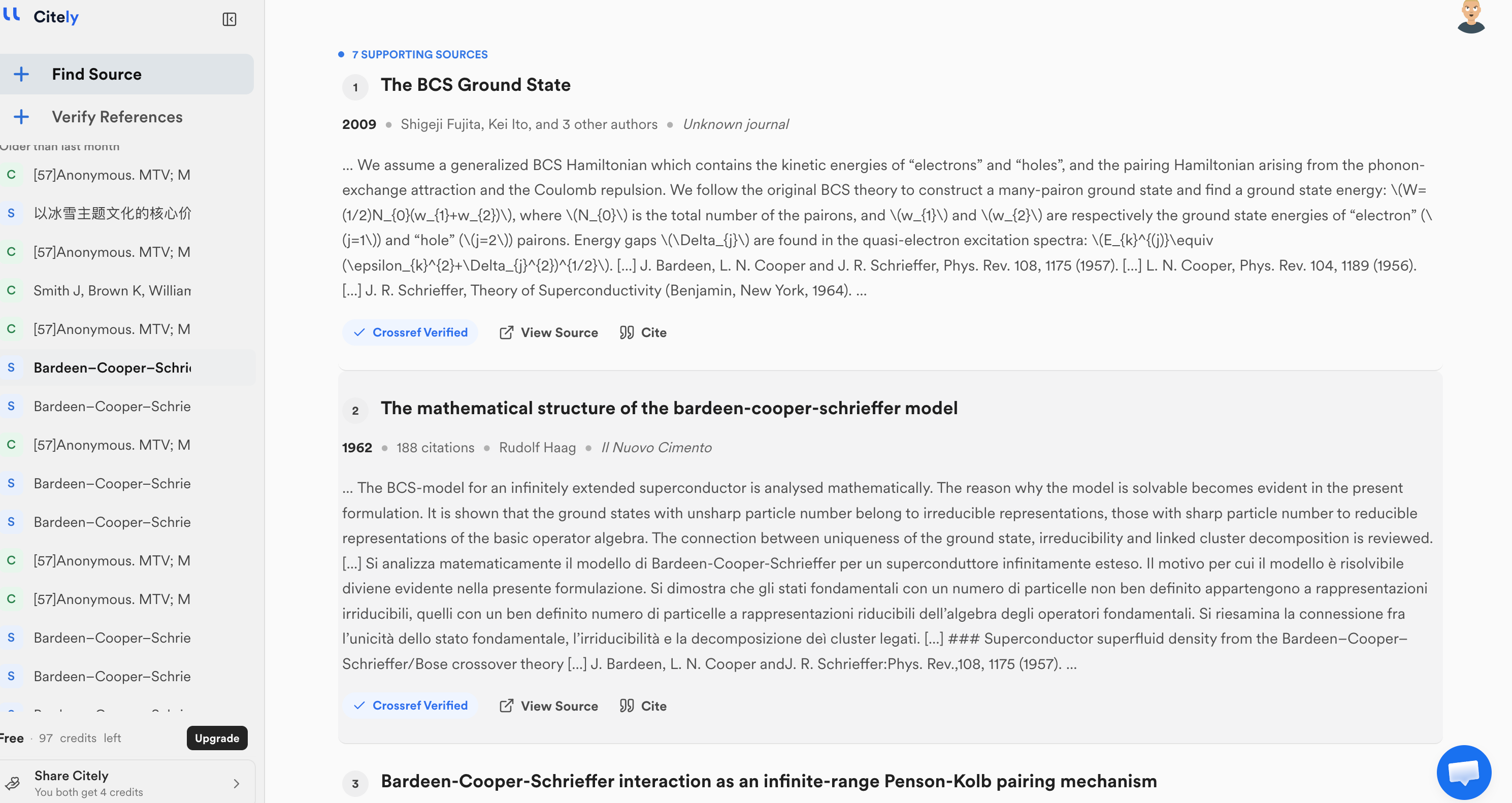
Find Source returns several relevant candidates instead of forcing you to accept a single answer. You can compare their titles, authors, publication years, journals, and supporting content, then open the original sources to read more. After reviewing the options, you can select the paper that best fits your argument and cite it.
The workflow therefore changes from “ask AI to generate a reference” to “search real scholarly databases, open the original papers, and choose the best source.”
The Final Check Before You Submit
Before sending an AI-assisted manuscript to a supervisor or journal, run the complete reference list through Citely's Verify References tool. Citely checks each entry against scholarly records and organizes the results into three categories:
- Verified: Citely found a scholarly record whose bibliographic details match the reference.
- Mismatch: A likely record exists, but one or more details do not match. Check the authors, title, journal, year, volume, issue, pages, and DOI.
- Not Found: Citely could not identify a matching record. Investigate the citation manually; if you cannot confirm that it exists, replace it.
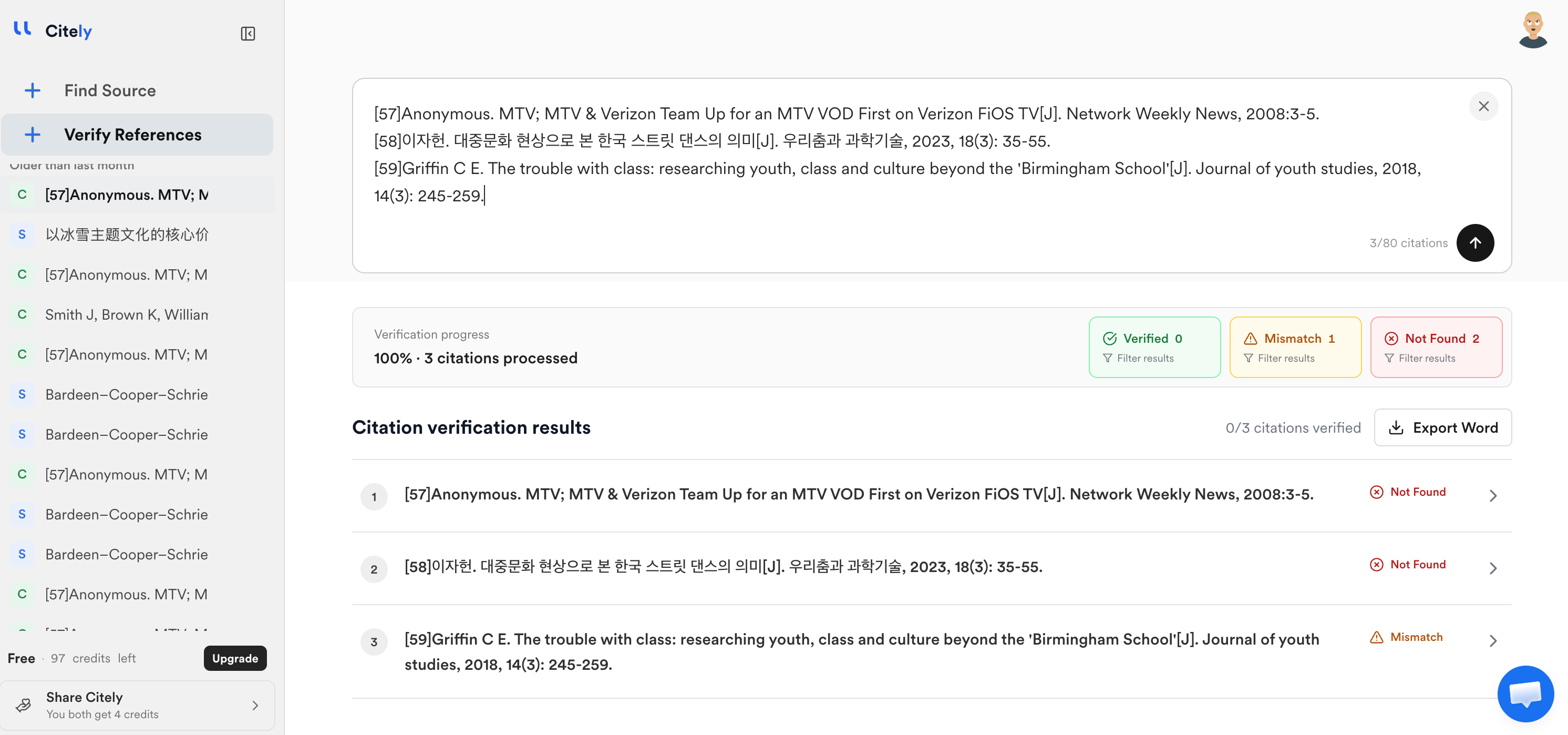
A red result is not merely a formatting inconvenience. It may indicate an AI-generated “ghost reference,” a corrupted citation, or an entry assembled from details belonging to different papers. An orange mismatch also deserves attention: the underlying paper may be real, but inaccurate metadata can prevent readers, editors, and reviewers from finding it.
For every flagged item:
- Open the original publication or its authoritative database record.
- Correct the authors, title, journal, year, volume, issue, pages, and DOI where necessary.
If you cannot verify a reference, replace it. Only then is the draft ready to leave your desk.
A Safer AI-Assisted Citation Workflow
Citely's two workflows solve two different problems.
When a claim in your manuscript needs a new citation, use Find Source. Citely searches connected scholarly databases and returns a set of relevant papers. Open the original sources, compare the candidates, and choose the one that best meets your needs.
When your manuscript already contains references suggested or generated by AI, use Verify References before sharing or submitting it. Citely checks the complete bibliography and helps you identify fabricated citations and inaccurate metadata.
The process can be summarized in one line:
Use Find Source to discover relevant papers from scholarly databases, and use Verify References to check the citations already in your manuscript.
Use AI—But Close the Verification Loop
Researchers and supervisors often debate whether students should use AI in academic writing. Our position is simple: use it, but build safeguards around it. AI can substantially reduce the time spent organizing material, locating candidate sources, and improving language.
The answer to citation hallucinations is not to reject AI altogether. It is to design a workflow that acknowledges where AI can fail.
Use AI to accelerate the work, Find Source to retrieve relevant papers from scholarly databases, and Verify References to check the bibliography before the manuscript reaches a supervisor, reviewer, or editor. AI can improve the workflow, Citely can reduce the risk of citation hallucinations, and the author remains responsible for the final reference list.
Related Articles
Continue exploring topics you care about.
Fake Citations Are Everywhere — Here's How to Spot Them (2026)
Up to 1 in 3 AI-generated references point to papers that don't exist. Learn the red flags of fabricated citations and how to verify any reference in seconds using DOI and CrossRef checks.
Read MoreWhy AI Chatbots Invent Citations That Look Completely Real
AI hallucinated references aren't random noise — they're plausible-looking fakes built from patterns in real citations. Here's why it happens and how to spot the ones most likely to be invented.
Read MoreIs It Cheating to Use AI to Find Sources for Your Paper?
Using AI to find academic sources sits in a grey area for a lot of students. Here's where the line actually falls between legitimate research help and academic misconduct.
Read More"90% of Startups Fail": How to Find the Original Source of a Claim
Some statistics get repeated everywhere and cited nowhere. Here's how to trace a widely quoted claim back to the study it came from — and what to do when the trail runs out.
Read MoreHow to Check If Citations Are Real (2026 Guide)
A practical 2026 guide to checking whether citations are real, spotting fake references, and verifying papers against Google Scholar, Crossref, PubMed, and OpenAlex before submission.
Read MoreHow to Find Academic Sources for Your Research Paper (2026 Guide)
Building a reference list from scratch? This guide covers where to search, how to evaluate what you find, and how to verify your sources are real — from first draft to final submission.
Read More