Short answer: no. As of September 2026, Grammarly has three features that touch citations: citation style formatting, which proofreads your APA, MLA or Chicago references for punctuation and consistency; the Citation Finder agent, which flags claims in your draft and suggests web sources to support them; and the plagiarism checker, which compares your prose against web pages and ProQuest's academic databases. None of them takes a reference you already have and asks CrossRef, PubMed, arXiv or OpenAlex whether that paper exists with those authors in that year. So a ChatGPT-generated bibliography with perfectly formatted, completely invented entries can come out of Grammarly looking better than it went in. That gap matters more every year. In a Lancet audit of about 2.5 million PubMed-indexed papers, roughly one in 277 papers from early 2026 cited at least one reference that doesn't exist.
Why this question keeps coming up
Most people asking whether Grammarly checks citations are not curious about Grammarly. They're worried about one specific reference list.
Usually it goes like this. You used an AI tool somewhere in drafting, or a co-author did, or you inherited a literature review from a previous student. Grammarly is already running in your browser, underlining your commas. It even has a panel that says "Citations." So it's natural to assume that if a reference were fake, Grammarly would say something.
It won't, and that isn't a bug. Grammarly is a writing tool, so it judges whether a citation is written correctly. Whether the paper exists is a separate question, and answering it means checking every reference against a bibliographic database. Grammarly doesn't do that, and its marketing never says it does. Words like "accurate citations" just make it easy to read more into the product than it promises.
The stakes are real. The Lancet audit, led by Maxim Topaz at Columbia and summarised by Retraction Watch, checked 97.1 million references and found 4,046 fabricated ones across 2,810 papers. The rate rose from one paper in 2,828 in 2023 to one in 277 in the first seven weeks of 2026. Those papers got through peer review. A formatting check was never going to catch them.
What each Grammarly citation feature actually checks
Here's what each feature does, based on Grammarly's own documentation. Two of the three are good at their job.
Citation style formatting: proofreading, not verification
Grammarly introduced citation style formatting in 2022. Its launch post describes it as a feature that will "proofread your in-text and full citations" for APA, MLA and Chicago. The plagiarism checker page says it catches "stray periods, misplaced parenthesis, and other formatting issues." On the current plans page it appears as "Keep your citations consistent," a Pro feature.
It's useful. Formatting errors cost marks, and most markers notice them. But look at what it takes as input: the text of the citation you typed. It checks whether the text follows a style guide. If you write Nguyen, T., & Hollis, R. (2021). Adaptive feedback loops in coastal sediment transport. *Journal of Marine Systems*, 44(2), 113–129., Grammarly can tell you the italics and punctuation are right. It can't tell you that the article was never written.
Citation Finder: sources for a claim, not a check on your references
The Citation Finder is the newer and more interesting feature. It launched with Grammarly's AI agents in August 2025 and runs inside Grammarly's "docs" writing surface. It scans your draft, flags claims that may need support, explains why, and suggests sources. You can insert an in-text citation in APA, MLA or Chicago with one click.
Three details from Grammarly's own pages are worth knowing:
- The sources are web-based. The Citation Finder user guide says it "generates links to web-based sources." The launch materials describe them as "publicly available sources." Some will be peer-reviewed papers and some won't. You still have to judge whether a source is something your supervisor will accept.
- It works on claims, not on your reference list. It starts from a sentence in your draft and looks for a source. It doesn't take the 40 references you already have and confirm each one.
- Free use is capped. According to the Citation Finder FAQ, free users can "view and insert up to five citations each day." Unlimited use requires Pro.
The user guide also says the agent "will verify your claims." That's a broad phrase. What the feature actually does is find sources that support, dispute or contradict a claim. That helps you find evidence, but it doesn't validate the bibliography you already have.
Plagiarism checker: missing citations, not fake ones
Grammarly's plagiarism checker compares your text against "over 16 billion web pages and academic papers in ProQuest's databases." It flags passages that match existing sources and gives you an originality score. It solves the opposite problem from ours: it finds places where you should have cited something and didn't. It doesn't evaluate the references you did include. A fabricated reference is original text almost by definition, so it gets through clean.
The three ways a reference goes wrong, and which ones Grammarly sees
It helps to split "bad citations" into categories, because each one needs a different check.
1. The paper doesn't exist. This is the headline AI failure. In a 2023 study in Scientific Reports, Walters and Wilder had ChatGPT write short literature reviews on 42 topics and checked all 636 citations. They found that 55% of GPT-3.5's citations and 18% of GPT-4's were fabricated. Grammarly's formatting check can't see this. The entry looks like any other reference.
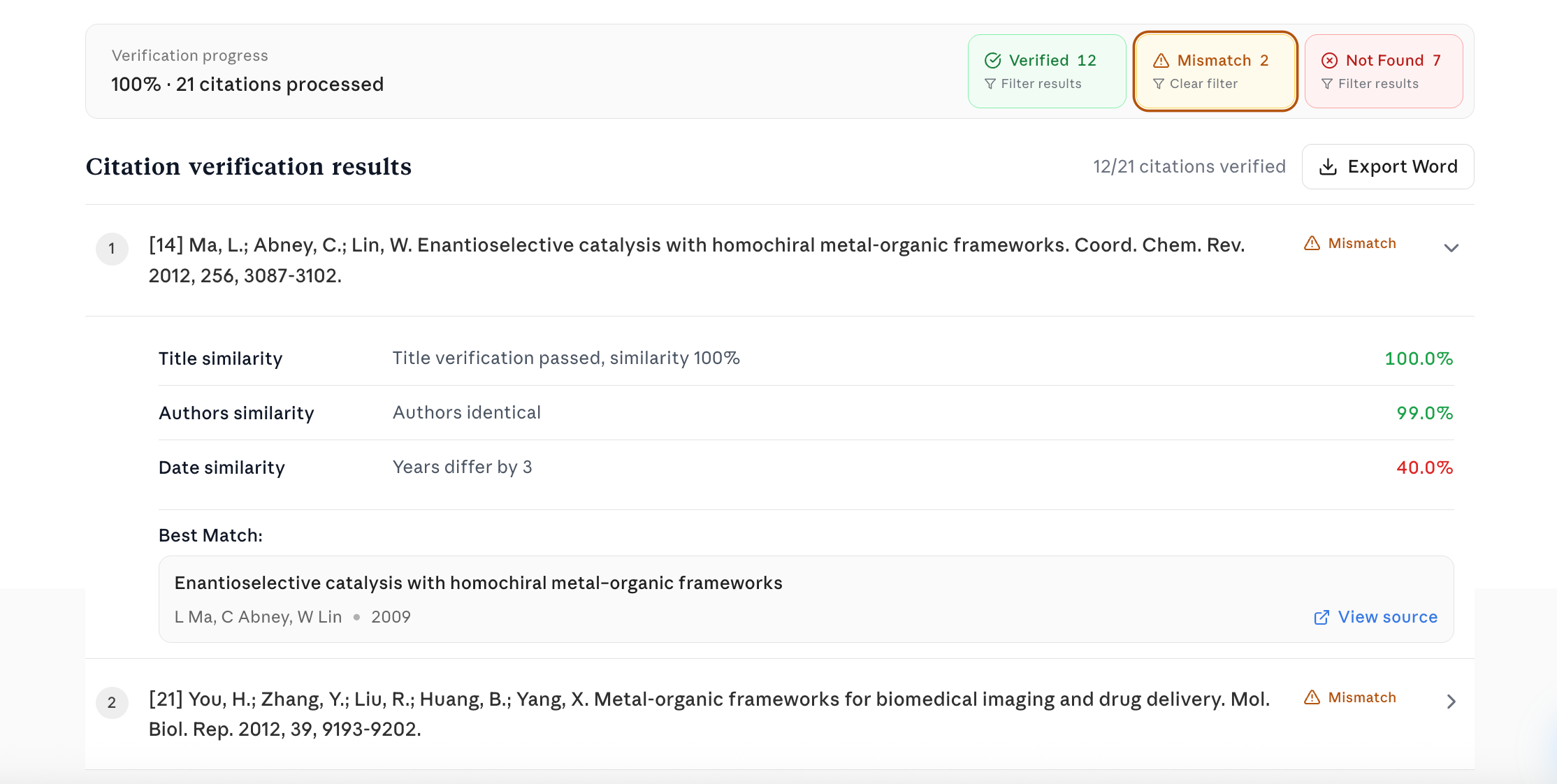
2. The paper exists, but the details are wrong. This failure is quieter and often more embarrassing, because the reference looks checkable. In the same study, 43% of GPT-3.5's real citations and 24% of GPT-4's had substantive errors. In a 2024 JMIR study, Chelli and colleagues asked GPT-3.5, GPT-4 and Bard to reproduce the reference lists of systematic reviews on rotator cuff pathology. They counted a reference as hallucinated if at least two of its title, first author and year were wrong. By that definition, 39.6% of GPT-3.5's references, 28.6% of GPT-4's and 91.4% of Bard's were hallucinated. Those figures describe older models on one medical topic, not today's tools in general. The pattern still holds: right title, wrong year, or a real paper credited to the wrong people. Grammarly can't see this either, because it never compares your entry with the published record.
3. The paper exists and is cited correctly, but doesn't support your sentence. Citation Finder gets closest to this one, since it starts from the claim. Nothing automated fully solves it, though. You have to read the paper.
So Grammarly addresses formatting, plus a version of the claim-to-source question. The two problems that most often sink an AI-assisted bibliography, invented papers and mismatched metadata, are the ones it doesn't check.
Grammarly vs. a citation checker, side by side
The table below compares what each tool takes as input and what it can tell you. Grammarly feature details and Citation Finder limits are from Grammarly's own pages (September 2026); its Pro price was re-checked on the plans page on 2026-11-07 and is still listed at $12 USD without a clear billing period. Citely's free tier is 3 free credits per new account (product fact confirmed 2026-11-04; the public pricing.md page still says “two free checks”). Prices may change; we re-check monthly.
| Grammarly citation style formatting | Grammarly Citation Finder | Grammarly plagiarism checker | Citely Citation Checker | |
|---|---|---|---|---|
| Input | Citations already in your text | Claims in your draft | Your prose | Your reference list |
| Confirms the paper exists | No | No (suggests new sources) | No | Yes, against Crossref, OpenAlex, Semantic Scholar, Google Scholar, PubMed, arXiv, Wanfang and CNKI |
| Catches wrong year or authors on a real paper | No | No | No | Yes, flagged as Mismatch |
| Fixes punctuation and style | Yes: APA, MLA, Chicago | Formats what it inserts | No | Outputs APA, MLA, Chicago, Harvard, IEEE, Vancouver, GB/T 7714, BibTeX |
| Finds sources for an uncited claim | No | Yes (web-based sources) | Flags passages that need a citation | No. Use Citely's Find Source for that |
| Checks that the source supports your claim | No | Partly (supporting vs. opposing evidence) | No | No. You still read the paper |
| Cost (prices checked 2026-11-07) | Pro, listed at $12 USD (the plans page does not state the billing period) | Free: up to 5 citations/day; Pro: unlimited | Pro | 3 free credits per new account; paid plans from $9 one-time |
Look at the "Confirms the paper exists" row. Grammarly is stronger on almost every writing task in that table. It just doesn't do this one.
How Citely fits
Citely does the part Grammarly skips. You paste in a reference list and each entry is matched against real bibliographic records. According to Citely, those records come from Crossref, OpenAlex, Semantic Scholar, Google Scholar, PubMed and arXiv, plus Wanfang and CNKI for Chinese papers.
The Citation Checker compares each reference field by field: title, authors, year, journal and DOI. Each reference gets one of three results:
- Verified: a published record matches the reference.
- Mismatch: the paper exists, but a detail such as the year, the authors or the DOI is wrong; Citely names the wrong field and shows the correct record. This is the "real paper, wrong details" case above, and a formatting tool can't find it. The fix is usually a quick correction, not a deletion.
- Not Found: no database holds a matching record. Most often the reference is fabricated; sometimes it is grey literature or brand new, so Citely shows the closest records for you to decide.
If your list came out of ChatGPT, Claude or Gemini, the AI Citation Checker targets typical LLM failures: chimera citations (real authors attached to a paper they never wrote), fabricated DOIs and temporal drift. For a full thesis or manuscript bibliography, the Reference Checker is the page to start from.
Here's how the cost works. Every new account gets 3 free credits, with no credit card required. That's enough to test it on the references you're least sure about. After that, Citely runs on credits, and the credits a check will use are shown before it starts. Paid plans are Trial at $9 one-time for 15 credits (valid one month), Monthly at $19 a month for 150 credits, Yearly at $168 a year (about $14 a month) for 1,500 credits, and Believer at $347 one-time for 5,000 credits over three years (prices checked 2026-11-02). After verification, you can export BibTeX or RIS and import the clean list into Zotero, Mendeley or EndNote.
In practice, the workflow is to run the checker first, fix or delete what it flags, and then let Grammarly polish the formatting of what's left. The two tools work well together, as long as you use them in that order.
When you should stay with Grammarly
You don't always need a separate verification step. Grammarly alone is enough in these cases:
- You built the reference list yourself from papers you opened. If every entry came from a database page or a PDF you read, it's reliable because you know where it came from. What you need now is formatting, and Grammarly handles that well.
- Your worry is uncited claims, not bad references. If a marker wrote "citation needed" in the margin, Citation Finder and the plagiarism checker are designed for exactly that. They work inside the document you're already editing.
- You have five references or fewer. Search each exact title in Google Scholar or paste the DOI into doi.org. It takes ten minutes and costs nothing, and you'll actually look at the papers.
- You need grammar, tone and plagiarism checks in one subscription. Grammarly covers all three. A citation checker doesn't do any of them, and it isn't trying to.
Add a verification pass when you didn't collect the list yourself. That includes an AI-drafted bibliography, a co-author's section, a reference list pasted from a chat tool, or anything you would struggle to find again. Existence checking isn't part of Grammarly's design, and the Lancet audit shows that journals often miss fake references too. So the check needs to happen before you submit.
Key Takeaways
- Grammarly doesn't check whether your citations are real. Its citation features check formatting, suggest sources for claims, or detect plagiarism. None of them compares an existing reference with a bibliographic database.
- Citation style formatting is proofreading. It catches punctuation and style errors in APA, MLA and Chicago. A perfectly formatted fake reference passes.
- Citation Finder goes from claim to source, not from citation to verification. It suggests web-based sources for sentences in your draft. The free tier allows five citations a day, and it doesn't audit the references you already have.
- Metadata mismatches are a separate risk from invented papers. Studies of GPT-3.5 and GPT-4 found errors in many real citations, not just fabricated ones. Catching them means comparing title, authors and year against the published record.
- Verify, then format. Run unfamiliar reference lists through a citation checker, fix every Mismatch and remove every Not Found, then let Grammarly clean up the style.