
A chimera citation is a reference stitched together from real parts: an author who really publishes in the field, a journal that really exists, a year that fits, and a title that no one ever wrote. It is the hardest kind of fake reference to catch, because every individual detail survives a quick look. Search the author in Google Scholar and you find a real researcher; search the journal and it is real too. Only the combination is false. A 2026 editorial in Exploration of Medicine classes these as "Type III" confabulated references, distinct from fully invented papers and from real papers with corrupted metadata. This guide explains how chimeras arise, what the research does and does not say about how common they are, a five-minute manual check using Crossref, PubMed and Google Scholar, and when a tool is worth it.
Why a reference can be half real
Language models do not look references up. They generate text that has the shape of a reference, and the most probable-looking pieces come from the real literature: author names that co-occur with a topic, journal names that publish on it, years that fit the field. The assembly is where it goes wrong. The result reads like something you have half seen before, which is exactly why you do not question it at 1 a.m.
That is the practical danger. If a reference is wholly invented, you usually notice: the authors are unfamiliar, the journal sounds off. A chimera borrows credibility from things you already trust. Your supervisor recognises the author's name and reads past it. A reviewer sees a journal they respect and moves on.
Three patterns cover most of what you will meet:
- Real authors, invented title. The names are genuine scholars in the area; the paper never existed.
- Real title, wrong authors. A genuine paper is credited to people who did not write it, often because a more famous researcher in the same area was substituted.
- Spliced records. The title comes from one paper, the journal and year from another, and the DOI from a third.
Citely describes chimera citations (real-looking authors, journals and years combined into a paper that does not exist) in its own citation hallucination patterns guide. The term is not yet standardised across the research literature, so you may see "chimeric" or "misattributed" instead. For the neighbouring failure, a real paper with wrong details, see when a citation is real but the details are wrong; for why models produce these at all, see why AI invents citations that look real.
What the research says (and where it goes quiet)
Be careful with anything that claims to measure "the chimera rate". As far as I could find, no published study reports one under that name. What exists is adjacent evidence, and each figure belongs to a specific model and year.
A taxonomy. In an editorial in Exploration of Medicine, Luca Fiorillo (2026) (DOI 10.37349/emed.2026.1001385) separates confabulated references into three types: fully fabricated references, real publications with corrupted metadata such as a wrong year or DOI, and chimeric or misattributed references that combine elements of authentic records, such as real authors with an incorrect title or journal. It is an editorial, not an empirical measurement, but it gives the clearest definition in print.
Fabrication in older models. Walters and Wilder (2023) in Scientific Reports (DOI 10.1038/s41598-023-41032-5) had GPT-3.5 and GPT-4 write short literature reviews on 42 topics and then checked every citation. Of 222 GPT-3.5 citations, 55% were fabricated; of 414 GPT-4 citations, 18%. Among the citations that did exist, 43% of GPT-3.5's and 24% of GPT-4's had substantive errors. The paper does not break out chimeras as a category.
Variation across 2026-era models. In a cross-model audit posted to arXiv, Naser (2026) prompted 10 commercial LLMs across four academic domains, collected 69,557 citation instances, and checked them against CrossRef, OpenAlex and Semantic Scholar. Hallucination rates ran from 11.4% to 56.8% depending on model, domain and prompt framing. It is a preprint, and the abstract does not name the models, so treat the range as evidence of variance rather than a score for any tool you use.
A different failure, for contrast. Rao, Wong and Callison-Burch (2026) examined citation URLs from commercial models and deep research agents and found 3–13% likely hallucinated and 5–18% non-resolving. That is a study about links, not chimera references, and it is a useful reminder that "the link works" and "the reference is right" are different questions.
The honest summary: fabrication is well documented, "real paper, wrong details" is documented, and chimeras sit in between with a definition but no clean prevalence number. Do not quote one.
A five-minute check for a suspicious reference
You do not need special software to test a single reference. You need to check the pieces against each other, not one at a time.
Step 1: Search the exact title, in quotation marks
Put the full title in quotes in Google Scholar and in PubMed if the topic is biomedical. A real paper normally appears. If nothing does, move on; if a near-match appears with different authors or a different year, you have found a Mismatch candidate, not a clean pass.
Step 2: Search the first author's publication list
Open the author's profile or search their name with the topic. If they are real and active in the area but no paper with that title appears, that is the signature of a real-author, invented-title chimera. Do not stop at "the author exists".
Step 3: Open the journal's volume and issue
Go to the journal's site, find the stated year and volume, and look at the contents. A paper that should be on those pages but isn't there is a strong signal. This is slower than Steps 1 and 2, so do it only when they leave doubt.
Step 4: Resolve the DOI and compare, if there is one
Paste the DOI after https://doi.org/ and read what it lands on. The question is not whether it loads, but whether the title, authors and year on the landing page match your reference. For a Crossref DOI, the Crossref REST API returns the registered record for the identifier, which is the fastest place to read the deposited title and authors. A DOI that resolves to a different paper is how spliced records usually give themselves away. Citely's guide to checking if a citation is real walks through the longer version.
Step 5: Decide, and write down what you decided
Three outcomes cover it. Everything matches: keep it. A real paper with different authors, year or venue: correct the reference from the real record. Nothing matches anywhere: remove it, and rebuild the sentence it supported from a source you have opened.
Why chimeras survive a normal read-through
Four things make them slip past careful people, and they are worth knowing so you can slow down at the right moments.
First, familiarity beats checking. A name you recognise lowers your guard. Second, volume: on a 90-item bibliography, nobody gives every entry a full check. Third, format hygiene hides content problems. A reference that is perfectly APA-formatted feels more real. Fourth, a spot check proves little. Checking five entries of fifty catches a chimera only if you happened to pick one.
The thing that does work is checking the same three fields every time: title, authors and date. They are the fields a chimera cannot get right all at once.
Five ways to catch a chimera, compared
| Method | What it catches | What it misses | Effort |
|---|---|---|---|
| Google Scholar title search | Papers with no matching title anywhere | Wrong-author cases if you only glance at the first result | About 1 minute per reference |
| PubMed or Crossref lookup | Registered title, authors, journal for biomedical and DOI-registered papers | Papers outside those indexes, such as many books and conference items | 1–3 minutes per reference |
| Doi.org resolution alone | A DOI that is not registered | A DOI that resolves to a different real paper | Seconds, but not sufficient |
| Reference manager (Zotero, Paperpile) | Formatting and duplicate entries | Whether the paper exists; both tools import whatever metadata you give them | Automatic, but not verification |
| Citely Citation Checker | Matches title, authors, year, journal and DOI and labels each reference Verified, Mismatch or Not Found | Works from the text you paste, so a reference with little usable detail gives it little to match | Paste a list; two free checks per new account, paid plans from $9 (Trial, one-time) |
Citely pricing checked 2026-11-04. Prices may change; we re-check monthly.
How Citely fits
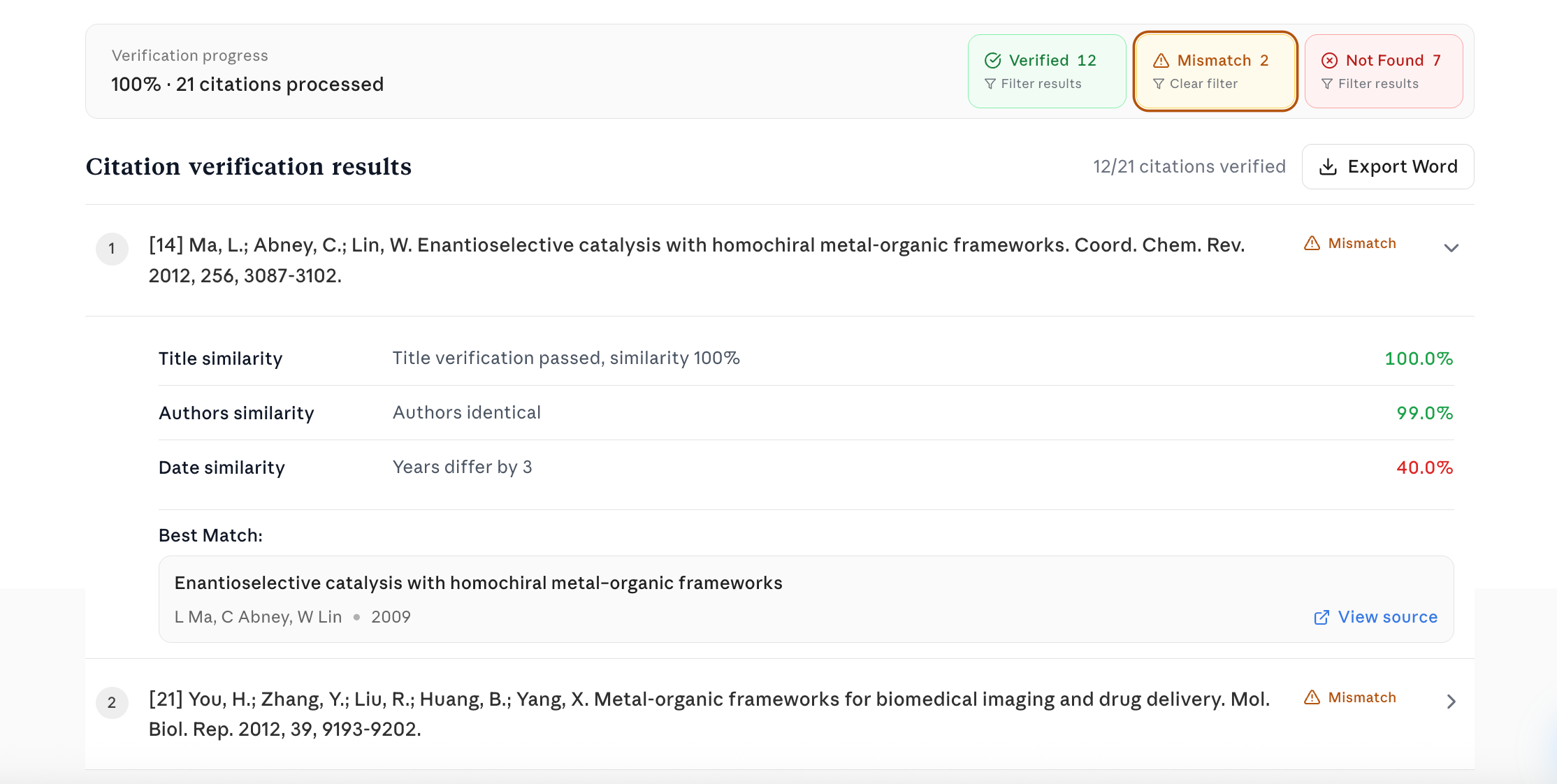
The manual check works, but it is exactly the kind of task that breaks down at scale. Citely's Citation Checker runs each reference against Crossref, OpenAlex, Semantic Scholar, Google Scholar, PubMed and arXiv, plus Wanfang and CNKI for Chinese papers, and does the field-by-field comparison for you. If no database holds a matching record, the reference is labelled Not Found, which is where a real-author, invented-title chimera normally lands; Citely labels the problem by pattern and shows the closest records. If a published record matches, it is Verified. If the paper exists but a field such as the year, the authors or the DOI is wrong, it is Mismatch, which is the label for a real paper credited wrongly. That last status is the main reason to use a checker rather than a link tester: a paper that exists but is misattributed would pass a simple "does it resolve?" test.
For a list that came out of a chatbot, the AI Citation Checker page covers that workflow, and the fake citation checker page explains the failure types. Every new account gets two free checks, with no credit card required. The credits a check will use are shown before it starts. Citely is a verification aid, not a ruling: when it flags something, open the record it matched and read it.
When you don't need a tool for this
Do it by hand when you have one or two references that someone has flagged. Steps 1 and 2 take under five minutes and give you more certainty than a score would. Do it by hand when every reference came from a database export or from papers you opened and read, since chimeras come from generation, not from copying. And do it by hand when the list is under about ten entries and you have an evening.
Reach for a checker when the references were produced or "tidied" by a chatbot, when the list is long, or when the cost of a missed Mismatch is a supervisor's comment on page 14.
Key Takeaways
- A chimera citation combines real authors, a real journal and a plausible year with a paper that does not exist, which is why checking the pieces separately does not catch it.
- Fiorillo (2026) defines the pattern as Type III confabulation, alongside fully fabricated references and real papers with corrupted metadata; no study I found reports a prevalence figure for chimeras specifically.
- Fabrication figures are tied to models and years: GPT-3.5 fabricated 55% of citations and GPT-4 18% in Walters and Wilder (2023), and a 2026 audit of 10 LLMs found a range of 11.4% to 56.8%. Never quote them as a current rate for AI generally.
- Check title, authors and date together, against a registered record. "The author is real" and "the DOI resolves" are each insufficient.
- Manual checks suit short lists; for chatbot-produced bibliographies, a Verified / Mismatch / Not Found pass saves time and still needs a human read of anything flagged.