
Short answer: no, not on its own. Zotero is a reference manager, and a very good one — but its job is to store metadata, not to interrogate it. If you type a fabricated reference into Zotero by hand, or import one from a bibliography ChatGPT wrote for you, Zotero will file it neatly alongside your real papers and say nothing. There are three places where Zotero gets close to verification — the Add Item by Identifier lookup, the Retraction Watch integration, and the community DOI Manager plugin — and each one checks something narrower than "does this paper exist?" This matters more than it did two years ago: an audit of roughly 2.5 million PubMed-indexed papers, published as correspondence to The Lancet in May 2026, found fabricated references in about one in 277 papers from early 2026, up from one in 2,828 in 2023.
Why people are asking this about Zotero specifically
The question usually arrives in a specific order. You drafted a section with AI help, or a co-author did. Someone — a supervisor, a reviewer, a librarian — flagged one reference that doesn't resolve. Now you're staring at a bibliography of 60 entries wondering which of the other 59 are real, and you already have Zotero open, so the natural thought is: surely my reference manager knows.
It doesn't, and the reason is architectural rather than a bug. Zotero's data model treats an item as a record you asserted. When you save from a publisher page or a database via the browser connector, the metadata comes from the source and is trustworthy by provenance. When you type it in, paste it in, or import a .bib file someone emailed you, Zotero stores exactly what you gave it. There is no round-trip back to CrossRef or PubMed to ask whether that record corresponds to anything real.
Zotero 10, released in August 2026, reinforces this: the headline features are a redesigned advanced search, batch editing, undo support, and a new Reading Mode for PDFs. Excellent quality-of-life work. None of it is verification.
The three things Zotero does check
Being fair to Zotero means being precise about what it already does, because two of these are genuinely useful and most people don't use them.
Add Item by Identifier is an accidental existence test
Zotero's "magic wand" button accepts a DOI, ISBN, PMID, arXiv ID, or ADS bibcode, looks it up against the relevant service, and creates an item from the returned metadata. You can paste several identifiers at once, separated by spaces or line breaks.
That lookup is, incidentally, the cheapest fake-reference test built into any reference manager. Paste a fabricated DOI and nothing comes back. Paste 40 DOIs from a suspect bibliography and the ones that fail to resolve are your first shortlist.
Two limits keep this from being a real audit. First, it only works on identifiers — a reference with no DOI, or one where the AI simply omitted the DOI, is invisible to it. Second, and more dangerous, is what happens when a fabricated citation carries a DOI that is real but belongs to a different paper. Zotero resolves it, fetches the correct record for that DOI, and cheerfully creates an item for a paper you never intended to cite. Nothing is flagged. Your bibliography now contains a real, resolvable, completely wrong reference.
The Retraction Watch integration catches a different problem well
Since Zotero 5.0.67 in 2019, Zotero has checked your library against the Retraction Watch database and flags retracted publications in the items list, with a warning in the item pane. If you try to cite a retracted item through the word processor plugin, it asks you to confirm. If something you already cited is retracted later, Zotero warns you the next time you refresh citations — even if the item was added by a co-author or is no longer in your library.
This is a genuinely excellent feature and the privacy design behind it (partial-identifier matching, so Zotero's servers never learn your library contents) is better engineering than most commercial tools manage. But retraction is a status on a paper that definitely exists. It answers "should I still cite this?", not "is this real?" And Zotero's own documentation notes the feature is limited to items with a DOI or PMID, covering roughly three-quarters of Retraction Watch data.
The DOI Manager plugin validates DOIs, not papers
Zotero DOI Manager (the zotero-shortdoi add-on) fetches DOIs for journal articles via the CrossRef API, converts between long and short DOIs, and — the useful part here — has a "Verify and clean DOIs" function that checks whether stored DOIs are valid and marks the invalid ones.
Run it across a suspect library and you get a batch version of the identifier test above. That is a real improvement over doing it by hand. It still tells you nothing about a reference whose DOI field is empty, and nothing about whether the author list and year attached to a valid DOI are the ones on the actual paper.
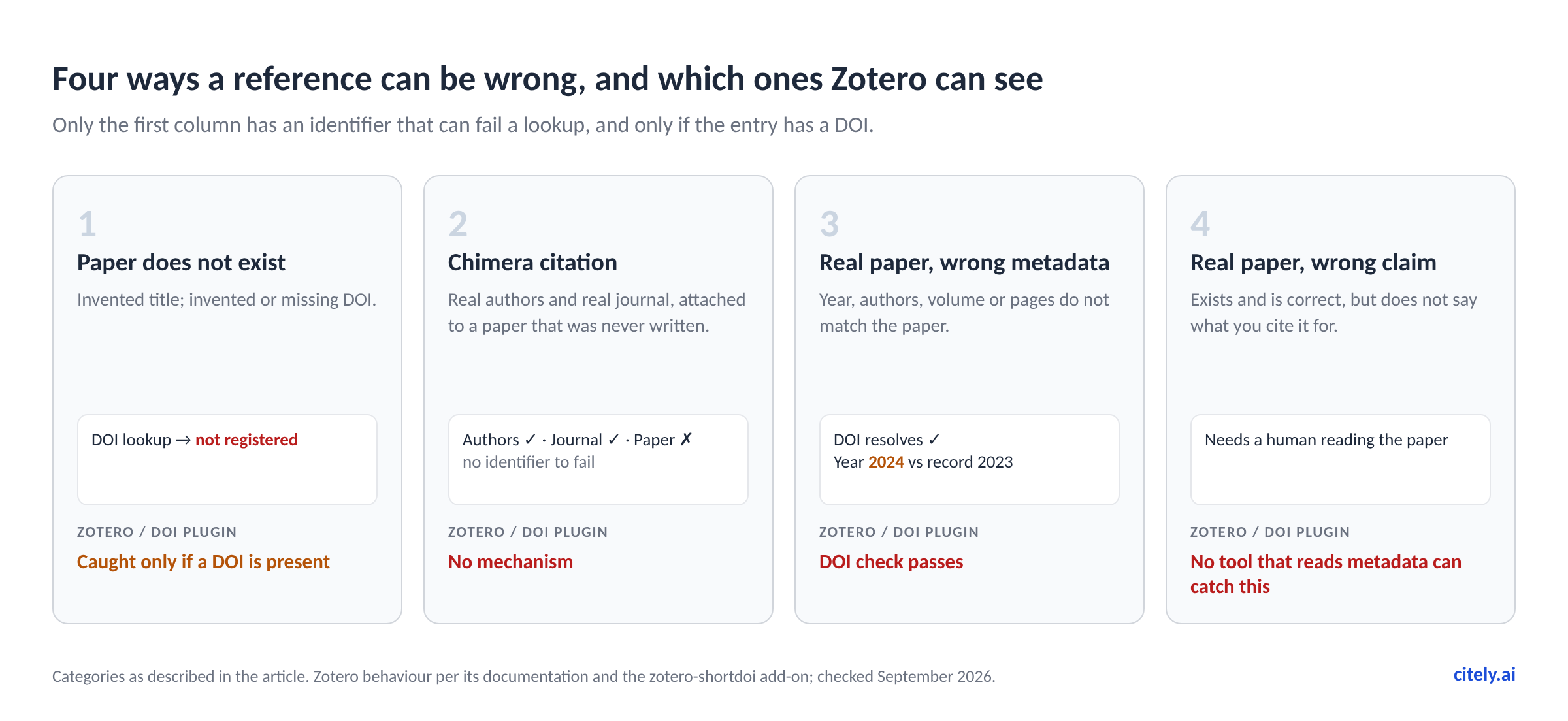
The four failure modes, and where each one lands
Fabricated references aren't one thing. Sorting them is the fastest way to see the gap.
1. The paper does not exist at all. Invented title, invented or absent DOI. Caught by an identifier lookup if the entry has a DOI. Missed entirely if it doesn't.
2. Chimera citations — real authors, real journal, paper that was never written. This is the nastiest category because every individual component checks out. Retraction Watch's own cofounder Ivan Oransky was named as the author of a fabricated reference in a Springer Nature journal paper in November 2025 — an article he did not write. Zotero has no mechanism for this. There is no identifier to fail.
3. Real paper, wrong metadata. The paper exists; the year, author list, volume or page range attached to it don't match. Walters and Wilder's study of ChatGPT-generated bibliographies across 42 topics, published in Scientific Reports in 2023, found that among the citations that were not fabricated, volume/issue/page details were wrong 34% of the time for GPT-3.5 and 13% for GPT-4, and dates were wrong 22% and 16% respectively (DOI: 10.1038/s41598-023-41032-5). A DOI check passes these. A reader who follows the citation finds a different paper than the one you described.
4. Real paper, doesn't say what you claim. No tool that reads metadata can catch this. It needs you.
Zotero, even with plugins, addresses a slice of category 1. Categories 2 and 3 are where most of the damage happens, and they are also where the hallucination rates get uncomfortable. Chelli and colleagues, replicating systematic reviews on shoulder rotator cuff pathology, reported hallucination rates of 39.6% for GPT-3.5, 28.6% for GPT-4, and 91.4% for Bard in JMIR in 2024 (DOI: 10.2196/53164). Those are specific models on a specific task in a specific year — not a universal rate — but they're the kind of number that should change how you handle a bibliography you didn't assemble yourself.
An honest comparison, as of November 2026
| Zotero (built-in) | Zotero + DOI Manager plugin | Citely Citation Checker | |
|---|---|---|---|
| Stores and formats references | Yes | Yes | No — it checks, then exports |
| Flags retracted papers | Yes, via Retraction Watch (DOI/PMID only) | Yes | No |
| Detects an invalid DOI | Only when you use Add by Identifier | Yes, in batch | Yes |
| Detects a fabricated reference with no DOI | No | No | Yes — matched by title against Crossref, OpenAlex, Semantic Scholar, Google Scholar, PubMed and arXiv, plus Wanfang and CNKI for Chinese papers |
| Detects a chimera citation (real author, nonexistent paper) | No | No | Yes |
| Flags a real paper with the wrong year or authors | No | No | Yes — this is the Mismatch state |
| Cost | Free and open source; storage 300 MB free, 2 GB $20/yr, 6 GB $60/yr, unlimited $120/yr | Free (MPL-2.0) | 3 free credits per new account, no credit card; paid from $9 |
Zotero pricing is from zotero.org/storage, checked 2026-11-09. Prices may change; we re-check monthly.
How Citely fits — and why it doesn't replace Zotero
The two tools sit at different points in the same workflow, and the honest framing is that Citely runs before Zotero, not instead of it.
Paste a reference list into the Citation Checker and each entry is matched against Crossref, OpenAlex, Semantic Scholar, Google Scholar, PubMed and arXiv, plus Wanfang and CNKI for Chinese papers. Every reference comes back in one of three states: Verified, Mismatch, or Not Found. The labels are deliberately narrow so the result means something. Verified means a published record matches the reference. Not Found means no database holds a matching record; Citely shows the closest records so you can decide. Mismatch means the paper exists but a field such as the year, the authors or the DOI is wrong, and Citely names that field — which is exactly failure mode 3 above, the one a DOI check waves through.
That middle state is the whole reason this is a separate step from your reference manager. "Not Found" tells you to delete the citation. "Mismatch" tells you the paper is real and you need to fix the year, not the argument.
For AI-generated bibliographies specifically, the ChatGPT Citation Checker is the same engine framed around the patterns LLMs actually produce — chimera citations, fabricated DOIs, and temporal drift. If you'd rather work from the whole list at once, the Reference Checker takes a pasted bibliography and the credits a check will use are shown before it starts.
Then the verified survivors go into Zotero. Citely formats references in APA, MLA, Chicago, Harvard, IEEE, Vancouver, GB/T 7714 and BibTeX and exports BibTeX or RIS; import the file into Zotero, Mendeley or EndNote, and you're back in the tool you already use — with a library where every entry has been matched to a record that exists.
Every new account gets 3 free credits, with no credit card required. That's enough to check a short bibliography and see whether any of this applies to you before spending anything.
When you should stay with Zotero and skip all of this
Most of the time, honestly.
If you built your library the normal way — browser connector on publisher pages, PDF metadata retrieval, Add by Identifier from a database — your references came from the source and there is nothing to verify. Running a checker over a hand-curated Zotero library is a waste of a credit and, more importantly, of your afternoon.
Stay with Zotero alone when:
- Every item was saved by the connector or by identifier. Provenance is verification. You already did it.
- Your bibliography is under about ten entries. Paste each DOI into doi.org and read the landing page. Ten minutes, zero cost, and you'll actually look at the papers.
- Your worry is retractions, not fabrication. Zotero's Retraction Watch integration is better than anything a citation checker gives you, and it keeps watching after you've submitted.
- You need shared group libraries, PDF annotation, or word processor integration. Zotero does all of that; a citation checker does none of it. These are not competing products.
The case for a separate verification pass is narrow and specific: a bibliography you didn't assemble entry-by-entry from sources you visited. AI-drafted reference lists, a co-author's contribution, a list inherited from a previous student, or a citation dump from a chat tool. That's it. If that describes your situation, note that in the Lancet audit, more than 98% of the papers found to contain fabricated references had seen no publisher action at the time of the analysis — which means the check is not going to happen downstream of you.
Key takeaways
- Zotero does not verify whether a reference exists. It stores what you give it. Items saved via the browser connector are trustworthy by provenance; typed, pasted, or imported items are not checked.
- Add Item by Identifier is the closest built-in test, and it only works on DOIs, ISBNs, PMIDs, arXiv IDs and ADS bibcodes — nothing without an identifier, and it silently accepts a real DOI pointing at the wrong paper.
- The Retraction Watch integration solves a different problem well. Retraction status applies to papers that exist; it says nothing about fabrication, and it covers only items with a DOI or PMID.
- The dangerous failures are chimera citations and metadata mismatches — real authors on papers that were never written, and real papers with the wrong year attached. Neither leaves a broken identifier behind.
- Verify first, then file. Run an unfamiliar bibliography through a checker, delete what comes back Not Found, fix what comes back Mismatch, then import the survivors into Zotero as BibTeX.