
A DOI that resolves is not proof that a citation is real. Crossref's own guidance for spotting a fake identifier is to resolve it through doi.org, but a DOI can land on a genuine paper that has nothing to do with the reference you pasted, and a made-up string in the right shape can fail in ways that look like a publisher glitch. In a 2024 study of ChatGPT (GPT-3.5) published in the Journal of Medical Internet Research, 42 of 47 humanities references carried a hallucinated DOI, defined as one that either did not exist or pointed to a different source. This guide gives you a four-step check that takes about a minute per reference: shape, resolution, comparison against the registered record, and prefix lookup. It also explains why fake DOIs sometimes resolve, what the research actually measured, and when a manual check is enough.
Why a DOI that "works" proves less than you think
Most people check a DOI the same way: paste it after https://doi.org/, see that a page loads, and move on. That confirms one thing only: the identifier points somewhere. It does not confirm that the page is the paper your reference list claims to cite.
The distinction matters most with AI-generated bibliographies. A language model produces DOIs the way it produces everything else, by predicting plausible text. The result can be a string with the right prefix and a plausible suffix that was never registered, or a string that happens to belong to a different article entirely. Mugaanyi and colleagues counted both outcomes as hallucinations in their 2024 evaluation, published in JMIR (DOI 10.2196/52935), precisely because a DOI that resolves to the wrong paper is as useless to your reader as one that resolves to nothing.
So "does it resolve?" is the first question, not the last. The steps below add the checks that catch the wrong-paper case.
The one-minute check, step by step
Step 1: Check the shape of the string
Before you resolve anything, look at its structure. Crossref's community team describes a valid DOI as starting with 10., followed by a prefix of four or five digits (above 999), a slash, and a suffix. In their November 2025 ticket of the month on spotting fake DOIs, they list strings that fail on shape alone:
100.1234/abcstarts with something other than1010.123/abchas a prefix with only three digits10.0123/abchas a prefix starting with zero10.abcd/123has letters in the prefix10/1234/abcuses a slash where the period should be
A bad shape settles the question immediately. A good shape settles nothing, which is why the next three steps exist.
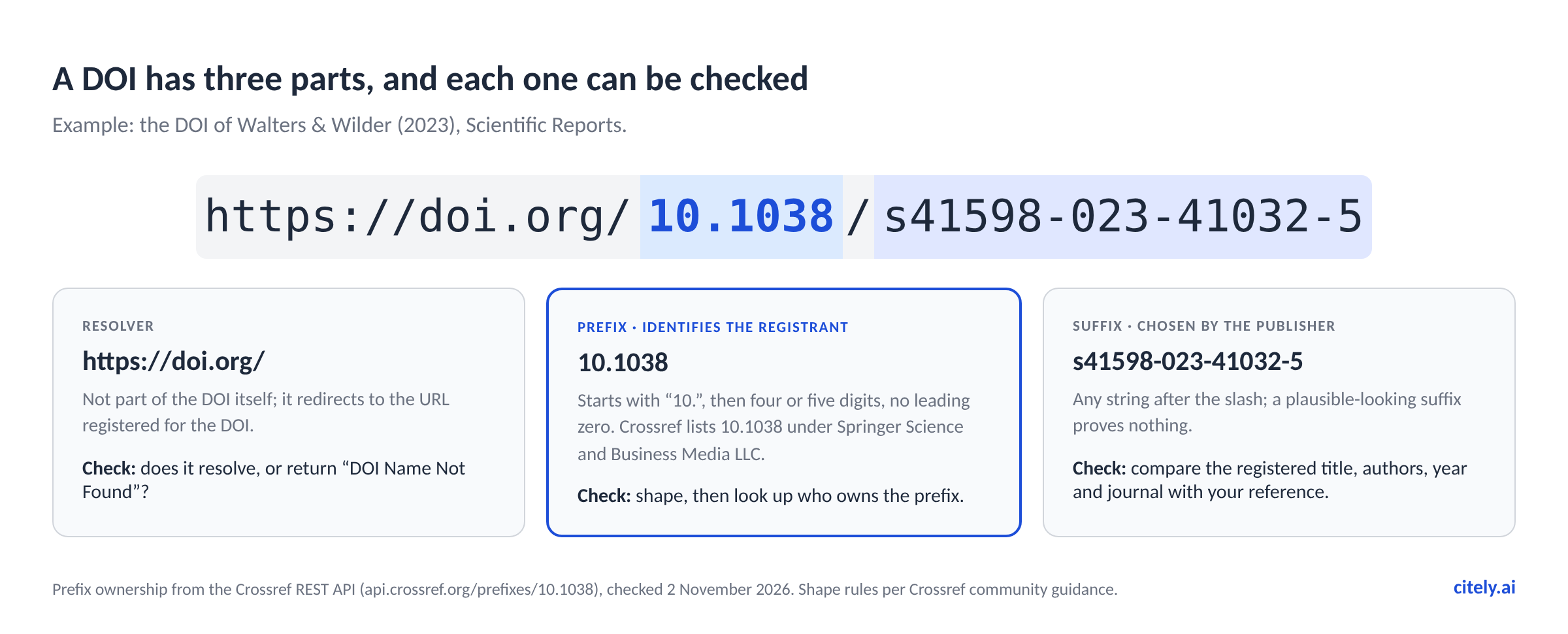
Step 2: Resolve it through doi.org
Append the DOI to https://doi.org/ and open it. According to the DOI Foundation's resolution documentation, the proxy looks up the handle record and redirects your browser to the URL stored there. A DOI that isn't registered gets a "DOI Name Not Found" page. The same documentation notes that results are cached for up to 24 hours, so a very recent change at the publisher can take a day to show up.
If you need to check dozens of identifiers, the same documentation describes a JSON endpoint at https://doi.org/api/handles/<handle>. A responseCode of 1 means the handle was found; 100 means it was not (returned with HTTP 404).
Step 3: Compare what it resolves to with what you cited
This is the step people skip, and it is where most AI-generated DOIs fail. Open the landing page and compare four things against your reference:
- The title, word for word (a close paraphrase is a warning sign, not a match)
- The author list, including the first author's surname and the order
- The year
- The journal or venue
For a metadata-first view, the Crossref REST API returns a single record for a Crossref DOI at https://api.crossref.org/works/{doi}. Reading the title, first author and issue date from that record is faster than navigating a publisher site, and it is the same registered metadata that the publisher deposited. Crossref's documentation also recommends adding a mailto parameter to use the polite pool.
You can try it on a paper you know. The Walters and Wilder study discussed below has the DOI 10.1038/s41598-023-41032-5, and its Crossref record returns the title, first author, journal and 2023 issue date you'd expect. If your own reference said 2024 or listed a different first author, that is a mismatch, even though the DOI is perfectly real.
Step 4: Look up the prefix
Everything before the slash is the prefix, and it identifies who registered the DOI. Per Crossref's ticket, resolving just the prefix (for example https://doi.org/10.71221) reveals which registration agency owns it, and there are 12 registration agencies worldwide, of which Crossref is one. A prefix that returns a "prefix only" error, such as 10.100000, has not been assigned, so any DOI built on it is not real today.
The prefix also tells you where to look the paper up. If it belongs to a different agency, a Crossref-only lookup may find nothing even though the DOI is legitimate.
Why fake DOIs sometimes resolve
The title promises an uncomfortable fact, so here it is straight: there are several ways for a DOI-like string to resolve, or appear to, without the citation being real.
The DOI is real but belongs to a different paper. This is the dominant failure in the AI-citation literature. The string is registered, it resolves, and it describes an article on a different topic by different authors. Step 3 is the only defence.
A lookalike domain is doing the resolving. Crossref's ticket warns that fake providers often use domains that add a letter to doi.org or swap the top-level domain. If a site asks you to resolve its "DOIs" through its own address, treat the identifier as unverified until you test it on doi.org itself.
A hyperlink is dressed up as a DOI. Some publishers print links that look like DOIs but are ordinary web addresses. Clicking works; pasting the string into doi.org gives an error. Crossref asks people to report this practice.
The DOI is registered but the landing page is broken. A legitimate DOI can lead to a 403 or 404, a blank page, or unrelated content such as a gambling site. Per Crossref, that usually means the publisher needs to update the landing-page URL, not that the DOI is fake. Do not discard the reference on this evidence alone; search the title instead.
The DOI was assigned but never deposited. Some platforms assign DOIs automatically without depositing the metadata, so the identifier does not resolve even though a real article exists. Crossref notes these are not considered fake. This is a good reason to follow a "not found" with a title search before concluding the paper is invented.
The practical rule that falls out of this list: a failed resolution means investigate, a successful resolution means compare, and neither one means verified until the metadata matches.
What the research says about AI-generated DOIs
Numbers on this topic are easy to over-read, so here is what the best-documented studies actually measured, and what they did not.
In a 2023 study in Scientific Reports (DOI 10.1038/s41598-023-41032-5), William Walters and Esther Wilder checked citations generated by GPT-3.5 and GPT-4. Of GPT-3.5's citations, 55% (122 of 222) were fabricated, versus 18% of GPT-4's 414. Among the citations that did correspond to real works, 43% of GPT-3.5's and 24% of GPT-4's contained substantive errors. That second finding is the one most people forget: "real paper, wrong details" is common. The study did not report a separate DOI error rate.
The DOI-specific numbers come from the JMIR study mentioned earlier. Mugaanyi and colleagues tested GPT-3.5 only, on 102 references across two areas. In the natural sciences (55 references), 61.8% of DOIs were hallucinated and 70.9% existed in some form. In the humanities (47 references), 89.4% were hallucinated and only 38.3% existed. Only 32.7% of natural-science DOIs and 8.5% of humanities DOIs were accurate. The authors checked each DOI against doi.org, Google Scholar and PubMed.
Two caveats before you quote either figure. Both studies tested older models, and the numbers are specific to those models, those prompts, and those years; they are not a current error rate for any tool you might use today. And an April 2026 preprint from the University of Pennsylvania that measured non-resolving URLs across commercial models and deep research agents notes that invented bibliographic details, including non-existent DOIs, have so far been documented mostly qualitatively and need their own systematic study. Treat any single "X% of AI DOIs are fake" claim without a named model and year as unreliable.
Four ways to check a DOI, compared
| Method | What it confirms | What it misses | Effort |
|---|---|---|---|
| Resolve at doi.org | The DOI is registered and points somewhere | Whether the destination matches your citation; results cached up to 24 hours | One click per DOI |
| doi.org handle API | Machine-readable found / not found (responseCode 1 or 100) | Title, authors and year; you still compare by hand | Scriptable, free |
Crossref /works/{doi} record | Registered title, authors, date for Crossref DOIs | DOIs from other registration agencies; whether your citation text matches | A few seconds per DOI, easier in a script |
| Citely Citation Checker | Compares title, authors, year, journal and DOI against the databases it searches and labels each reference Verified, Mismatch or Not Found | Works from the reference text you paste, so a reference with no usable title or authors gives it little to match | Paste a list; 3 free credits for new accounts, paid plans available |
How Citely fits
The manual steps above work, but they scale badly: a 60-reference bibliography is an hour of tab switching, and the comparison in Step 3 is the part tired people get wrong at 1 a.m.
Citely's Citation Checker automates that comparison. You paste your references, and it checks each one against Crossref, OpenAlex, Semantic Scholar, Google Scholar, PubMed and arXiv, plus Wanfang and CNKI for Chinese papers. If it has a DOI, the DOI is resolved and the record is compared field by field; without one, the title is searched and the best match is compared on authors, year and journal. A matching record is labelled Verified; no matching record in any database is Not Found; and a real paper with a wrong field, such as the year, the authors or the DOI, is Mismatch. That last label is the DOI-adjacent case from this article, a real paper cited with the wrong details, and it is the one a plain "does the link work?" check never surfaces.
Every new account gets 3 free credits, with no credit card required. The credits a check will use are shown before it starts. For a list that came out of a chatbot, the AI Citation Checker page covers that workflow, and the fake citation checker page explains the failure types, including fabricated DOIs. If you want the non-DOI version of this process, see how to check if a citation is real.
When a manual check is enough
You do not need a tool for every reference. Do it by hand when:
- You have fewer than about ten references and each one has a DOI. Steps 2 and 3 take a minute each.
- The references come from a database export or a reference manager you populated yourself from publisher pages, not from a chatbot. The risk profile is different when you copied the metadata from the source.
- You are checking one suspicious reference your supervisor or a reviewer flagged. Resolve it, open the record, compare, and search the title if it fails.
Reach for a tool when the list came from an AI model, when it runs past a few dozen items, or when you are close enough to a deadline that a missed Mismatch costs you more than the minute it saves.
Key Takeaways
- A DOI that resolves only proves the identifier points somewhere. You still have to compare the title, authors, year and venue on the landing page against your reference.
- Check the shape first: it starts with
10., has a four- or five-digit prefix above 999, then a slash and a suffix. Many invalid strings fail here. - A failed resolution does not always mean the paper is fake. Unregistered, mis-deposited or broken-landing-page DOIs exist; search the title before you discard the reference.
- The best-documented AI figures are model-specific and dated: in Walters and Wilder (2023), GPT-3.5 fabricated 55% of citations and GPT-4 18%; in Mugaanyi et al. (2024), GPT-3.5's DOIs were hallucinated 61.8% of the time in natural sciences and 89.4% in humanities. Never quote them as current rates for AI in general.
- "Real paper, wrong details" is the most common quiet failure. Catch it by matching title, authors and date, not by clicking the link.